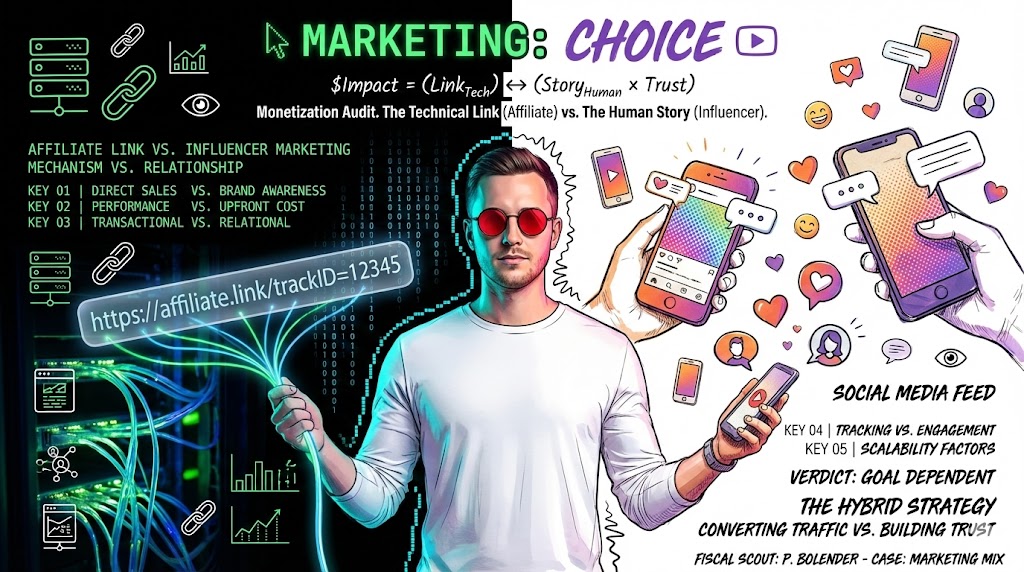
Affiliate Link vs Influencer Marketing: Key Differences + Best Choice
It depends. The best choice hinges on your specific marketing goals, budget, and target audience, as each strategy offers distinct advantages and caters to different stages of the customer journey.
- ✅ Affiliate marketing offers a performance-based, lower-risk model focused on direct conversions.
- ⚠️ Influencer marketing requires upfront investment and focuses on brand awareness and trust-building.
- 💡 Use Case: Affiliate for direct sales, Influencer for brand building and audience engagement.
Affiliate Marketing vs. Influencer Marketing
| Criterion | Affiliate Marketing | Influencer Marketing |
|---|---|---|
| Primary Use Case | Driving direct sales and conversions. | Building brand awareness, trust, and engagement. |
| Strengths | ✅ Performance-based, scalable, measurable ROI. | ✅ Authentic reach, strong audience connection, content creation. |
| Limitations | ⚠️ Less brand control, potential for low-quality traffic. | ⚠️ Higher upfront cost, harder to measure direct ROI, authenticity risks. |
| Pricing | 💰 Commission-based (CPA, CPS, CPL). | 💰 Flat fee, product, or hybrid models. |
| Best for | E-commerce, SaaS, lead generation, direct response. | New product launches, brand storytelling, community building. |
Understanding Affiliate Marketing: The Performance-Based Partnership
Affiliate marketing is a performance-based marketing strategy where a business rewards one or more affiliates for each visitor or customer brought by the affiliate’s own marketing efforts. Essentially, it’s a way for companies to outsource their sales and marketing to a network of partners, paying only when a desired action, such as a sale or lead, occurs. This model has gained immense popularity due to its cost-effectiveness and measurable results, making it a cornerstone for many e-commerce and SaaS businesses.
The core principle revolves around tracking. Affiliates are provided with unique tracking links or codes that attribute sales or leads back to their specific efforts. This allows businesses to accurately compensate affiliates and analyze the effectiveness of different partnerships. From a business perspective, it’s an attractive model because it shifts the risk from upfront advertising costs to a commission structure based on actual performance.
What is Affiliate Marketing?
At its heart, affiliate marketing is a system where a merchant (the business selling a product or service) partners with an affiliate (an individual or company) to promote their offerings. The affiliate earns a commission for every sale, lead, or click generated through their unique referral link. This creates a win-win scenario: merchants expand their reach without significant upfront marketing spend, and affiliates earn income by leveraging their audience or traffic sources.
The beauty of affiliate marketing lies in its diversity. Affiliates can range from large content websites and coupon sites to individual bloggers, YouTubers, and even email marketers. Each affiliate brings their own unique audience and promotional methods, creating a broad ecosystem for product promotion. The focus is almost exclusively on driving a specific, measurable action.
How Affiliate Marketing Works (Mechanics)
The mechanics of affiliate marketing are relatively straightforward but rely heavily on robust tracking technology. It typically involves four key players: the merchant, the affiliate, the consumer, and the affiliate network (optional but common). When a consumer clicks an affiliate’s unique link, a cookie is placed on their browser. This cookie tracks the consumer’s activity and, if they complete a purchase or desired action within a specified timeframe, the sale is attributed to the affiliate.
This tracking mechanism is crucial for ensuring fair compensation and accurate performance analysis. Affiliate networks often facilitate this process, providing the technological infrastructure for tracking, reporting, and payment processing. Without precise attribution, the performance-based nature of affiliate marketing would be impossible to maintain, leading to disputes and inefficiencies.
Key Players in Affiliate Marketing
Understanding the ecosystem requires identifying its main components:
- The Merchant (Advertiser): The company that creates the product or service. They set the commission rates and terms.
- The Affiliate (Publisher): The individual or company that promotes the merchant’s products. They leverage their platforms (blogs, social media, email lists) to drive traffic and conversions.
- The Consumer: The end-user who makes the purchase or completes the desired action. Their interaction with the affiliate’s link is what triggers the commission.
- The Affiliate Network: A platform that acts as an intermediary between merchants and affiliates. They provide tracking software, payment processing, and a marketplace for finding partners. Examples include ShareASale, CJ Affiliate, and Rakuten Marketing.
Payment Models (CPA, CPL, CPS)
Affiliate marketing offers several payment models, each suited to different business objectives:
- Cost Per Sale (CPS): The most common model, where affiliates earn a percentage of the sale price when a customer makes a purchase. This is ideal for e-commerce businesses.
- Cost Per Lead (CPL): Affiliates are paid for each qualified lead generated, such as a form submission, newsletter signup, or software download. This is popular for SaaS and service-based businesses.
- Cost Per Action (CPA): A broader term encompassing any specific action, including sales, leads, clicks, or app installs. It emphasizes a defined outcome.
- Cost Per Click (CPC): Less common in pure affiliate marketing, but sometimes used for brand awareness campaigns where affiliates are paid for each click on their link, regardless of conversion.
Affiliate Marketing’s Enduring Growth
Industry reports typically indicate that affiliate marketing spend continues to rise, with projections suggesting it could reach over $8 billion in the U.S. alone by 2022, demonstrating its sustained effectiveness and adoption across various sectors.
Insider Tip: Choosing the Right Affiliate Network
When starting with affiliate marketing, don’t just pick the biggest network. Research networks that specialize in your niche. Smaller, niche-specific networks often have higher-quality affiliates and better support for your product category, leading to more relevant traffic and conversions.
Understanding Influencer Marketing: The Trust and Reach Strategy
Influencer marketing is a strategy that leverages individuals with a dedicated social following and perceived authority in a specific niche to promote products or services. Unlike traditional advertising, which often feels intrusive, influencer marketing aims to integrate brand messages into authentic content created by trusted voices. This approach taps into the existing relationship between influencers and their audience, fostering a more genuine connection and driving engagement.
The power of influencer marketing stems from social proof and authenticity. Consumers are increasingly skeptical of direct advertising and tend to trust recommendations from people they admire or relate to. Influencers, by sharing their experiences and opinions, can bridge the gap between brands and consumers, making product discovery feel more organic and less like a sales pitch. This makes it particularly effective for brand building, awareness, and driving consideration.
What is Influencer Marketing?
Influencer marketing involves collaborating with individuals who have the power to affect the purchasing decisions of others because of their authority, knowledge, position, or relationship with their audience. These individuals, known as influencers, typically have a significant following on social media platforms (Instagram, TikTok, YouTube, blogs, etc.) and are seen as experts or trusted figures within their community.
The goal is to have the influencer organically integrate a brand’s message or product into their content, thereby exposing it to their engaged audience. This can range from sponsored posts and product reviews to brand ambassadorships and co-created content. The key is the influencer’s ability to sway opinions and drive action through their credibility and connection.
How Influencer Marketing Works (Mechanics)
The process of influencer marketing typically begins with identifying relevant influencers whose audience aligns with the brand’s target demographic. Once identified, brands negotiate terms, which can include compensation, deliverables (e.g., number of posts, stories, videos), and content guidelines. The influencer then creates content featuring the product or service, often incorporating a call to action or a unique discount code.
Unlike affiliate marketing’s direct tracking, measuring the impact of influencer marketing often involves a blend of direct and indirect metrics. Direct metrics include link clicks and discount code redemptions, while indirect metrics focus on brand mentions, sentiment analysis, website traffic spikes, and follower growth. Building a successful influencer campaign requires clear communication, creative freedom for the influencer, and a focus on long-term relationships.
Types of Influencers (Nano, Micro, Macro, Celebrity)
Influencers are often categorized by the size of their following, which impacts their reach, engagement, and cost:
- Nano-influencers (1,000-10,000 followers): Highly engaged, niche audiences. Often seen as more authentic and accessible. Lower cost.
- Micro-influencers (10,000-100,000 followers): Strong niche authority and good engagement rates. A sweet spot for many brands seeking a balance of reach and authenticity. Moderate cost.
- Macro-influencers (100,000-1,000,000 followers): Wider reach, often professional content creators. Can drive significant awareness. Higher cost.
- Celebrity influencers (1,000,000+ followers): Massive reach, high visibility. Best for broad brand awareness campaigns. Very high cost.
Compensation Models (Flat Fee, Product, Hybrid)
Influencer compensation varies widely based on the influencer’s reach, engagement, content type, and industry:
- Flat Fee: The most common model, where influencers are paid a set amount for a specific piece of content or campaign.
- Product Gifting: Influencers receive free products in exchange for content, often used with nano and micro-influencers.
- Performance-Based/Hybrid: A combination of a flat fee and a commission on sales or leads generated (similar to affiliate marketing, but with an upfront payment).
- Long-Term Retainer: For ongoing partnerships or brand ambassadorships, influencers are paid a recurring fee.
Myth
Influencer Marketing is Only for B2C Brands.
Reality
While often associated with B2C, influencer marketing is increasingly effective in B2B. Thought leaders, industry experts, and niche consultants on platforms like LinkedIn can influence purchasing decisions for business solutions, software, and services by sharing their expertise and endorsing products to their professional networks.
Insider Tip: Vetting Influencers for Authenticity
Beyond follower count, scrutinize engagement rates, comment quality, and audience demographics. Look for consistent engagement, genuine conversations, and comments that aren’t generic. Tools can help detect fake followers, but manual review of recent posts is crucial for assessing true authenticity.
Core Differences in Audience Engagement and Trust
The fundamental distinction between affiliate and influencer marketing lies in their approach to audience engagement and the type of trust they leverage. Affiliate marketing primarily relies on transactional trust – the trust that a link will lead to a valid offer and that a commission will be paid upon conversion. Influencer marketing, conversely, builds on relational trust – the deep, often emotional, connection an audience has with the influencer.
This difference dictates how each strategy interacts with the consumer and what stage of the buying journey they are most effective at influencing. Understanding this distinction is crucial for aligning your marketing efforts with your overarching business objectives.
Affiliate’s Transactional Focus
Affiliate marketing is inherently transactional. Affiliates often use direct calls to action, promotional codes, and clear incentives to drive immediate conversions. Their content might be comparison reviews, deal aggregators, or product roundups, all designed to push the consumer towards a purchase decision. The relationship between the affiliate and the consumer is often one of utility – the consumer trusts the affiliate to provide a good deal or a relevant product link.
The trust here is less about personal endorsement and more about the efficiency of the referral. Consumers trust that the affiliate link will work, that the product is available as advertised, and that any promised discounts will be applied. This makes affiliate marketing highly effective for audiences already in the consideration or decision phase of their buying journey.
Influencer’s Relational Focus
Influencer marketing thrives on relational trust. Influencers cultivate a personal connection with their audience over time, sharing aspects of their lives, opinions, and expertise. When they recommend a product, it’s perceived as a genuine endorsement from a trusted friend or expert, rather than a direct advertisement. This personal touch fosters a sense of authenticity and credibility that can be incredibly powerful for brand building.
The content created by influencers is often narrative-driven, showcasing how a product fits into their lifestyle or solves a problem they genuinely face. This approach resonates deeply with audiences, influencing them at earlier stages of the buying journey, such as awareness and interest, by shaping perceptions and building desire.
Impact on Purchase Journey
These differing focuses mean affiliate and influencer marketing impact different stages of the customer purchase journey. Influencer marketing is excellent for the awareness and interest stages, introducing products to new audiences, building brand recognition, and generating initial excitement. It helps potential customers discover a brand and develop a positive sentiment towards it.
Affiliate marketing, on the other hand, excels in the consideration and decision stages. Once a customer is aware of a product and considering a purchase, an affiliate’s compelling offer, detailed review, or comparison can be the final push needed to convert. It capitalizes on existing intent rather than creating it from scratch.
Cost Structures and ROI Measurement: A Financial Deep Dive
The financial implications and methods for measuring return on investment (ROI) differ significantly between affiliate and influencer marketing. Affiliate marketing is often lauded for its performance-based, lower-risk cost structure, while influencer marketing typically requires a more substantial upfront investment with ROI that can be harder to quantify directly.
Understanding these financial models is paramount for businesses to allocate budgets effectively and set realistic expectations for campaign outcomes. The choice between the two often comes down to a business’s risk tolerance and its primary marketing objectives.
Affiliate Marketing Cost Efficiency
Affiliate marketing is inherently cost-efficient because it operates on a pay-for-performance model. Businesses only incur costs when a desired action (sale, lead, click) occurs. This means there’s minimal upfront financial risk. Commission rates are typically a percentage of the sale or a fixed amount per lead, allowing businesses to control their customer acquisition cost (CAC) very precisely.
The scalability of affiliate marketing is also a major advantage. As an affiliate program grows, the associated costs grow proportionally with successful conversions, not with speculative ad spend. This makes it an attractive option for businesses with limited marketing budgets or those seeking predictable ROI.
Influencer Marketing Investment
Influencer marketing generally requires an upfront investment. Influencers are typically paid a flat fee for their content and reach, regardless of the immediate sales generated. This fee can vary significantly based on the influencer’s following, engagement, niche, and the complexity of the content required. While some micro-influencers might accept free products, larger influencers command substantial fees.
Beyond the direct payment to influencers, brands may also incur costs for product samples, agency fees for influencer discovery and management, and internal resources for content review and coordination. This upfront investment means businesses must have a clear budget and be prepared for a potentially longer sales cycle before seeing a direct financial return.
Tracking and Attribution Challenges
Measuring ROI is more straightforward in affiliate marketing due to its direct tracking mechanisms. Unique links and cookies provide clear attribution for sales and leads, allowing businesses to calculate the exact cost per acquisition and the revenue generated by each affiliate. This data-driven approach makes it easy to optimize campaigns and identify top-performing partners.
Influencer marketing, while offering some direct tracking through unique discount codes or UTM links, often presents greater attribution challenges. The impact on brand awareness, sentiment, and long-term loyalty is harder to quantify with immediate sales figures. Brands often rely on a combination of metrics like engagement rates, reach, impressions, website traffic spikes, brand mentions, and sentiment analysis to gauge success, making ROI calculation more complex and holistic.
Case Study: Measuring ROI in a Hybrid Campaign
The Trap: A new fashion brand launched a product line using both influencer endorsements and affiliate links, but struggled to differentiate the ROI. Influencers drove significant engagement, but direct sales via their affiliate codes were low, leading to confusion about which strategy was more effective.
The Win: The brand implemented a multi-touch attribution model. They realized influencers were driving initial awareness and interest (top-of-funnel), leading customers to search for the brand later. Affiliate links then captured these customers at the decision stage. By attributing a portion of the final sale to the initial influencer touchpoint, they saw a much clearer picture: influencers boosted brand search volume by 30%, and affiliate conversions for those who had seen influencer content were 2x higher. This demonstrated the synergistic ROI of both strategies working in tandem.
Control and Brand Messaging: Who Holds the Reins?
The degree of control a brand maintains over its messaging and creative output is another significant differentiator between affiliate and influencer marketing. This aspect can have profound implications for brand consistency, reputation management, and the overall effectiveness of a campaign. Brands must weigh their desire for creative freedom against the need for strict brand adherence when choosing a strategy.
While both strategies involve external partners promoting your brand, the nature of that partnership dictates how much input and oversight you can realistically expect to have over the content being produced.
Affiliate’s Limited Creative Control
In affiliate marketing, brands typically have limited direct creative control over how affiliates promote their products. While merchants provide brand guidelines, product descriptions, and approved creatives (banners, text links), affiliates largely determine their own promotional methods. They might write reviews, create comparison tables, or integrate links into existing content in ways that are unique to their platform.
This lack of direct control can be a double-edged sword. On one hand, it allows for diverse and innovative promotional approaches that a brand might not have considered. On the other hand, it carries the risk of off-brand messaging, misleading claims, or even association with low-quality content if affiliates are not properly vetted and monitored. Brands often rely on affiliate network policies and their own terms of service to enforce standards.
Influencer’s Creative Freedom
Influencer marketing, by its very nature, thrives on the influencer’s creative freedom and authentic voice. Brands partner with influencers precisely because of their unique style and ability to connect with an audience in a genuine way. While brands provide a brief outlining key messages, product features, and campaign goals, the influencer is typically given significant creative license to produce content that resonates with their followers.
This approach fosters authenticity and can lead to highly engaging content that feels organic rather than overtly promotional. However, it also means brands must trust the influencer to represent them appropriately. While content approval processes are common, over-editing or micromanaging can stifle creativity and undermine the influencer’s authenticity, potentially alienating their audience.
Brand Consistency Implications
The differing levels of control have direct implications for brand consistency. With affiliate marketing, maintaining a consistent brand voice across hundreds or thousands of affiliates can be challenging. Brands must rely on clear guidelines and diligent monitoring to ensure affiliates adhere to messaging standards and legal disclosures.
In influencer marketing, while there’s more creative freedom, the smaller number of partners often allows for more direct communication and collaboration. This can lead to more nuanced and consistent brand storytelling, provided the brand and influencer are aligned on core values and messaging. The challenge lies in ensuring the influencer’s personal brand aligns with the company’s brand identity to avoid dissonance.
Scalability and Long-Term Strategy
Scalability and long-term strategic planning are crucial considerations when deciding between affiliate and influencer marketing. Each strategy offers different pathways for growth and requires distinct approaches to sustain momentum and build lasting value for a business.
Understanding how each model scales and what it contributes to a long-term marketing vision will help businesses make informed decisions that support their growth trajectories and brand objectives.
Scaling Affiliate Programs
Affiliate marketing is highly scalable. Once an affiliate program is established, it can theoretically grow indefinitely by recruiting more affiliates. The infrastructure of affiliate networks allows for easy onboarding, tracking, and payment processing for a large number of partners. As more affiliates join and promote products, the potential for increased sales and leads grows proportionally.
Scaling an affiliate program involves continuously recruiting new, high-quality affiliates, optimizing commission structures, providing fresh creative assets, and fostering relationships with top performers. The performance-based nature means that scaling up doesn’t necessarily mean a proportional increase in risk, as costs are tied to successful outcomes. This makes it an attractive option for businesses looking for exponential growth without a linear increase in fixed marketing overhead.
Scaling Influencer Campaigns
Scaling influencer campaigns presents a different set of challenges. While it’s possible to work with more influencers, each partnership often requires individual negotiation, content briefing, and review. This can become resource-intensive as the number of influencers grows. The personal nature of influencer relationships means that automating the process entirely is difficult without sacrificing authenticity.
Scaling influencer marketing often involves moving from individual collaborations to broader campaigns with multiple influencers, or establishing long-term brand ambassadorships. It might also mean expanding to different platforms or targeting new demographics with specific influencer types. While it can scale, it typically requires more hands-on management and strategic planning than simply adding more affiliates to a network.
Building Long-Term Relationships
Both strategies benefit from long-term relationships, but the nature of these relationships differs. In affiliate marketing, long-term relationships with top-performing affiliates can lead to consistent sales and deeper integration of your products into their content. These affiliates become reliable sources of traffic and conversions, and nurturing these partnerships through higher commissions or exclusive offers can be highly beneficial.
For influencer marketing, long-term relationships are often foundational. Brand ambassadorships, where an influencer consistently promotes a brand over an extended period, build deeper trust and credibility with their audience. This sustained exposure reinforces brand messaging and can lead to more significant, lasting impact on brand perception and loyalty than one-off campaigns. These relationships are often more personal and collaborative, evolving over time.
Legal and Ethical Considerations
Navigating the legal and ethical landscape is crucial for both affiliate and influencer marketing. Regulatory bodies worldwide have established guidelines to ensure transparency and protect consumers from deceptive advertising. Non-compliance can lead to significant fines, reputational damage, and loss of consumer trust.
Brands must be proactive in educating their partners and implementing robust monitoring systems to ensure all promotional activities adhere to legal requirements and ethical standards. This is not just about avoiding penalties, but about building a sustainable and trustworthy brand image.
Disclosure Requirements (FTC, ASA)
A primary legal consideration for both affiliate and influencer marketing is disclosure. Regulatory bodies like the Federal Trade Commission (FTC) in the U.S. and the Advertising Standards Authority (ASA) in the UK mandate that consumers must be aware when content is sponsored or when a financial relationship exists between the promoter and the brand.
- Affiliate Marketing: Affiliates must clearly disclose that they may earn a commission from purchases made through their links. This is typically done with a disclaimer near the link or at the top of a review.
- Influencer Marketing: Influencers must prominently disclose their partnership with a brand using clear hashtags like #ad, #sponsored, or #partner, or by using platform-specific disclosure tools. The disclosure must be easy to see and understand, not buried in a caption or comments.
Failure to disclose can result in severe penalties for both the affiliate/influencer and the brand. It also erodes consumer trust, which is detrimental to long-term marketing success.
Brand Safety and Reputation Management
Brand safety is a significant concern in both strategies, though the risks manifest differently. In affiliate marketing, the risk often comes from affiliates using questionable tactics (e.g., spamming, misleading claims, trademark bidding) or associating your brand with low-quality or inappropriate content. Brands must have clear terms of service and actively monitor affiliate activities to prevent such issues.
In influencer marketing, brand safety revolves around the influencer’s personal conduct and the content they create. An influencer’s controversial statements, past actions, or association with inappropriate content can quickly reflect negatively on the brands they endorse. Brands must thoroughly vet influencers, establish clear content guidelines, and have contingency plans in place for potential crises. The personal nature of influencer content means that the brand’s reputation is directly tied to the influencer’s public image.
When to Choose Affiliate Marketing
Deciding when to lean into affiliate marketing depends heavily on your business model, marketing objectives, and the stage of your customer’s journey you aim to influence. Affiliate marketing is not a one-size-fits-all solution, but it excels in specific scenarios where its performance-based nature and direct conversion focus are most beneficial.
If your primary goal is to drive measurable sales with a controlled cost per acquisition, affiliate marketing often presents a compelling case.
Ideal Business Models
Affiliate marketing is particularly well-suited for:
- E-commerce Businesses: Brands selling physical products online can leverage affiliates to drive direct sales, often through product reviews, comparison sites, or coupon sites.
- SaaS Companies: Software-as-a-Service businesses can use affiliates to generate leads, free trial sign-ups, or direct subscriptions, paying commissions for each successful conversion.
- Lead Generation Businesses: Companies that rely on collecting qualified leads (e.g., insurance, financial services, education) can pay affiliates for each form submission or inquiry.
- Digital Product Creators: E-books, online courses, and other digital products can be effectively promoted by affiliates who share a relevant audience.
Businesses with clear conversion funnels and products that can be easily tracked and attributed to a specific referral will find affiliate marketing highly effective.
Specific Campaign Goals
Choose affiliate marketing when your campaign goals are:
- Direct Sales & Conversions: Your primary objective is to increase immediate revenue or acquire new customers.
- Cost-Per-Acquisition (CPA) Control: You need to maintain a predictable and scalable cost for acquiring each customer.
- Market Penetration: You want to quickly expand your reach into new markets or demographics without significant upfront investment.
- Performance-Based Growth: You prefer to pay only for results, minimizing risk and maximizing efficiency.
- Leveraging Existing Purchase Intent: You aim to capture customers who are already actively searching for products or solutions and are close to making a buying decision.
When to Choose Influencer Marketing
Influencer marketing shines in different contexts, focusing more on brand building, audience engagement, and fostering a deeper connection with potential customers. It’s a strategic choice when your objectives extend beyond immediate sales to encompass long-term brand equity and community development.
If your goal is to cultivate trust, generate authentic content, and create buzz around your brand, influencer marketing is likely the more appropriate path.
Ideal Business Models
Influencer marketing is particularly effective for:
- Fashion, Beauty & Lifestyle Brands: Products that benefit from visual storytelling and personal endorsement thrive with influencers who can showcase them in real-life contexts.
- Food & Beverage Companies: Influencers can create engaging recipe content, taste tests, and lifestyle integrations that drive desire.
- Travel & Hospitality: Destinations, hotels, and travel experiences are perfectly suited for visual content and authentic reviews from travel influencers.
- New Product Launches: Generating excitement and awareness for novel products or services benefits greatly from influencer buzz.
- Brands Targeting Niche Communities: Micro and nano-influencers can provide highly targeted reach within specific, passionate communities.
Specific Campaign Goals
Opt for influencer marketing when your campaign goals are:
- Brand Awareness & Visibility: You want to introduce your brand to new audiences and increase recognition.
- Trust & Credibility Building: You aim to leverage authentic endorsements to enhance your brand’s reputation and trustworthiness.
- Audience Engagement & Community Building: You seek to foster interaction, generate user-generated content, and build a loyal community around your brand.
- Content Creation: You need high-quality, authentic content that showcases your product in a lifestyle context.
- Shaping Brand Perception: You want to influence how your target audience perceives your brand, its values, and its unique selling propositions.
Hybrid Approaches: Combining the Best of Both Worlds
While affiliate and influencer marketing have distinct strengths, the most powerful strategies often involve a hybrid approach, integrating elements of both. By combining the trust-building power of influencers with the performance-driven nature of affiliates, businesses can create a comprehensive marketing ecosystem that addresses various stages of the customer journey and maximizes overall ROI.
A well-executed hybrid strategy can amplify reach, deepen engagement, and ultimately drive more conversions than either strategy could achieve in isolation. It’s about creating synergy between awareness and action.
Strategies for Integration
Integrating affiliate and influencer marketing can take several forms:
- Influencers as Affiliates: Many influencers are open to performance-based compensation in addition to their flat fees. Provide influencers with unique affiliate links or discount codes to track direct sales generated from their content. This allows brands to leverage their reach for awareness while also measuring direct conversion impact.
- Affiliate-Driven Influencer Discovery: Use data from top-performing affiliates to identify potential influencers. If a particular blog or content creator consistently drives sales, they might also be a good candidate for a deeper influencer partnership.
- Tiered Campaigns: Use macro-influencers for broad awareness at the top of the funnel, then micro-influencers and affiliate partners for more targeted engagement and conversion at the middle and bottom of the funnel.
- Content Amplification: Have affiliates promote influencer-generated content. For example, an affiliate blog could feature a review that includes an influencer’s video endorsement, linking back to both the influencer’s channel and the product page.
Benefits of a Combined Approach
The synergy created by a hybrid strategy offers several compelling benefits:
- Holistic Customer Journey: Influencers build awareness and trust, while affiliates capture purchase intent, covering the entire customer journey from discovery to conversion.
- Enhanced Credibility: When an influencer promotes a product and also offers a trackable discount code, it adds an extra layer of authenticity and incentive for the consumer.
- Improved ROI Tracking: By giving influencers affiliate links, brands can gain more direct insights into the sales impact of influencer campaigns, making ROI measurement more robust.
- Diversified Traffic Sources: A hybrid approach diversifies your traffic and conversion sources, reducing reliance on a single channel and making your marketing efforts more resilient.
- Content Repurposing: Influencer-generated content can be repurposed by affiliates, providing them with high-quality, authentic assets to use in their promotions.
Insider Tip: Crafting a Hybrid Campaign Brief
When briefing influencers for a hybrid campaign, clearly communicate both the brand awareness goals and the conversion goals. Provide them with their unique affiliate link or discount code upfront, and explain how their performance will be tracked. Emphasize that while their creative freedom is valued, the campaign also has a performance component, encouraging them to integrate the call to action naturally.
Pros and Cons of Affiliate Marketing
Advantages of Affiliate Marketing
- Low Risk, Performance-Based: You only pay when a sale or lead is generated, significantly reducing upfront marketing expenditure and risk.
- Highly Scalable Reach: Easily expand your market presence by partnering with numerous affiliates without a linear increase in management overhead.
- Measurable ROI: Direct tracking links and cookies provide clear data on conversions, allowing for precise ROI calculation and campaign optimization.
- Diverse Traffic Sources: Affiliates bring traffic from various channels (blogs, social, email, coupon sites), diversifying your customer acquisition efforts.
- Cost-Effective Customer Acquisition: Often results in a lower customer acquisition cost compared to traditional advertising, as you’re paying for actual results.
Disadvantages of Affiliate Marketing
- Less Brand Control: Limited influence over how affiliates promote your products can lead to off-brand messaging or quality concerns.
- Potential for Fraud: Risk of affiliates using unethical tactics or generating fake leads/sales, requiring vigilant monitoring and robust fraud detection.
- Competition Among Affiliates: High competition can drive down commission rates or lead to affiliates bidding on your brand keywords, impacting your own PPC efforts.
- Dependency on Affiliate Quality: Success heavily relies on the quality and relevance of your affiliate partners; poor affiliates can damage brand reputation.
- Initial Setup & Management: Setting up an effective program, finding quality affiliates, and ongoing management can be time-consuming, especially without a network.
Pros and Cons of Influencer Marketing
Advantages of Influencer Marketing
- Builds Trust & Credibility: Leverages the influencer’s existing relationship with their audience, leading to more authentic and trusted recommendations.
- Authentic Content Creation: Influencers generate high-quality, engaging content that resonates with their audience and can be repurposed by the brand.
- Targeted Audience Reach: Connects your brand with highly specific, engaged niche communities that align with your target demographic.
- Drives Brand Awareness & Engagement: Excellent for increasing visibility, generating buzz, and fostering meaningful interactions around your brand.
- Humanizes Your Brand: Showcases your products in real-life contexts, making your brand more relatable and approachable to consumers.
Disadvantages of Influencer Marketing
- Higher Upfront Investment: Often requires significant upfront payments to influencers, regardless of direct sales generated.
- Harder to Measure Direct ROI: While engagement is high, directly attributing sales to influencer campaigns can be challenging without specific tracking.
- Authenticity Risks: If an influencer is perceived as inauthentic or promotes too many products, it can erode trust and negatively impact your brand.
- Brand Safety Concerns: An influencer’s controversial behavior or past content can reflect poorly on your brand, requiring careful vetting.
- Time-Consuming Management: Identifying, vetting, negotiating with, and managing influencers can be a labor-intensive process.
Choosing Your Path: A Strategic Decision Framework
The choice between affiliate and influencer marketing, or a hybrid approach, is not arbitrary. It should be a strategic decision rooted in a clear understanding of your business goals, target audience, and available resources. By systematically evaluating these factors, you can determine which strategy will yield the most impactful results for your specific situation.
This framework helps to cut through the noise and focus on what truly matters for your marketing success, ensuring that your investment aligns with your desired outcomes.
Assessing Your Business Goals
Start by defining your primary marketing objectives:
- Are you focused on immediate sales and conversions? If so, affiliate marketing’s performance-based model is highly efficient.
- Is your priority brand awareness, trust, and engagement? Influencer marketing excels at building brand equity and fostering community.
- Do you need high-quality content for your marketing channels? Influencers are natural content creators.
- Are you launching a new product and need to generate buzz? Influencers can create significant initial excitement.
- Do you have a mature product and need to scale sales efficiently? Affiliate marketing can provide scalable, performance-driven growth.
Clearly articulating these goals will provide a foundation for your decision-making process.
Understanding Your Target Audience
Who are you trying to reach, and how do they make purchasing decisions?
- Where does your audience spend their time online? If they follow specific content creators on social media, influencer marketing is a strong fit. If they search for deals, reviews, or product comparisons, affiliates might be more effective.
- What influences their buying decisions? Do they trust personal recommendations from figures they admire, or are they driven by direct offers and detailed product information?
- What stage of the buying journey are they typically in when they encounter your brand? If it’s early discovery, influencers are key. If it’s late-stage consideration, affiliates can close the deal.
A deep understanding of your audience’s behavior and preferences is critical for selecting the most impactful strategy.
Evaluating Your Budget and Resources
Your financial and operational capacity will also play a significant role:
- What is your budget for marketing? If you have limited upfront capital and prefer to pay for results, affiliate marketing is less risky. If you have a budget for upfront investment in content and relationships, influencer marketing is viable.
- Do you have internal resources for management? Influencer marketing often requires more hands-on relationship management. Affiliate marketing can be more automated through networks, but still requires oversight.
- What is your risk tolerance? Affiliate marketing carries lower financial risk per conversion, while influencer marketing has higher upfront risk but potentially greater long-term brand impact.
Aligning your strategy with your available resources ensures that your chosen path is sustainable and achievable.
Key Metrics for Success in Each Strategy
Measuring the effectiveness of your marketing efforts is crucial for optimization and demonstrating ROI. While some metrics overlap, each strategy has specific key performance indicators (KPIs) that best reflect its success. Focusing on the right metrics ensures you’re evaluating performance accurately and making data-driven decisions.
Understanding these distinct KPIs allows you to set appropriate goals and track progress effectively for both affiliate and influencer campaigns.
Affiliate Marketing KPIs (Conversion Rate, EPC, AOV)
For affiliate marketing, the focus is heavily on performance and direct financial outcomes:
- Conversion Rate: The percentage of clicks that result in a desired action (e.g., sale, lead). This is a direct measure of an affiliate’s effectiveness in driving conversions.
- Earnings Per Click (EPC): The average amount of money earned for each click an affiliate sends to your site. This helps evaluate the profitability of different affiliates and campaigns.
- Average Order Value (AOV): The average amount spent each time a customer completes an order. While not directly an affiliate metric, it’s important for calculating total revenue generated by affiliates.
- Return on Ad Spend (ROAS): The revenue generated for every dollar spent on affiliate commissions. This is a critical measure of profitability.
- Customer Lifetime Value (CLTV): The total revenue a business can expect from a single customer account. While harder to attribute directly to affiliates, understanding the long-term value of customers acquired through affiliates is vital.
Influencer Marketing KPIs (Engagement Rate, Reach, Mentions)
Influencer marketing KPIs often lean towards brand awareness, engagement, and sentiment:
- Engagement Rate: The percentage of an influencer’s audience that interacts with their content (likes, comments, shares, saves). This indicates the quality of their audience and content.
- Reach & Impressions: The number of unique users who saw the content (reach) and the total number of times the content was displayed (impressions). These measure visibility.
- Brand Mentions & Sentiment: Tracking how often your brand is mentioned and the overall tone (positive, negative, neutral) of those mentions. This indicates brand perception.
- Website Traffic & Referrals: Spikes in direct or referral traffic to your website during a campaign, often tracked via UTM links or specific landing pages.
- Follower Growth: An increase in your brand’s social media followers during or after an influencer campaign, indicating expanded audience interest.
- Earned Media Value (EMV): An estimate of what it would cost to achieve the same reach and engagement through paid advertising. This helps quantify the value of influencer content.
Common Pitfalls and How to Avoid Them
Both affiliate and influencer marketing, while powerful, come with their own set of challenges and potential pitfalls. Being aware of these common issues and implementing preventative measures can save your brand from financial losses, reputational damage, and wasted effort. Proactive risk management is key to long-term success in either strategy.
Ignoring these potential problems can undermine even the most well-planned campaigns, making it essential to address them head-on.
Affiliate Fraud Prevention
Affiliate fraud is a significant concern in performance marketing, where unscrupulous affiliates might attempt to generate fake conversions or manipulate tracking systems:
- Click Fraud: Generating fake clicks to earn CPC commissions (less common in CPS/CPL).
- Lead Fraud: Submitting fake or unqualified leads to earn CPL commissions.
- Cookie Stuffing: Illegally dropping affiliate cookies on users’ browsers without their knowledge or a click.
- Trademark Bidding: Affiliates bidding on your brand’s keywords in paid search, driving up your own ad costs.
Prevention: Use reputable affiliate networks with robust fraud detection tools. Implement strict terms and conditions, regularly audit affiliate activity, monitor traffic sources, and use CAPTCHAs or other verification methods for lead generation. Clearly define acceptable promotional methods and enforce them rigorously.
Influencer Authenticity and Fake Followers
The rise of influencer marketing has unfortunately led to issues with authenticity, including fake followers and inflated engagement metrics:
- Fake Followers: Influencers purchasing followers to appear more popular, leading to low engagement rates and wasted ad spend.
- Engagement Pods: Groups of influencers artificially boosting each other’s engagement through likes and comments.
- Inauthentic Content: Influencers promoting products they don’t genuinely use or believe in, eroding trust with their audience and your brand.
Prevention: Thoroughly vet influencers beyond follower count. Analyze engagement rates (comments, likes, shares relative to followers), check comment quality for genuine interactions, and use third-party tools to detect bot activity. Request audience demographics to ensure alignment with your target market. Prioritize long-term relationships with influencers who genuinely love your product.
Case Study: Overcoming Low Engagement in Influencer Campaigns
The Trap: A beauty brand partnered with several macro-influencers, expecting massive reach and engagement. While follower counts were high, the actual engagement rate on sponsored posts was surprisingly low, and comments were generic, indicating a disconnect with the audience.
The Win: The brand pivoted its strategy. Instead of focusing solely on macro-influencers, they shifted resources to a larger number of micro and nano-influencers within highly specific beauty niches. They also gave these smaller influencers more creative freedom and encouraged authentic storytelling rather than scripted endorsements. The result was significantly higher engagement rates (up to 5x), more genuine comments, and a noticeable increase in brand mentions and user-generated content, proving that authentic connection often trumps sheer follower count.
Future Trends in Performance and Relationship Marketing
The digital marketing landscape is constantly evolving, and both affiliate and influencer marketing are adapting to new technologies, consumer behaviors, and regulatory changes. Staying abreast of these emerging trends is essential for brands to maintain a competitive edge and ensure their strategies remain effective and relevant.
From the integration of artificial intelligence to the growing emphasis on authenticity and niche communities, the future of performance and relationship marketing promises exciting developments.
AI in Affiliate Marketing
Artificial intelligence is set to revolutionize affiliate marketing in several ways:
- Enhanced Personalization: AI can analyze consumer data to deliver highly personalized product recommendations through affiliate channels, increasing conversion rates.
- Fraud Detection: Advanced AI algorithms can more effectively detect and prevent affiliate fraud by identifying suspicious patterns and anomalies in traffic and conversion data.
- Affiliate Matching: AI-powered platforms can more accurately match merchants with the most relevant and high-performing affiliates based on audience demographics, content niche, and historical performance.
- Content Optimization: AI tools can help affiliates optimize their content for SEO and conversion by suggesting keywords, improving readability, and identifying high-performing content formats.
Rise of Micro-Influencers and UGC
The trend towards authenticity and niche communities continues to drive the importance of smaller-scale influencers:
- Micro and Nano-Influencers: These influencers, with their highly engaged and specific audiences, will become even more critical. Their perceived authenticity and direct connection often lead to higher conversion rates and more genuine brand advocacy.
- User-Generated Content (UGC): Brands will increasingly leverage UGC, often spurred by influencer campaigns, as a powerful form of social proof. Consumers trust content created by their peers more than traditional advertising.
- Community-Led Marketing: The focus will shift from one-to-many broadcasting to fostering active brand communities where influencers act as facilitators and advocates, driving organic conversations and recommendations.
Live Shopping and Short-Form Video
The growth of platforms like TikTok and the increasing popularity of live shopping events are shaping how both affiliates and influencers engage audiences:
- Short-Form Video: Influencers will continue to dominate short-form video platforms, creating highly engaging and digestible content that drives quick awareness and interest.
- Live Shopping: Both influencers and affiliates will increasingly participate in live shopping events, offering real-time product demonstrations, Q&As, and exclusive deals to drive immediate sales. This blends the authenticity of influencers with the direct conversion focus of affiliates.
Myth
Traditional Affiliate Marketing is Dead.
Reality
While the landscape has evolved, traditional affiliate marketing is far from dead. It has adapted, becoming more sophisticated with advanced tracking, AI-driven optimization, and a greater emphasis on compliance and quality. It remains a highly effective, performance-based channel for driving measurable sales, especially for e-commerce and SaaS, and continues to grow year over year.
Checklist: Launching Your Marketing Strategy
Your 7-Step Marketing Strategy Launch Checklist
- Define Clear Goals (Week 1): Clearly articulate whether your primary objective is direct sales, brand awareness, or a blend of both.
- Budget Allocation (Week 1-2): Determine your upfront investment capacity and preferred payment model (performance-based vs. flat fee).
- Audience Research (Week 2-3): Deeply understand where your target audience congregates online and what influences their purchasing decisions.
- Partner Identification & Vetting (Week 3-5): For affiliates, research networks and potential partners. For influencers, identify and thoroughly vet individuals for authenticity and audience alignment.
- Contract & Disclosure (Week 5-6): Draft clear contracts, ensure all partners understand and implement proper disclosure guidelines (FTC, ASA).
- Content Strategy & Briefing (Week 6-7): Develop content guidelines, provide necessary assets, and brief partners on messaging and calls to action.
- Tracking & Monitoring Setup (Ongoing): Implement robust tracking systems (affiliate links, UTMs, discount codes) and set up ongoing monitoring for compliance and performance.
Frequently Asked Questions
Can I do both affiliate and influencer marketing simultaneously?
Yes, absolutely. In fact, a hybrid approach is often recommended. Influencers can drive brand awareness and trust, while affiliate links or codes they share can track direct conversions. This synergy can lead to more comprehensive and effective campaigns.
Which strategy is better for small businesses?
For small businesses with limited upfront budgets and a strong focus on direct sales, affiliate marketing often presents a lower-risk entry point. However, micro-influencer marketing can also be highly effective for building niche community trust with a relatively smaller investment, sometimes even through product gifting.
How do I find reliable affiliates/influencers?
For affiliates, consider joining reputable affiliate networks (e.g., ShareASale, CJ Affiliate) that connect merchants with publishers. For influencers, use discovery platforms (e.g., Upfluence, Grin), conduct manual searches on social media, or leverage agencies. Always vet partners for authenticity, audience relevance, and past performance.
What’s the typical ROI for each?
ROI varies widely based on industry, product, and campaign execution. Affiliate marketing typically offers a more direct and measurable ROI due to its performance-based nature. Influencer marketing ROI can be harder to quantify in direct sales but often yields significant returns in brand awareness, engagement, and long-term customer loyalty, which are harder to put an immediate monetary value on.
Is it possible for an influencer to also be an affiliate?
Yes, many influencers operate as affiliates. They can receive a flat fee for content creation and also earn a commission on sales generated through their unique affiliate links or discount codes. This hybrid model is increasingly popular as it aligns the influencer’s incentives with direct sales performance.