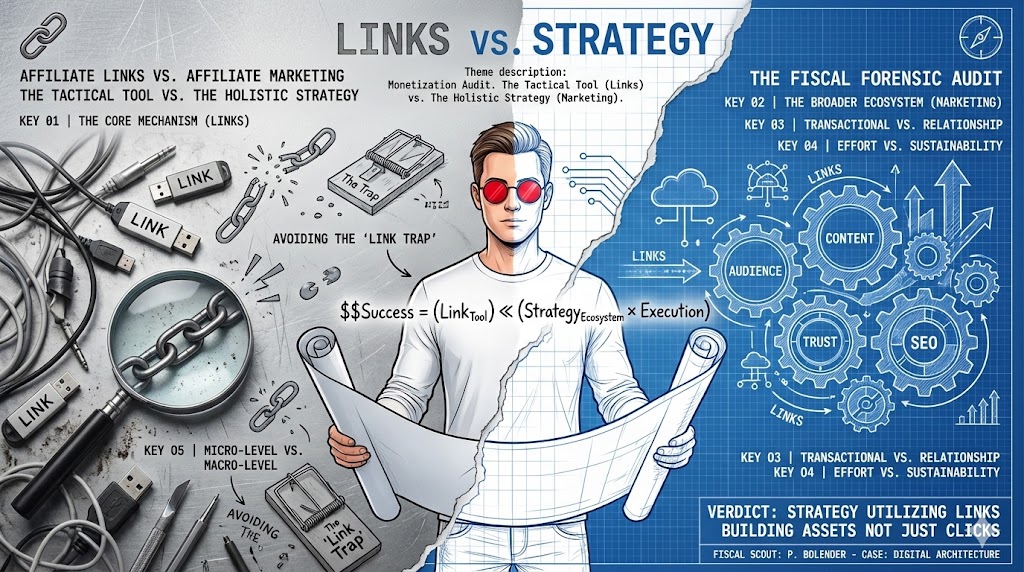
Affiliate Links vs Affiliate Marketing: Key Differences + Best Choice
It depends. While often used interchangeably, affiliate links are merely a tool within the broader strategy of affiliate marketing. The ‘best choice’ isn’t about picking one over the other, but understanding how they integrate to achieve your monetization goals.
- Affiliate marketing is a comprehensive strategy involving content, audience building, and promotion.
- Affiliate links are the trackable URLs that connect your efforts to sales and commissions.
- Focusing solely on links without a marketing strategy yields minimal results; a holistic approach maximizes earnings.
Affiliate Links vs Affiliate Marketing
| Criterion | Affiliate Links | Affiliate Marketing |
|---|---|---|
| Use Case | Specific product/service promotion. | Holistic business model for online monetization. |
| Strengths | Direct tracking, simple implementation, clear conversion path. | Scalability, diversified income, brand building, audience engagement. |
| Limitations | No inherent strategy, relies on existing traffic, limited long-term value. | Requires significant effort, time, content creation, and audience trust. |
| Pricing | Free to generate, costs associated with traffic generation. | Varies based on tools, content, advertising, and platform fees. |
| Best for | Quick promotions, existing content monetization, direct referrals. | Entrepreneurs, content creators, publishers seeking sustainable online income. |
Understanding Affiliate Links: The Core Mechanism
At its most fundamental level, an affiliate link is a unique URL provided by a merchant to an affiliate. This link contains a tracking ID or code that allows the merchant to identify the affiliate responsible for driving a specific visitor or sale. When a user clicks this link and subsequently performs a desired action (like making a purchase, signing up for a service, or filling out a form), the affiliate is credited with the conversion and earns a commission.
These links are the digital breadcrumbs that connect promotional efforts to tangible results. Without them, the entire system of performance-based marketing would collapse. They are typically generated through affiliate networks (e.g., ShareASale, CJ Affiliate, Amazon Associates) or directly from merchant affiliate programs. The sophistication of these links can vary, from simple URLs to complex ones embedded with deep-linking capabilities that direct users to specific product pages rather than just a homepage.
- Tracking ID: A unique identifier embedded in the URL to attribute conversions.
- Cookie Duration: The length of time a cookie (placed upon click) remains active, crediting the affiliate for future purchases.
- Deep Linking: The ability to link directly to specific product pages, enhancing user experience and conversion rates.
- Link Cloaking: A technique to shorten and brand affiliate links, making them more appealing and trustworthy.
Ultimately, an affiliate link is a transactional tool. It’s the direct conduit through which potential earnings flow, making its proper implementation and strategic placement crucial for any affiliate’s success.
Pros of Affiliate Marketing
- Low startup costs and minimal risk compared to traditional businesses.
- Flexibility to work from anywhere, setting your own hours.
- Scalability potential to earn passive income from multiple sources.
- No need to create your own products or handle customer service.
- Access to a vast array of products and niches to promote.
Cons of Affiliate Marketing
- Income can be inconsistent, especially in the early stages.
- Reliance on merchant programs and their terms, which can change.
- High competition in popular niches requires significant effort to stand out.
- Building trust and an audience takes considerable time and consistent effort.
- Potential for link rot or programs closing, requiring constant maintenance.
Deconstructing Affiliate Marketing: A Broader Ecosystem
Affiliate marketing, in contrast to a mere link, is a comprehensive online business model and strategy. It encompasses the entire process of promoting other companies’ products or services, earning a commission on sales or leads generated through your unique efforts. This isn’t just about dropping a link; it’s about building an audience, creating valuable content, establishing trust, and strategically integrating promotional materials.
Think of affiliate marketing as a digital ecosystem. It involves various components: the affiliate (you), the merchant (the company whose products you promote), the customer (the end-user), and often an affiliate network (the platform connecting affiliates and merchants). A successful affiliate marketer understands how these components interact and leverages them to create a sustainable revenue stream. This often involves SEO, content marketing, email marketing, social media promotion, and paid advertising.
- Audience Building: Cultivating a loyal following through valuable content and engagement.
- Content Creation: Producing reviews, guides, comparisons, and tutorials that naturally integrate product recommendations.
- Traffic Generation: Employing SEO, social media, email, or paid ads to bring visitors to your content.
- Niche Selection: Identifying a specific market segment to target, allowing for focused content and authority building.
- Relationship Management: Building trust with your audience and fostering good relationships with merchants/networks.
Affiliate marketing is a long-term game that requires strategic thinking, consistent effort, and adaptability to market changes. It’s about creating value first, and then monetizing that value through carefully placed affiliate links.
The Growth of Affiliate Marketing
Industry reports suggest that affiliate marketing spending in the U.S. alone is projected to reach over $8.2 billion by 2022, up from $5.4 billion in 2017. This consistent growth underscores its viability as a powerful online monetization strategy for businesses and individuals alike.
The Symbiotic Relationship: How Links Power Marketing
It’s crucial to understand that affiliate links and affiliate marketing are not mutually exclusive; rather, they exist in a symbiotic relationship. Affiliate marketing is the overarching strategy, the ‘how-to’ guide for generating income online, while affiliate links are the indispensable tools that make that strategy actionable and measurable. You cannot effectively do affiliate marketing without using affiliate links, and merely using affiliate links without a marketing strategy is unlikely to yield significant results.
Consider a blogger reviewing a product. The blog post, the SEO efforts to rank it, the social media promotion, and the email newsletter announcing it—these are all components of affiliate marketing. The specific URL embedded within that review, which tracks clicks and sales, is the affiliate link. The link is the mechanism of conversion, but the marketing is the engine that drives traffic to that link and persuades users to click.
- Marketing as the Foundation: Building authority, trust, and traffic through various digital channels.
- Links as the Conversion Point: The specific element that enables tracking and commission attribution.
- Strategic Placement: Integrating links naturally within valuable content, not just spamming them.
- Performance Measurement: Links provide the data (clicks, conversions) to refine and optimize marketing efforts.
- Audience Journey: Marketing guides the user through the decision-making process; the link facilitates the final action.
A truly successful affiliate understands this interplay, focusing on creating a robust marketing framework that makes their affiliate links not just visible, but compelling and trustworthy to their audience.
Insider Tip: Context is King
Never just drop an affiliate link. Always provide context, value, and a clear reason why your audience should consider clicking it. A well-placed link in a helpful review or tutorial will outperform dozens of randomly scattered links.
Key Differences in Scope and Strategy
The primary distinction between affiliate links and affiliate marketing lies in their scope and strategic depth. An affiliate link is a singular, tactical element—a piece of code. Affiliate marketing, on the other hand, is a holistic, strategic approach that encompasses a wide array of activities designed to generate consistent revenue. This difference dictates the level of effort, planning, and long-term vision required for each.
If you’re simply sharing an affiliate link with a friend, that’s using an affiliate link. If you’re building a website, creating content, optimizing for search engines, running email campaigns, and then embedding those links, you’re engaged in affiliate marketing. The former is a one-off action; the latter is a sustained business endeavor. The strategic depth of affiliate marketing involves understanding market trends, audience psychology, content optimization, and conversion funnels.
- Scope: Links are micro-level tools; marketing is a macro-level business strategy.
- Effort: Generating a link is minimal; building an affiliate marketing business is substantial.
- Goal: Link’s goal is a single conversion; marketing’s goal is sustainable, scalable income.
- Skillset: Links require basic copying/pasting; marketing demands SEO, content, analytics, and persuasion skills.
- Longevity: A raw link has no inherent longevity; a marketing strategy builds long-term assets like audience and brand.
Recognizing this fundamental difference is the first step toward building a truly effective and profitable online presence, moving beyond mere transactional clicks to strategic influence.
The Myth
‘Affiliate marketing is just about putting links everywhere.’
The Reality
Effective affiliate marketing is about strategic content creation, audience engagement, and trust-building, with links serving as the conversion mechanism within that larger ecosystem. Spamming links is counterproductive.
Monetization Models: Direct vs. Holistic Approaches
When considering monetization, affiliate links represent a direct, transactional approach, while affiliate marketing embodies a holistic, multi-faceted strategy. With an affiliate link, the monetization model is straightforward: a click leads to a desired action, and a commission is earned. This is often a pay-per-sale (PPS), pay-per-lead (PPL), or pay-per-click (PPC) model, directly tied to the link’s performance.
Affiliate marketing, however, opens up a broader spectrum of monetization. While it relies on affiliate links for direct commissions, a well-executed affiliate marketing strategy can also generate income through other avenues. This might include ad revenue from high-traffic content, selling your own digital products (eBooks, courses) to your engaged audience, offering consulting services, or even building and selling the entire affiliate website as a valuable asset. The focus shifts from individual transactions to creating a valuable platform that attracts and serves a specific audience.
- Link Monetization: Direct commission from sales, leads, or clicks attributed to the specific link.
- Marketing Monetization: Includes direct commissions PLUS ad revenue, direct product sales, sponsorships, and lead generation for other services.
- Value Creation: Links offer transactional value; marketing builds intrinsic value in content and audience.
- Income Stability: Link-based income can be volatile; a diversified marketing strategy offers greater stability.
- Asset Building: Affiliate marketing builds digital assets (website, email list, social following) that have long-term value.
The holistic approach of affiliate marketing allows for a more resilient and potentially more lucrative business model, as it diversifies income streams and builds tangible assets beyond just commissions.
Risk, Effort, and Reward: A Comparative Analysis
Analyzing affiliate links versus affiliate marketing through the lens of risk, effort, and reward reveals significant differences. Simply using an affiliate link involves minimal risk and effort, but also offers limited, often sporadic, rewards. You might share a link on social media, and if someone buys, great. If not, no significant loss.
Affiliate marketing, conversely, demands a substantial initial and ongoing effort. This includes time invested in research, content creation, SEO, audience engagement, and technical setup. This higher effort naturally comes with a greater initial risk (time, resources) but also promises significantly higher and more sustainable rewards. The reward in affiliate marketing isn’t just a commission; it’s the creation of a valuable online asset, a loyal audience, and a diversified income stream that can grow exponentially over time.
- Risk (Links): Low financial risk, low time investment risk.
- Risk (Marketing): Higher time/resource investment risk, but mitigated by diversified strategies.
- Effort (Links): Minimal, often a copy-paste action.
- Effort (Marketing): High and continuous (content, SEO, promotion, analysis).
- Reward (Links): Transactional, often small, inconsistent commissions.
- Reward (Marketing): Scalable, potentially passive, diversified, and sustainable income.
For those seeking a serious online business, the higher effort and initial risk associated with affiliate marketing are a necessary investment for the potential of substantial, long-term rewards.
Case Study: The Niche Blogger’s Ascent
The Trap A new blogger started by simply embedding Amazon affiliate links into generic product lists, hoping for quick sales. Traffic was low, and commissions were negligible, leading to frustration and burnout.
The Win After shifting to an affiliate marketing strategy, the blogger focused on creating in-depth, problem-solving content (e.g., ‘Top 5 Eco-Friendly Gadgets for Sustainable Living’). They built an email list, engaged on social media, and optimized for specific keywords. Within 18 months, their monthly affiliate income grew from $50 to over $3,000, demonstrating the power of a strategic, value-driven approach.
Building an Affiliate Marketing Strategy: Beyond Just Links
A robust affiliate marketing strategy goes far beyond the mere placement of links. It’s a multi-layered approach that involves understanding your audience, selecting the right niche, creating compelling content, driving targeted traffic, and continuously optimizing your efforts. The links are the final step in a carefully constructed funnel designed to guide users towards a purchase decision.
Key components of a successful strategy include thorough keyword research to identify what your audience is searching for, crafting high-quality reviews or informational articles that genuinely help users, and building an email list to nurture leads and promote offers over time. It also involves understanding analytics to see what’s working and what’s not, allowing for data-driven adjustments. Without this strategic framework, affiliate links are like a car without an engine—they exist, but they can’t take you anywhere.
- Niche Selection: Choose a profitable niche you’re passionate about or knowledgeable in.
- Audience Research: Understand their pain points, desires, and search intent.
- Content Strategy: Plan and create valuable content (reviews, guides, comparisons) that naturally includes product recommendations.
- Traffic Generation: Implement SEO, social media, email marketing, or paid ads to attract visitors.
- Conversion Optimization: Analyze data, test different calls-to-action, and improve user experience to maximize clicks and sales.
- Relationship Building: Foster trust with your audience and maintain good communication with affiliate managers.
By focusing on these strategic pillars, you transform simple links into powerful revenue generators, building a sustainable online business rather than just chasing quick commissions.
Insider Tip: Diversify Your Traffic Sources
Don’t put all your eggs in one basket. Relying solely on SEO or social media can be risky. Diversify your traffic generation efforts across multiple channels like organic search, social media, email marketing, and even paid ads to create a more resilient affiliate business.
Common Pitfalls and How to Avoid Them
Navigating the world of affiliate monetization comes with its own set of challenges. One of the most common pitfalls is focusing exclusively on the affiliate link without building a foundational marketing strategy. This often leads to low traffic, poor conversion rates, and ultimately, discouragement. Another trap is promoting too many products indiscriminately, which can dilute your brand and erode audience trust.
Many affiliates also neglect the importance of disclosure, which is not only an ethical practice but often a legal requirement (e.g., FTC guidelines). Failing to disclose your affiliate relationship can severely damage your credibility. Furthermore, ignoring analytics means you’re operating blind, unable to identify what content resonates, which links convert, or where your traffic is coming from. Avoiding these pitfalls requires a disciplined, audience-first approach.
- Over-reliance on Links: Avoid just dropping links; create valuable content around them.
- Lack of Niche Focus: Don’t promote everything; specialize to build authority and trust.
- Ignoring Disclosure: Always clearly state your affiliate relationships to maintain transparency.
- Neglecting Analytics: Regularly review data to understand performance and optimize strategy.
- Chasing Trends: While staying current is good, avoid constantly jumping on every new product without proper research.
- Poor SEO Practices: Not optimizing content for search engines means your valuable content won’t be found.
By being aware of these common mistakes and proactively implementing best practices, affiliates can build a more resilient and profitable business model.
The Impact of Trust
A study by Edelman found that 81% of consumers say they need to trust a brand to buy from them. For affiliate marketers, this translates directly to the importance of transparency and genuine recommendations. Without trust, even the best-placed affiliate links will fail to convert.
Choosing Your Path: When to Focus on Links, When on Marketing
The decision of whether to focus primarily on affiliate links or a full-fledged affiliate marketing strategy depends heavily on your goals, resources, and long-term vision. If your aim is simply to earn a few extra dollars by recommending products to a small, existing network (friends, family, a small social media group), then a direct focus on sharing affiliate links might suffice. This is a low-effort, low-reward approach suitable for casual monetization.
However, if your objective is to build a significant, sustainable, and scalable income stream, then investing in a comprehensive affiliate marketing strategy is non-negotiable. This path requires dedication to content creation, audience engagement, SEO, and continuous learning. It’s about building a brand, becoming an authority in your niche, and creating a valuable asset that generates passive income over time. The ‘best choice’ is always aligned with your ultimate ambition.
- Focus on Links (Casual): For quick, small-scale monetization, personal recommendations, or supplementing existing content.
- Focus on Marketing (Strategic): For building a long-term business, generating substantial income, and creating a valuable digital asset.
- Resource Allocation: Links require minimal resources; marketing demands significant time, effort, and potentially financial investment.
- Growth Potential: Link-only has limited growth; marketing offers exponential scalability.
- Skill Development: Links require basic digital literacy; marketing necessitates a broad range of digital marketing skills.
Ultimately, affiliate links are the tactical instruments, while affiliate marketing is the strategic orchestra. For serious players, conducting the orchestra is the path to true success.
Future Trends in Affiliate Monetization
The landscape of affiliate monetization is constantly evolving, driven by technological advancements and shifts in consumer behavior. Understanding these future trends is crucial for any affiliate marketer aiming for long-term success. One significant trend is the rise of influencer marketing integration, where affiliates leverage their personal brand and direct audience connection on platforms like Instagram, TikTok, and YouTube to promote products more authentically.
Another key trend is the increasing importance of first-party data and personalization. As privacy concerns grow, affiliates who can build direct relationships with their audience through email lists and personalized content will have a significant advantage. Furthermore, the adoption of AI for content generation, SEO analysis, and conversion optimization is set to revolutionize how affiliates operate, making processes more efficient and data-driven. Voice search optimization and the growth of niche communities also present new opportunities for targeted affiliate promotions.
- AI & Automation: Leveraging AI tools for content outlines, SEO analysis, and ad optimization.
- Video Content Dominance: Increased focus on YouTube, TikTok, and short-form video for product reviews and tutorials.
- Personalization: Tailoring content and offers based on user data and preferences for higher conversion.
- Niche Community Building: Engaging with highly specific audiences on platforms like Reddit, Discord, or private forums.
- Ethical & Transparent Marketing: Greater emphasis on genuine recommendations and clear disclosures to build trust.
- Cookieless Future: Adapting to new tracking technologies and focusing on first-party data collection.
Staying abreast of these trends and adapting your affiliate marketing strategy accordingly will be vital for maintaining a competitive edge and ensuring continued monetization success in the years to come.
Affiliate Marketing Success Checklist
- Define Your Niche (Week 1): Research and select a profitable niche you’re passionate about.
- Build Your Platform (Weeks 2-4): Set up a website/blog or choose a primary content platform (e.g., YouTube channel).
- Create Foundational Content (Months 1-3): Publish high-quality, valuable content (reviews, guides) with natural affiliate link integration.
- Drive Targeted Traffic (Ongoing): Implement SEO, social media, and email marketing strategies.
- Analyze & Optimize (Monthly): Review analytics to understand performance and refine your strategy.
- Build an Email List (Ongoing): Implement lead magnets to capture emails and nurture your audience.
- Diversify Income Streams (Year 1+): Explore additional monetization beyond direct affiliate commissions.
What is the main difference between an affiliate link and affiliate marketing?
An affiliate link is a specific, trackable URL used to attribute sales or leads to an affiliate. Affiliate marketing is the entire strategic process of promoting products, building an audience, and generating traffic to ultimately drive conversions through those links.
Can I do affiliate marketing without using affiliate links?
No, affiliate links are the fundamental mechanism for tracking and attributing sales in affiliate marketing. Without them, there’s no way for merchants to know you drove a conversion, and thus, no way for you to earn a commission.
Is it better to focus on affiliate links or affiliate marketing?
For sustainable and significant income, it is always better to focus on a comprehensive affiliate marketing strategy. Affiliate links are merely tools within that larger strategy. A strong marketing foundation maximizes the effectiveness of your links.
Do I need a website to do affiliate marketing?
While a website is highly recommended for building authority and a long-term asset, you can engage in affiliate marketing through other platforms like YouTube, social media (e.g., Instagram, TikTok), or email marketing, provided you adhere to platform rules and disclosure requirements.
How do affiliate links track sales?
Affiliate links contain a unique tracking ID. When a user clicks the link, a cookie is typically placed on their browser. This cookie stores the affiliate’s ID and a duration. If the user makes a purchase within that cookie’s lifespan, the sale is attributed to the affiliate.