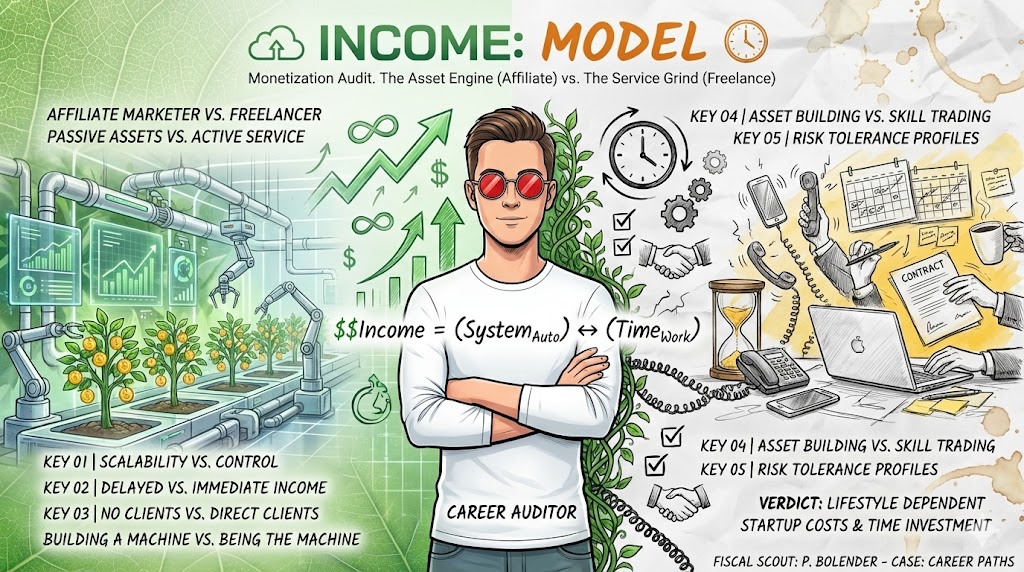
Affiliate Marketer vs Freelance: Key Differences & Best Choice
The best choice between affiliate marketing and freelancing depends heavily on your risk tolerance, desired income stability, and passion for direct client interaction. Both paths offer entrepreneurial freedom but with distinct operational models and reward structures.
- Affiliate marketing offers significant passive income potential and scalability without direct client management.
- Freelancing provides immediate income and direct control but requires constant client acquisition and project delivery.
- Choose affiliate marketing for long-term asset building and passive revenue, or freelancing for quicker cash flow and direct service delivery.
Affiliate Marketer vs. Freelancer: A Direct Comparison
| Criterion | Affiliate Marketer | Freelancer |
|---|---|---|
| Primary Goal | Drive sales/leads for third-party products/services. | Provide direct services to clients for a fee. |
| Income Model | Commission-based, often passive over time. | Project-based or hourly, directly tied to work delivered. |
| Strengths | Scalability, passive potential, no client management, diverse niches. | Immediate income, direct control, skill development, client relationships. |
| Limitations | Delayed income, reliance on third-party products, market fluctuations. | Constant client acquisition, income instability, limited scalability without hiring. |
| Startup Costs | Low to moderate (website, tools, content creation). | Generally low (portfolio, basic tools). |
| Best for | Individuals seeking long-term asset building, passive income, and marketing focus. | Individuals seeking immediate income, direct client interaction, and service-based work. |
Understanding Affiliate Marketing: The Passive Income Play
Affiliate marketing is a performance-based marketing strategy where individuals or businesses earn a commission for promoting another company’s products or services. Essentially, you act as a digital salesperson, driving traffic and conversions to a merchant’s offerings through unique affiliate links. When a customer makes a purchase or completes a desired action via your link, you receive a percentage of the sale or a fixed fee. This model thrives on leveraging various online channels, from blogs and social media to email lists and YouTube channels, to connect potential buyers with relevant products.
The core appeal of affiliate marketing lies in its potential for passive income and scalability. Once your content or promotional assets are established, they can continue to generate revenue with minimal ongoing effort. This doesn’t mean it’s entirely hands-off; successful affiliate marketers consistently analyze data, optimize campaigns, and update content to maintain relevance and conversion rates. However, the initial heavy lifting often leads to a more automated income stream compared to direct service delivery.
- Product Selection: Identifying profitable niches and high-quality products that resonate with your audience.
- Content Creation: Developing valuable reviews, tutorials, comparisons, or informational articles around chosen products.
- Traffic Generation: Driving visitors to your content through SEO, paid ads, social media, or email marketing.
- Conversion Optimization: Refining your content and calls to action to encourage clicks and purchases through your affiliate links.
- Performance Tracking: Analyzing metrics to understand what works and what doesn’t, allowing for continuous improvement.
Ultimately, affiliate marketing is about building trust with an audience and providing genuine value, guiding them towards solutions that happen to be affiliate products. It requires a strong understanding of digital marketing principles and a long-term vision for asset development.
Decoding Freelancing: The Direct Service Model
Freelancing, by contrast, involves offering specialized services directly to clients on a project-by-project or contractual basis. As a freelancer, you are your own boss, responsible for marketing your skills, acquiring clients, negotiating rates, and delivering high-quality work. Common freelance professions include writing, graphic design, web development, consulting, virtual assistance, and digital marketing services. The fundamental difference here is the direct exchange of your time and expertise for payment, rather than earning commissions on sales you facilitate.
The immediate benefit of freelancing is the potential for quick income generation. Once you secure a client and complete a project, payment is typically rendered within a short timeframe. This direct correlation between effort and reward can be highly motivating and provides a sense of control over your earnings. However, this also means that your income is directly tied to your ability to consistently find and satisfy clients. When you stop working, the income stops, making it an active income model.
- Skill Development: Continuously honing your expertise to remain competitive and offer high-value services.
- Portfolio Building: Showcasing your best work to attract new clients and demonstrate your capabilities.
- Client Acquisition: Actively seeking out and pitching to potential clients through networking, platforms, and personal outreach.
- Project Management: Managing timelines, client expectations, and deliverables efficiently to ensure satisfaction.
- Financial Management: Handling invoicing, taxes, and budgeting as an independent contractor.
Freelancing demands strong communication skills, self-discipline, and a proactive approach to business development. It’s ideal for those who enjoy direct client interaction and seeing the tangible impact of their work on a project-by-project basis.
Pros of Affiliate Marketing
- Scalability and Passive Income Potential: Once content is created, it can generate income 24/7 without direct intervention.
- No Client Management: You don’t deal with client demands, revisions, or direct service delivery.
- Low Overhead: Generally fewer operational costs compared to running a traditional service business.
- Flexibility: Work from anywhere, anytime, on your own schedule.
- Diverse Niches: Opportunity to promote products across a vast array of industries.
Cons of Affiliate Marketing
- Delayed Income: It can take months or even years to build a profitable affiliate business.
- Reliance on Third Parties: Dependent on merchant programs, product quality, and commission structures.
- Market Volatility: Algorithm changes, competition, and product discontinuation can impact earnings.
- No Direct Control: You don’t own the product or service, limiting influence over customer experience.
- High Competition: Many niches are saturated, requiring significant effort to stand out.
Pros of Freelancing
- Immediate Income: Get paid directly for your work, often with quicker turnaround times.
- Direct Control: You set your rates, choose your clients, and define your services.
- Skill Development: Constantly learning and adapting to new client needs and industry trends.
- Client Relationships: Build strong professional networks and repeat business.
- Tangible Impact: See the direct results of your work on client projects.
Cons of Freelancing
- Income Instability: Feast or famine cycles are common, requiring constant client acquisition.
- Client Management: Dealing with demanding clients, scope creep, and payment issues can be stressful.
- Limited Scalability: Your income is often capped by the hours you can work unless you hire staff.
- No Passive Income: Income stops when you stop working; it’s an active income model.
- Administrative Burden: Responsible for all aspects of your business, including marketing, sales, and accounting.
Income Potential and Stability: Which Path Pays More Consistently?
When evaluating affiliate marketing versus freelancing, income potential and stability are critical factors. Both models offer uncapped earning potential, but the journey to reaching significant income and maintaining its consistency differs dramatically. Freelancing typically offers a more immediate and predictable income stream in the short term, as you directly exchange your time and skills for money. You can set hourly rates or project fees and, assuming consistent client acquisition, forecast your earnings with reasonable accuracy. However, this income is often limited by the number of hours you can realistically work and the rates you can command.
Affiliate marketing, on the other hand, can be a slow burn. Initial earnings are often minimal, and it can take months or even years of consistent effort to build an audience and generate substantial commissions. However, once established, an affiliate business has the potential for much greater scalability and passive income. A well-optimized website or content piece can continue to generate sales long after its creation, leading to exponential growth that is less directly tied to your active working hours. The stability in affiliate marketing comes from diversifying your traffic sources and product promotions, mitigating the risk of relying on a single channel or merchant.
- Freelancing Income Factors:
- Your specific skill set and level of expertise.
- Your hourly rate or project fees.
- The number of clients you can serve simultaneously.
- Your ability to consistently market yourself and acquire new projects.
- Affiliate Marketing Income Factors:
- The size and engagement of your audience.
- The conversion rates of the products you promote.
- The commission rates offered by merchants.
- Your ability to drive targeted traffic to your affiliate offers.
While freelancing offers a more direct and often quicker path to income, affiliate marketing holds the promise of greater long-term wealth creation through leverage and automation, albeit with a higher initial risk and longer gestation period for profitability.
Required Skill Sets and Learning Curves
The skills required for success in affiliate marketing and freelancing, while overlapping in some areas, diverge significantly in their primary focus. Understanding these differences is crucial for choosing the path that best aligns with your natural talents and willingness to learn.
Affiliate marketing heavily emphasizes digital marketing skills. This includes a strong grasp of search engine optimization (SEO) to rank content, content creation (writing, video production), social media marketing, email marketing, and analytics. You need to understand how to attract an audience, build trust, and persuade them to take action. Technical skills like website development (WordPress, basic HTML/CSS) are often beneficial, though not always strictly necessary with modern tools. The learning curve can be steep, as it requires mastering multiple disciplines and staying updated with ever-evolving algorithms and trends.
- Key Affiliate Marketing Skills:
- Content Creation (writing, video, graphics)
- Search Engine Optimization (SEO)
- Social Media Marketing
- Email Marketing
- Analytics and Data Interpretation
- Copywriting and Persuasion
- Basic Web Development/Platform Management
Freelancing, on the other hand, prioritizes a specific service-based skill. Whether it’s graphic design, coding, writing, or consulting, your primary asset is your expertise in a particular domain. Beyond that core skill, freelancers must also develop strong business acumen. This includes client communication, project management, negotiation, time management, and self-promotion. While marketing skills are important for client acquisition, they are often secondary to the ability to deliver the core service effectively. The learning curve for freelancing often involves deepening your primary skill and then learning the ropes of running a small business.
- Key Freelancing Skills:
- Core Service Expertise (e.g., writing, design, coding)
- Client Communication and Relationship Management
- Project Management and Organization
- Negotiation and Sales
- Time Management and Productivity
- Self-Marketing and Personal Branding
- Financial Management and Invoicing
Both paths require dedication and continuous learning, but affiliate marketing leans into broad marketing strategy, while freelancing focuses on deep expertise in a specific service area combined with strong client-facing business skills.
Flexibility, Autonomy, and Work-Life Balance
One of the most attractive aspects of both affiliate marketing and freelancing is the promise of increased flexibility and autonomy compared to traditional employment. However, the nature of this freedom and its impact on work-life balance can vary significantly between the two models.
Affiliate marketing often offers unparalleled flexibility. You are your own boss, setting your hours, choosing your projects, and working from virtually anywhere with an internet connection. There are no client deadlines in the traditional sense, and you’re not beholden to specific meeting times. This allows for a high degree of autonomy in how you structure your day and week. The trade-off, especially in the early stages, is that the work can be all-consuming, as you’re constantly building and optimizing. However, once systems are in place, the potential for a truly passive income stream can lead to an excellent work-life balance, freeing up time for other pursuits.
- Affiliate Marketing Flexibility:
- Set your own schedule and work hours.
- Choose your niche and products to promote.
- Work from any location globally.
- No direct client meetings or urgent demands.
- Potential for significant time freedom once established.
Freelancing also provides substantial flexibility, but it comes with its own set of constraints. You can choose your clients, projects, and often your working hours. However, client deadlines, communication requirements, and the need to be responsive mean that your schedule isn’t entirely your own. While you avoid a traditional boss, your clients effectively become your bosses, each with their own expectations. Achieving work-life balance in freelancing often means mastering time management, learning to say no to unsuitable projects, and proactively scheduling downtime. The immediate income, however, can provide a sense of financial freedom that contributes to overall well-being.
- Freelancing Flexibility:
- Choose which clients and projects to take on.
- Negotiate your own rates and terms.
- Often work remotely, but may require client meetings.
- Direct control over your service offerings.
- Requires strong boundaries to maintain work-life balance.
Both paths require discipline to manage your own time effectively. Affiliate marketing offers more long-term potential for true ‘set it and forget it’ passive income, while freelancing provides immediate control over your work and income, but often with ongoing client-driven demands.
Risk Factors and Long-Term Viability
Every entrepreneurial venture carries inherent risks, and both affiliate marketing and freelancing are no exception. Understanding these risks and the factors influencing long-term viability is crucial for making an informed decision about your career path.
Affiliate marketing faces significant external risks. A major concern is reliance on third-party platforms and algorithms. Google algorithm updates can drastically impact organic search traffic, while changes in social media platform policies can cripple paid campaigns. Merchants can alter commission rates, discontinue products, or even shut down their affiliate programs without warning. This means your income stream is often subject to factors beyond your direct control. Long-term viability in affiliate marketing hinges on diversification: promoting multiple products, using various traffic sources, and building an owned audience (e.g., email list) that isn’t dependent on a single platform. Building a resilient affiliate business requires constant adaptation and strategic foresight.
- Affiliate Marketing Risks:
- Algorithm changes (Google, social media) impacting traffic.
- Merchant program changes (commission cuts, termination).
- Product discontinuation or quality issues.
- Increased competition in profitable niches.
- Ad platform policy changes or account suspensions.
Freelancing, while offering more direct control, has its own set of risks, primarily related to income consistency and client dependency. The ‘feast or famine’ cycle is a common challenge, where periods of high workload are followed by dry spells. Losing a major client can significantly impact your income, making client acquisition an ongoing necessity. Burnout is another risk, as freelancers often juggle multiple projects, administrative tasks, and marketing efforts. Long-term viability in freelancing depends on building a strong reputation, cultivating a network of repeat clients, and continuously updating your skills to remain competitive. Diversifying your client base and services is key to mitigating risk.
- Freelancing Risks:
- Income instability and unpredictable cash flow.
- Client disputes, non-payment, or scope creep.
- Burnout from juggling multiple roles and projects.
- Difficulty scaling beyond personal capacity.
- Market saturation for specific services.
Both models demand a proactive approach to risk management. Affiliate marketers must diversify their digital assets and traffic, while freelancers must diversify their client portfolio and continuously enhance their value proposition.
Client Interaction vs. Audience Building
The nature of human interaction is a fundamental differentiator between affiliate marketing and freelancing, influencing daily tasks, communication styles, and the overall business experience. Your preference for direct client engagement versus broad audience cultivation should heavily weigh into your decision.
Freelancing is inherently client-centric. Your success directly depends on your ability to understand client needs, communicate effectively, manage expectations, and deliver services that meet or exceed their requirements. This involves regular meetings, email exchanges, feedback loops, and potentially navigating difficult conversations. Building strong client relationships is paramount for repeat business, referrals, and long-term success. For those who enjoy direct collaboration, problem-solving for specific individuals or businesses, and seeing immediate results of their work, freelancing can be highly rewarding. However, it also means dealing with client personalities, potential scope creep, and the emotional labor of managing expectations.
- Freelancing Interaction Focus:
- Direct, one-on-one or small-group communication.
- Understanding specific client project requirements.
- Negotiating terms and managing expectations.
- Providing regular updates and receiving feedback.
- Building long-term professional relationships.
Affiliate marketing, conversely, focuses on audience building and engagement. While you interact with people, it’s typically on a broader, less personal scale. Your goal is to attract a target audience, provide them with valuable content, and subtly guide them towards affiliate products. This involves understanding market demographics, creating compelling content, responding to comments or inquiries on your platforms, and building a community around your niche. You don’t have ‘clients’ in the traditional sense, but rather an audience whose trust you aim to earn. This model is ideal for those who prefer to communicate through content and marketing strategies rather than direct service delivery. The relationship is often one-to-many, rather than one-to-one.
- Affiliate Marketing Interaction Focus:
- Broad communication through content (blogs, videos, social media).
- Understanding general audience needs and pain points.
- Building trust and authority within a niche.
- Engaging with comments and community feedback.
- Driving traffic and conversions through persuasive marketing.
Your comfort level with direct client demands versus the strategic art of mass communication will be a significant factor in determining which path feels more natural and sustainable for you.
Startup Costs and Time Investment
Launching any new venture requires an investment of both time and capital. While both affiliate marketing and freelancing can be started with relatively low financial barriers compared to traditional businesses, the nature and scale of these initial investments differ.
Affiliate marketing typically requires a moderate initial financial investment. The most common costs include setting up a website (domain, hosting), purchasing essential tools (keyword research, email marketing software), and potentially investing in paid advertising to accelerate traffic. While you can start with free platforms, serious affiliate marketers often find paid tools and professional website setup to be crucial for long-term success. The time investment, however, is often substantial and front-loaded. It takes considerable time to research niches, create high-quality content, build an audience, and establish SEO authority. Profitability can take many months, sometimes a year or more, making it a long-term game requiring patience and consistent effort before seeing significant returns.
- Affiliate Marketing Startup Investments:
- Domain name and web hosting (e.g., $50-200/year).
- Premium WordPress theme or website builder (e.g., $0-100/year).
- Keyword research tools (e.g., $0-100+/month).
- Email marketing service (e.g., $0-50+/month, scales with subscribers).
- Content creation (your time, or outsourcing costs).
- Optional: Paid advertising (can be hundreds to thousands per month).
Freelancing, in many cases, can have even lower initial financial costs. If you already possess a marketable skill and the necessary equipment (e.g., a computer and relevant software for a designer), your primary startup cost might be building a portfolio, setting up a professional online presence (LinkedIn, a simple website), and perhaps investing in networking events. The time investment is also significant, focusing on marketing yourself, building a client base, and refining your services. However, the time-to-income is generally much shorter. Once you land your first client, you can start earning almost immediately, providing quicker cash flow to reinvest in your business or cover living expenses. The initial time investment is heavily weighted towards client acquisition and service delivery.
- Freelancing Startup Investments:
- Professional portfolio (often free to build online).
- Basic website/online presence (LinkedIn, Behance, personal site).
- Necessary software for your service (e.g., Adobe Creative Suite, coding IDEs).
- Networking and marketing efforts (your time).
- Optional: Online course to upskill or specialize.
If you need to generate income quickly, freelancing often provides a faster path. If you have the capital and patience for a longer ramp-up, affiliate marketing offers the potential for greater long-term passive returns.
Scalability and Growth Opportunities
The ability to grow and expand your business is a key consideration for any entrepreneur. Both affiliate marketing and freelancing offer avenues for scalability, but the methods and limitations differ significantly.
Affiliate marketing boasts high scalability potential. Once your content and marketing funnels are established, they can theoretically reach an unlimited audience. You can scale by: expanding into new niches, promoting more products, diversifying traffic sources (e.g., adding YouTube to a blog), or investing more in paid advertising. The beauty is that your income isn’t directly tied to your hours worked. A single piece of content can generate revenue for years. This leverage allows for exponential growth without a proportional increase in personal effort, making it an attractive model for those seeking to build a large-scale online business. The primary limitation is market saturation and the need for continuous optimization.
- Affiliate Marketing Scaling Strategies:
- Expanding into related or new niches.
- Adding more products and services to promote.
- Diversifying traffic channels (SEO, social, email, paid ads).
- Automating processes (e.g., email sequences).
- Outsourcing content creation or technical tasks.
Freelancing, while offering growth, faces inherent limitations in scalability due to its direct service model. Your income is largely capped by the hours you can personally dedicate to client work. To scale as a freelancer, you typically need to: increase your rates (by specializing or gaining more experience), take on larger projects, or hire other freelancers/employees to delegate tasks. The latter option transforms you from a sole freelancer into an agency owner, which is a different business model altogether. While you can grow your reputation and client base, true exponential growth without increasing your personal workload is challenging. The bottleneck is often your own time and capacity.
- Freelancing Scaling Strategies:
- Increasing hourly rates or project fees.
- Specializing in high-value niche services.
- Taking on larger, more complex projects.
- Building a team or outsourcing tasks (transition to agency).
- Creating and selling digital products (e.g., courses, templates) as a hybrid model.
If your ultimate goal is to build a business that can generate significant income independently of your direct daily involvement, affiliate marketing offers a more straightforward path to that kind of leverage. Freelancing can scale, but often requires a shift in business structure to do so effectively.
Choosing Your Path: A Decision Framework
Deciding between affiliate marketing and freelancing is a personal journey that should align with your strengths, preferences, and long-term aspirations. There’s no universally ‘better’ option; only the one that is better for you. To help clarify your choice, consider the following framework and self-assessment questions.
First, reflect on your personality and work style. Are you a self-starter who thrives on independent work, or do you prefer direct collaboration? Are you patient enough for long-term gains, or do you need immediate gratification? Your answers to these questions will provide significant insight. Second, assess your skill set and interests. Are you passionate about marketing, content creation, and analytics, or do you excel at a specific service like writing, design, or coding? Third, evaluate your financial goals and risk tolerance. Are you comfortable with income volatility for the potential of passive wealth, or do you prioritize consistent, albeit capped, income?
- Self-Assessment Questions for Affiliate Marketing:
- Do I enjoy researching niches and products?
- Am I patient enough to build an audience and wait for income to grow?
- Am I comfortable with digital marketing, SEO, and content creation?
- Do I prefer working independently without direct client demands?
- Am I willing to adapt to algorithm changes and market shifts?
- Self-Assessment Questions for Freelancing:
- Do I possess a highly marketable skill that clients need?
- Do I enjoy direct client interaction and problem-solving?
- Am I good at managing projects and meeting deadlines?
- Do I need immediate income and a more predictable cash flow?
- Am I comfortable with self-promotion and client acquisition?
It’s also worth noting that these paths are not mutually exclusive. Many successful individuals start as freelancers to generate immediate income and then gradually build an affiliate marketing business on the side, leveraging their existing skills and audience. This hybrid approach can offer the best of both worlds, providing stability while building towards passive income. Ultimately, the best choice is the one that excites you, challenges you in positive ways, and aligns with your vision for a fulfilling career.
Action Checklist: Your Next Steps
- Assess Your Skills & Interests (1-2 Days): List your core competencies and what kind of work truly excites you. Do you prefer marketing strategy or direct service delivery?
- Research Market Demand (3-5 Days): For your chosen path, investigate the demand for specific niches (affiliate) or services (freelance). Use tools like Google Trends or freelance platforms.
- Define Your Financial Goals (1 Day): Determine your short-term and long-term income needs. How quickly do you need to generate revenue?
- Start Learning & Building (Ongoing): Dedicate time daily to learn essential skills for your chosen path (e.g., SEO for affiliate, portfolio building for freelance).
- Create a Minimum Viable Product/Service (1-2 Weeks): For affiliate, set up a basic website. For freelance, create a strong portfolio and service offering.
- Begin Outreach/Promotion (Ongoing): Start promoting your affiliate content or pitching your freelance services to potential clients immediately.
What is the main difference between an affiliate marketer and a freelancer?
An affiliate marketer earns commissions by promoting other companies’ products or services, focusing on driving sales or leads. A freelancer provides direct services (like writing, design, or coding) to clients for a fee, exchanging their time and skills for payment.
Which path offers more stable income?
Freelancing generally offers more immediate and stable income in the short term, as payment is directly tied to completed projects. Affiliate marketing can be highly volatile initially, with income often delayed, but offers greater potential for passive and scalable income long-term.
Can I do both affiliate marketing and freelancing simultaneously?
Yes, many individuals successfully combine both. Freelancing can provide immediate income and build valuable skills and networks, which can then be leveraged to start or grow an affiliate marketing business. This hybrid approach offers both stability and long-term growth potential.
Which option requires more technical skills?
Affiliate marketing often requires a broader range of digital marketing technical skills, including SEO, website management, and analytics. Freelancing requires deep technical expertise in your specific service area (e.g., advanced coding for a web developer, mastery of design software for a graphic designer), alongside strong client communication skills.
Is affiliate marketing truly passive?
While affiliate marketing can generate passive income once established, it’s rarely entirely hands-off. It requires ongoing effort in content creation, optimization, traffic generation, and staying updated with market trends and algorithm changes to maintain and grow earnings. The ‘passive’ aspect refers to the ability to earn without directly trading time for money on every transaction.