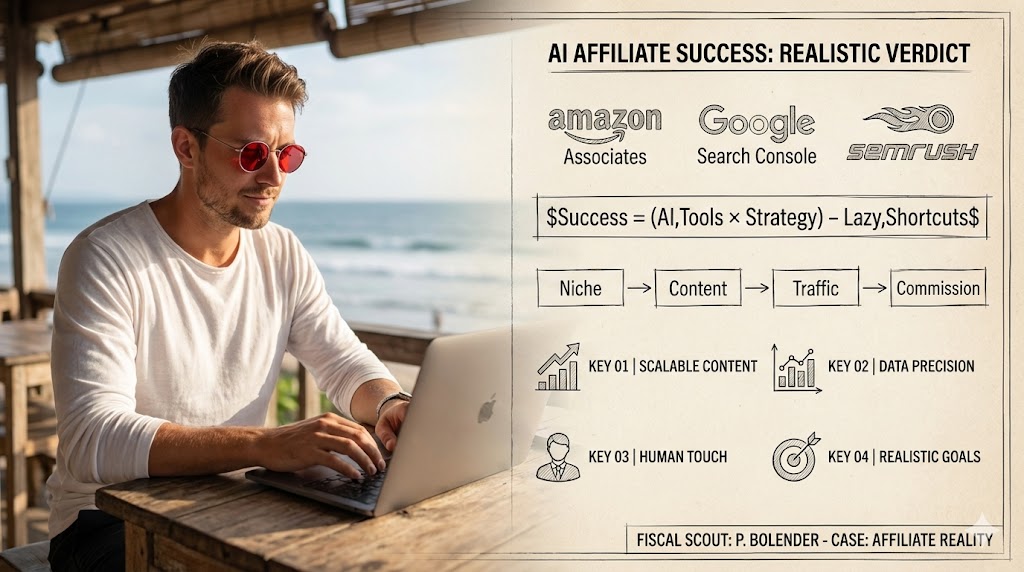
Navigating AI Affiliate Success: A Realistic Verdict
It depends. While AI offers unprecedented opportunities for affiliate marketers, success is not guaranteed and hinges on strategic implementation rather than simple automation.
- Strongest Advantage: AI significantly enhances content creation, audience targeting, and data analysis, leading to scalable and efficient operations.
- Biggest Limitation: Over-reliance on AI without human oversight can lead to generic content, algorithmic penalties, and a lack of authentic engagement.
- Concrete Use Case: AI excels in generating high-volume, SEO-optimized product reviews and comparisons for niche affiliate websites.
What is AI Affiliate Marketing and Why Now?
AI affiliate marketing involves leveraging artificial intelligence tools and technologies to streamline, optimize, and scale various aspects of an affiliate business. This includes everything from content generation and SEO to audience targeting and conversion rate optimization. The rapid advancements in AI, particularly in natural language processing and machine learning, have made sophisticated tools accessible to individual marketers, democratizing capabilities once reserved for large enterprises.
The current landscape demands efficiency and precision, making AI an indispensable ally. Marketers face increasing competition, evolving search algorithms, and the need to process vast amounts of data to identify profitable niches and products. AI provides the analytical power and automation capabilities to meet these challenges head-on, allowing affiliates to focus on strategy and creativity rather than repetitive tasks. Understanding the fundamental shift AI brings is crucial for long-term success.
AI affiliate marketing: The strategic application of artificial intelligence technologies to automate, optimize, and enhance core affiliate marketing processes, including content creation, SEO, audience analysis, and campaign management, to drive higher conversions and revenue.
The ‘why now’ is rooted in the maturity of AI models and their integration into user-friendly platforms. These tools can analyze market trends, predict consumer behavior, and even craft compelling ad copy or blog posts at a speed and scale previously unimaginable. This creates a significant competitive advantage for those who adopt these technologies early and effectively, allowing them to capture market share in burgeoning niches with unparalleled speed.
- Content Automation: Generating articles, product descriptions, and social media posts rapidly.
- SEO Optimization: Identifying keywords, analyzing competitor strategies, and optimizing on-page elements.
- Audience Segmentation: Pinpointing ideal customer profiles and tailoring marketing messages.
- Performance Analysis: Interpreting campaign data to identify trends and areas for improvement.
Pros of AI in Affiliate Marketing
- Scalability: Automate content creation and campaign management to expand operations without proportional increases in manual labor.
- Efficiency: Drastically reduce time spent on research, writing, and data analysis, freeing up resources for strategic planning.
- Precision Targeting: Utilize advanced analytics to identify and reach highly specific audience segments, improving conversion rates.
Cons of AI in Affiliate Marketing
- Quality Control: AI-generated content may lack unique voice or depth, requiring significant human editing to maintain quality and authenticity.
- Algorithmic Dependence: Over-reliance on AI can make businesses vulnerable to changes in platform algorithms or AI model biases.
- Initial Learning Curve: Effective implementation often requires a foundational understanding of AI tools and data interpretation, which can be a barrier for some.
The Core Mechanics: How AI Powers Affiliate Success
At its heart, AI empowers affiliate success by providing superior data processing and pattern recognition capabilities. Instead of manually sifting through keyword research tools or competitor analyses, AI algorithms can ingest vast datasets and extract actionable insights in moments. This includes identifying underserved niches, predicting product trends, and even understanding the sentiment around specific brands or products. The ability to make data-driven decisions quickly is a game-changer for affiliates operating in fast-paced markets.
Beyond analysis, AI tools actively contribute to content creation and optimization. For instance, AI writers can generate drafts of articles, product reviews, or social media updates based on specific prompts and target keywords. These tools can also suggest improvements for existing content, ensuring it aligns with SEO best practices and appeals to the target audience. This blend of analytical power and creative assistance allows affiliates to maintain a consistent output of high-quality, relevant content, which is fundamental for attracting and converting traffic.
AI Adoption in Digital Marketing
A recent industry survey indicated that approximately 60% of digital marketers are currently using AI tools, with another 25% planning to adopt them within the next year, primarily for content creation and data analysis tasks.
Furthermore, AI plays a crucial role in personalizing the user experience. By analyzing user behavior on a website, AI can dynamically recommend products or content that are most likely to resonate with an individual visitor, increasing the chances of a click-through and subsequent conversion. This level of personalization, often seen on major e-commerce platforms, is now accessible to affiliate marketers, enabling them to create a more engaging and effective sales funnel. The continuous learning aspect of AI means these recommendations become more accurate over time, leading to sustained improvements in affiliate performance.
- Niche Identification: AI analyzes market gaps and emerging trends to suggest profitable niches.
- Content Generation: Tools create articles, reviews, and ad copy optimized for engagement and SEO.
- Predictive Analytics: Forecasts consumer behavior and product demand to inform strategy.
- Personalized Recommendations: Tailors product suggestions to individual users, boosting conversions.
Real-World Case Study: AI-Driven Content Generation for Niche Sites
One of the most compelling applications of AI in affiliate marketing is its ability to rapidly generate high-quality, SEO-optimized content for niche websites. Consider the example of ‘EcoGadget Reviews,’ a relatively new affiliate site focused on sustainable technology. The founder, Sarah, struggled to keep up with the content demands of reviewing dozens of new eco-friendly products each month while also managing SEO and promotion.
EcoGadget Reviews: Scaling Content with AI
The trap: Sarah was spending over 60 hours a week on manual product research, writing, and basic SEO optimization, leading to burnout and slow growth for her niche affiliate site.
The win: By integrating an AI SEO writer like Postlabs.ai, Sarah was able to automate the initial drafting of product reviews, comparison articles, and buyer’s guides. The AI tool helped identify relevant keywords, structure the content for readability, and even suggest internal linking opportunities. This allowed her to produce 5x more content per week, freeing up her time to focus on editing for accuracy, adding personal insights, and building backlinks. Within six months, ‘EcoGadget Reviews’ saw a 300% increase in organic traffic and a 250% boost in affiliate commissions, demonstrating the power of AI in scaling content operations effectively.
This case study highlights how AI can serve as a powerful force multiplier. By offloading the initial, labor-intensive stages of content creation, affiliates can dramatically increase their output without sacrificing quality, provided they maintain a crucial human oversight layer. The AI handles the heavy lifting of research and drafting, while the human expert refines, personalizes, and ensures factual accuracy and brand voice. This synergy is where the true power of AI lies.
- Keyword Integration: AI ensures target keywords are naturally woven into content.
- Content Structure: AI helps create logical headings and paragraphs for better readability.
- Drafting Speed: Reduces content creation time from hours to minutes for initial drafts.
- Scalability: Enables the production of hundreds of articles per month with a small team.
Beyond Content: AI for Audience Targeting and Conversion Optimization
While content generation often grabs headlines, AI’s capabilities extend far beyond writing. In affiliate marketing, understanding your audience and optimizing the conversion path are equally critical. AI tools can analyze vast amounts of user data – including demographics, browsing history, purchase behavior, and engagement patterns – to create highly accurate audience segments. This allows affiliates to tailor their promotional efforts, whether through email campaigns, social media ads, or on-site recommendations, to resonate deeply with specific groups of potential customers. The result is a significant increase in the relevance of marketing messages.
Insider tip: Micro-Segmentation
Don’t just segment by broad demographics. Use AI to identify ‘micro-segments’ based on specific behaviors (e.g., ‘visited product page but didn’t add to cart in last 24 hours’). These highly targeted groups often yield significantly higher conversion rates for personalized retargeting campaigns.
Furthermore, AI is instrumental in conversion rate optimization (CRO). Tools equipped with AI can perform A/B testing at scale, identifying which headlines, calls-to-action, or page layouts perform best. They can also analyze user journeys on a website, highlighting friction points where visitors tend to drop off. By continuously learning from user interactions, AI can suggest real-time adjustments to website elements or funnel steps, leading to incremental but significant improvements in conversion rates over time. This iterative optimization process is a cornerstone of sustainable affiliate growth.
- Behavioral Analysis: AI tracks user interactions to understand preferences and pain points.
- Dynamic Personalization: Adjusts website content or product displays based on individual user profiles.
- Predictive Lead Scoring: Identifies which leads are most likely to convert, prioritizing efforts.
- Automated A/B Testing: Runs multiple test variations simultaneously to find optimal solutions.
Common Pitfalls in AI Affiliate Strategies
Despite its immense potential, implementing AI in affiliate marketing is not without its challenges. One of the most common pitfalls is the expectation that AI can entirely replace human input. While AI excels at automation and data processing, it often lacks the nuanced understanding, creativity, and ethical judgment of a human marketer. Over-reliance can lead to generic, uninspired content that fails to connect with an audience or, worse, content that violates ethical guidelines or platform policies. The key is to view AI as an assistant, not a replacement, for human intelligence and oversight. Neglecting this balance can severely undermine an affiliate’s brand and credibility, leading to diminished trust and traffic.
Warning: The ‘Set It and Forget It’ Trap
Critical mistake to avoid: Deploying AI tools for content or campaigns and then neglecting ongoing human review and refinement. This can lead to the propagation of outdated information, factual errors, or content that sounds robotic and lacks genuine authority, ultimately harming your SEO and user engagement.
Another significant challenge is the potential for algorithmic penalties. Search engines like Google are constantly evolving their algorithms to detect low-quality, spammy, or purely AI-generated content that lacks originality or value. While AI can produce high volumes of text, if that text is not fact-checked, edited for unique insights, and aligned with E-E-A-T (Experience, Expertise, Authoritativeness, Trustworthiness) principles, it risks being de-ranked. Affiliates must ensure their AI-assisted content is always enhanced with human expertise and provides genuine value to the reader to avoid these costly penalties. This requires a proactive quality assurance process.
- Generic Content: Producing unoriginal content that fails to stand out or engage readers.
- Factual Inaccuracies: AI models can ‘hallucinate’ information, requiring rigorous fact-checking.
- Lack of Brand Voice: Difficulty in maintaining a consistent, authentic brand voice across AI-generated content.
- Ethical Concerns: Potential for AI to generate misleading or biased content if not properly guided.
Case Study: Leveraging AI for Product Research and Selection
Identifying profitable products and niches is a foundational step in affiliate marketing, and AI can dramatically streamline this process. Consider Mark, an affiliate marketer specializing in home improvement tools. Traditionally, Mark spent countless hours manually browsing e-commerce sites, reading reviews, and analyzing sales data to find products with high demand and good commission rates. This manual approach was time-consuming and often led to missed opportunities.
Mark’s Tool Finder: AI for Niche Product Discovery
The trap: Mark was overwhelmed by the sheer volume of products in the home improvement niche, leading to slow product discovery and missed trends, limiting his affiliate income potential.
The win: Mark implemented an AI-powered market research tool that scraped product data from major retailers, analyzed customer reviews for sentiment, identified trending search queries, and even estimated potential commission earnings based on historical data. This allowed him to quickly pinpoint emerging product categories like ‘smart garden irrigation systems’ and ‘eco-friendly power tools’ before they became saturated. By being an early mover, Mark captured significant organic traffic and affiliate sales for these products, increasing his monthly revenue by 40% within three months. The AI provided the strategic foresight he previously lacked, making his product selection process highly efficient.
This case study illustrates how AI acts as a powerful analytical engine, sifting through noise to find signals of opportunity. It transforms product research from a tedious, hit-or-miss endeavor into a precise, data-driven strategy. By understanding consumer sentiment and market demand with greater accuracy, affiliates can confidently invest their content and promotional efforts into products that are most likely to convert. This strategic advantage is crucial for maintaining competitiveness in crowded affiliate landscapes, ensuring that effort is directed towards maximum impact.
- Trend Spotting: AI identifies nascent product trends and shifts in consumer interest.
- Sentiment Analysis: Gauges public opinion on products from reviews and social media.
- Competitor Analysis: Reveals what products competitors are promoting and their performance.
- Profitability Estimation: Provides data-backed insights into potential earnings for various products.
Myth vs. Reality: Does Google Penalize AI Content?
One of the most persistent myths in AI affiliate marketing is the belief that Google automatically penalizes any content generated by artificial intelligence. This fear often stems from early, low-quality AI outputs and Google’s emphasis on helpful, reliable content. However, the reality is more nuanced. Google’s stance is not against AI-generated content per se, but against unhelpful, low-quality content, regardless of how it was produced. The core principle remains: content should be created for people, not for search engines.
Myth
Google automatically detects and penalizes all AI-generated content, making it impossible to rank affiliate sites using AI.
Reality
Google’s guidelines state they do not penalize content solely because it’s AI-generated. Their focus is on the quality and helpfulness of the content. If AI is used to produce high-quality, original, and valuable content that meets E-E-A-T standards, it can rank just as well as human-written content. The penalty comes from low-quality, spammy, or unoriginal content, whether human or AI-produced.
The distinction is critical for affiliate marketers. Using AI to draft content, brainstorm ideas, or optimize for keywords is perfectly acceptable, provided the final output is edited, fact-checked, and infused with unique insights and value. The goal should always be to produce content that genuinely answers user queries, demonstrates expertise, and builds trust. If AI helps achieve that efficiently, then it’s a valuable tool. The danger lies in using AI to churn out vast quantities of superficial, repetitive, or inaccurate content without human oversight, which is what Google’s algorithms are designed to detect and demote. Therefore, human review and enhancement are non-negotiable.
- Quality Focus: Google prioritizes helpful, reliable content over its creation method.
- E-E-A-T Importance: AI content must still demonstrate Experience, Expertise, Authoritativeness, and Trustworthiness.
- Human Oversight: Essential for fact-checking, adding unique perspectives, and refining tone.
- Value Proposition: Content must provide genuine value to the reader to avoid algorithmic flags.
Choosing the Right AI Tools for Your Affiliate Business
Selecting the appropriate AI tools is a critical decision that can significantly impact the efficiency and success of your affiliate marketing efforts. The market is flooded with various AI solutions, each specializing in different aspects, from content generation to SEO analysis and ad optimization. The ‘right’ tool for you will depend heavily on your specific needs, budget, and technical proficiency. It’s crucial to prioritize tools that offer a good balance of automation and customization, allowing you to maintain control over the output and inject your unique brand voice. Don’t be swayed by tools that promise complete automation without any human input, as these often lead to generic or low-quality results. Focus on solutions that empower you to work smarter, not just faster, ensuring strategic alignment.
Insider Tip: Start Small, Scale Smart
Instead of investing in an all-in-one AI suite immediately, begin with one or two specialized tools that address your most pressing pain points (e.g., content drafting or keyword research). Master those, integrate them into your workflow, and then gradually expand your AI toolkit as your needs evolve and you understand their capabilities better.
When evaluating AI tools, consider their integration capabilities with your existing tech stack. A tool that seamlessly connects with your CMS, analytics platform, or email marketing software will save you considerable time and effort in data transfer and workflow management. Look for robust customer support and a community of users, which can be invaluable for troubleshooting and discovering best practices. Many tools offer free trials or freemium versions, allowing you to test their effectiveness before committing to a subscription. This due diligence ensures you invest in solutions that truly enhance your operations and provide a clear return on investment.
- Core Functionality: Does it excel at content, SEO, analytics, or a combination?
- Ease of Use: Is the interface intuitive, or does it require extensive training?
- Integration: Can it connect with your current marketing platforms and tools?
- Cost-Benefit: Does the potential efficiency gain justify the subscription cost?
Maximizing ROI: Advanced AI Techniques for Affiliate Growth
To truly maximize the return on investment from AI in affiliate marketing, moving beyond basic automation is essential. Advanced techniques involve using AI for predictive analytics, hyper-personalization, and sophisticated competitive intelligence. For instance, AI can analyze vast datasets of past campaign performance, market trends, and economic indicators to predict which products or niches are likely to become profitable in the future. This foresight allows affiliates to position themselves early, capturing market share before competitors catch on. Such predictive capabilities transform affiliate marketing from a reactive endeavor into a proactive, strategic operation.
AI-Driven Conversion Uplift
Businesses employing AI for personalization and predictive analytics commonly report a 15-20% uplift in conversion rates compared to those using traditional methods, demonstrating a significant ROI potential.
Another advanced application is hyper-personalization, where AI not only segments audiences but also dynamically adjusts website content, product recommendations, and even ad copy in real-time for each individual visitor. This creates an incredibly relevant and engaging experience, significantly boosting click-through rates and conversions. By understanding individual user preferences at a granular level, AI ensures that every touchpoint is optimized for maximum impact. This level of customization is virtually impossible to achieve manually, highlighting the unique value proposition of AI in fostering deeper customer engagement and driving superior affiliate outcomes.
- Predictive Niche Discovery: AI identifies future trends and underserved markets.
- Dynamic Content Optimization: AI adjusts website elements in real-time based on user behavior.
- Competitor Strategy Dissection: AI analyzes competitor backlinks, keywords, and content gaps.
- Automated Campaign Bidding: AI optimizes ad spend for maximum ROI on paid traffic sources.
The Future of Affiliate Marketing with AI: Trends to Watch
The landscape of affiliate marketing is continuously evolving, and AI is poised to be a primary driver of future innovation. One key trend is the increasing sophistication of AI in understanding and generating human-like content, moving beyond mere factual accuracy to incorporate tone, style, and emotional resonance. This will enable affiliates to create highly engaging and persuasive content at scale, blurring the lines between human and AI authorship. The focus will shift even more towards AI-assisted creativity, where AI acts as a co-pilot for marketers.
“The future of marketing isn’t about AI replacing humans; it’s about AI augmenting human capabilities, allowing marketers to be more strategic, creative, and impactful than ever before.”
— Andrew Ng, Co-founder of Coursera and Google Brain, on the impact of AI
Another significant trend is the integration of AI with voice search optimization and conversational commerce. As more consumers interact with smart devices and voice assistants, AI will become crucial for optimizing affiliate content for spoken queries and facilitating seamless transactions through conversational interfaces. This opens up entirely new channels for affiliate promotion and conversion. Furthermore, AI will play an increasing role in fraud detection and compliance, helping to maintain the integrity of the affiliate ecosystem. These advancements suggest a future where AI is not just a tool but an integral, intelligent partner in every facet of affiliate marketing, making it more efficient, ethical, and ultimately, more profitable for those who embrace its full potential. The emphasis will be on ethical AI deployment and continuous learning.
- Hyper-Personalized Experiences: AI will deliver unique content paths for every user.
- Voice Search Optimization: AI will tailor content for spoken queries and conversational interfaces.
- Advanced Analytics: Deeper insights into customer journeys and market dynamics.
- Ethical AI Frameworks: Development of guidelines for responsible AI use in marketing.
Actionable Steps to Launch Your AI Affiliate Journey
Your AI Affiliate Marketing Launch Checklist
- Identify a Niche (1 Week): Research and commit to a specific, underserved niche using AI-powered trend analysis tools. This decision is largely irreversible once content starts to rank.
- Select Core AI Tools (2 Weeks): Choose 1-2 AI tools for content generation (e.g., an AI SEO writer) and 1 for keyword/competitor research. Purchase subscriptions or commit to free trials.
- Develop Content Strategy (1 Week): Outline your initial content pillars and target keywords, leveraging AI for topic ideation and content brief creation.
- Generate Initial Content (4 Weeks): Produce 10-20 high-quality, AI-assisted articles or reviews. Ensure rigorous human editing, fact-checking, and optimization for E-E-A-T. Publish these pieces.
- Implement On-Page SEO (Ongoing): Use AI tools to continuously optimize titles, meta descriptions, internal links, and image alt text for published content.
- Monitor Performance (Ongoing): Set up analytics to track traffic, conversions, and keyword rankings. Use AI insights to identify underperforming content or new opportunities.
FAQ
Can AI completely automate my affiliate marketing business?
No, AI cannot completely automate an affiliate marketing business. While AI tools can automate many repetitive tasks like content drafting, keyword research, and data analysis, human oversight, strategic planning, and creative input remain essential for success. AI is a powerful assistant, not a replacement for human intelligence.
Is AI content considered duplicate content by Google?
Not inherently. Google’s algorithms focus on the quality and helpfulness of content, not solely on whether it was AI-generated. If AI is used to produce unique, valuable, and well-researched content that provides a good user experience, it is unlikely to be flagged as duplicate. The issue arises when AI is used to churn out generic, unedited, or rephrased content without adding new value.
What’s the biggest mistake new AI affiliate marketers make?
The biggest mistake is often the ‘set it and forget it’ mentality. New marketers might expect AI to handle everything without any human intervention, leading to low-quality content, factual errors, and a lack of authentic brand voice. Consistent human review, editing, and strategic guidance are crucial for AI tools to deliver optimal results.
How can I ensure my AI-generated content ranks well?
To ensure AI-generated content ranks well, focus on quality, originality, and adherence to E-E-A-T principles. This means using AI to assist in research and drafting, but always having a human expert refine, fact-check, add unique insights, and optimize for user intent. The content must provide genuine value and be more helpful than competing articles.