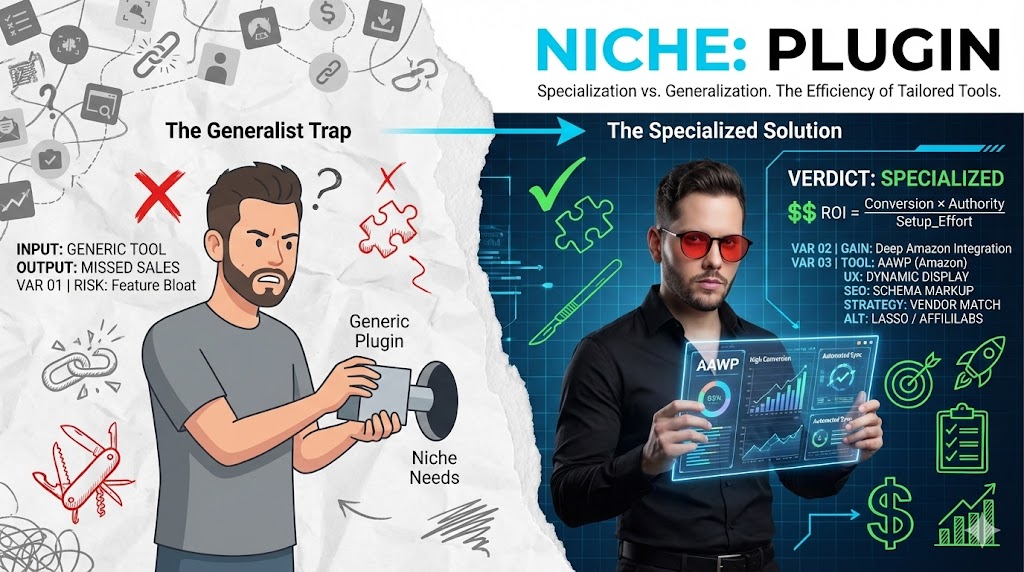
Choosing the Right Affiliate Plugin for Niche Sites
It depends significantly on your niche and monetization strategy. While Content Egg offers broad integration, the ‘best’ alternative is highly situational, demanding a careful match between plugin capabilities and your site’s specific needs.
- Strongest Advantage: Specialized alternatives often provide deeper integration and superior features for specific platforms (e.g., Amazon, custom product feeds).
- Biggest Limitation: Over-reliance on a single plugin can limit future flexibility or introduce vendor lock-in, especially with niche-specific tools.
- Concrete Use Case: A niche site primarily monetizing through Amazon Associates will find AAWP more efficient and feature-rich than Content Egg for Amazon-specific displays.
Content Egg vs. AAWP: A Niche Site Showdown
| Criterion | Content Egg | AAWP |
|---|---|---|
| Primary Use Case | Multi-vendor affiliate marketing, price comparisons, diverse product feeds. | Deep integration and optimization for Amazon Associates program. |
| Strengths | Broad data source support, flexible content modules, price tracking, comparison tables. | Superior Amazon product displays, geo-targeting, caching, high conversion rates for Amazon links. |
| Limitations | Can be complex to configure for specific platforms; Amazon features might be less refined than dedicated plugins. | Limited to Amazon Associates; not suitable for multi-vendor or direct affiliate program integration. |
Why Specialized Affiliate Plugins Are Crucial for Niche Sites
Niche sites thrive on authority and relevance, making the choice of an affiliate plugin a critical decision that impacts both user experience and monetization potential. Generic solutions often fall short, lacking the specific features required to effectively display products, track prices, or manage links in a way that resonates with a highly targeted audience. A specialized plugin can significantly enhance the presentation of affiliate products, ensuring they integrate seamlessly with your content and provide genuine value to your readers.
The right plugin goes beyond merely inserting links; it offers functionalities like dynamic product boxes, comparison tables, and automated price updates, which are essential for building trust and driving conversions in competitive niches. Without these specialized tools, niche sites risk appearing unprofessional or providing outdated information, both of which can quickly erode reader confidence and negatively impact affiliate earnings. Investing in a tailored solution is an investment in the long-term viability and profitability of your niche site.
- Enhanced User Experience: Dynamic product displays and comparison tables improve engagement.
- Increased Conversion Rates: Optimized calls-to-action and up-to-date pricing build trust.
- Time Savings: Automation of price tracking and link updates reduces manual effort.
- Competitive Edge: Professional presentation sets your site apart from less sophisticated competitors.
Affiliate Plugin: A WordPress plugin designed to streamline the management, display, and optimization of affiliate links and products on a website, often integrating with various affiliate programs or data sources to automate content generation and tracking.
Understanding Content Egg’s Core Strengths and Limitations
Content Egg has established itself as a versatile WordPress plugin, particularly favored by niche site owners who need to integrate products from a wide array of affiliate programs. Its primary strength lies in its ability to pull data from numerous sources, including Amazon, eBay, ShareASale, and many others, allowing for the creation of rich, dynamic content like product lists, comparison tables, and price drop alerts. This broad compatibility makes it an attractive option for sites that don’t exclusively rely on a single affiliate network.
However, Content Egg’s versatility can also be a source of its limitations. While it supports many data sources, the depth of integration for any single platform might not match that of a dedicated, niche-specific plugin. For instance, its Amazon features, while robust, may not offer the same level of granular control or conversion-optimized display options as AAWP. Furthermore, the sheer number of options can sometimes lead to a steeper learning curve for new users, potentially causing initial setup complexities for those unfamiliar with its extensive feature set.
- Strengths:
- Multi-Vendor Support: Integrates with numerous affiliate networks and data sources.
- Dynamic Content Modules: Creates product boxes, lists, and comparison tables.
- Price Tracking: Monitors and updates product prices automatically.
- Limitations:
- Configuration Complexity: Can be challenging to set up for optimal performance across all integrations.
- Platform-Specific Depth: May lack advanced features found in dedicated plugins for specific networks.
- Performance Overhead: Extensive features can sometimes impact site loading speed if not optimized.
Pros of Using Specialized Affiliate Plugins
- Boosts Niche Authority: Professional product displays and accurate data establish your site as a reliable resource.
- Maximizes Earnings: Optimized link placement and conversion-focused features lead to higher click-through rates and sales.
- Saves Valuable Time: Automation of price updates, link generation, and product data fetching frees up content creation time.
Cons of Relying on Affiliate Plugins
- Potential Performance Impact: Feature-rich plugins can sometimes slow down site loading speeds if not properly configured.
- Learning Curve: Advanced functionalities often require time to master, delaying initial setup and deployment.
- Dependency on Plugin Updates: Compatibility issues or lack of support can disrupt affiliate operations if the plugin is abandoned.
Key Features to Prioritize in an Alternative
When seeking an alternative to Content Egg, identifying the most crucial features for your niche site is paramount. Beyond basic link insertion, consider plugins that offer advanced display options such as customizable product boxes, comparison tables, and dynamic lists that automatically update with current pricing and availability. The ability to tailor these displays to match your site’s branding and content style is essential for maintaining a cohesive user experience and maximizing conversions.
Another critical aspect is the plugin’s integration capabilities. Does it support the specific affiliate networks you primarily use? Look for robust API integrations that ensure reliable data fetching and real-time updates. Features like geo-targeting for international audiences, advanced caching to improve site speed, and comprehensive analytics to track performance are also highly valuable. Prioritizing these elements will ensure the alternative plugin truly enhances your affiliate strategy rather than just replacing an existing tool.
- Customizable Product Displays: Tailor boxes, lists, and tables to your site’s aesthetic.
- Real-time Data Updates: Ensure prices, availability, and product information are always current.
- API Integration Depth: Strong connections to your primary affiliate networks for reliability.
- Performance Optimization: Caching mechanisms and lightweight code to prevent site slowdowns.
- Geo-Targeting: Direct international visitors to their local Amazon or affiliate store.
Insider Tip
Before committing to a new affiliate plugin, always check its documentation for API limitations and update frequency. A plugin that consistently updates its integrations is crucial for long-term stability and compliance with evolving affiliate program rules.
AAWP: The Go-To for Amazon-Centric Niche Sites
For niche sites that primarily monetize through the Amazon Associates program, AAWP (Amazon Affiliate WordPress Plugin) stands out as a superior alternative to Content Egg due to its deep and highly optimized integration with Amazon’s API. AAWP excels at creating visually appealing and conversion-focused Amazon product displays, including dynamic text links, product boxes, bestseller lists, and new release lists. Its strength lies in its ability to leverage Amazon’s data effectively, ensuring that product information, images, and prices are always up-to-date and accurate, which is vital for maintaining reader trust.
Beyond its display capabilities, AAWP offers advanced features specifically designed for Amazon affiliates, such as geo-targeting, which automatically redirects international visitors to their respective Amazon storefronts, maximizing global earnings. It also includes robust caching mechanisms to prevent API request limits and improve site performance, a common concern for sites with many affiliate products. While its scope is limited to Amazon, for dedicated Amazon niche sites, AAWP’s specialized functionalities often lead to higher conversion rates and a more streamlined management experience compared to broader solutions.
- Amazon-Specific Optimization: Tailored features for Amazon Associates program.
- Dynamic Product Displays: Bestseller lists, new releases, and customizable product boxes.
- Geo-Targeting: Automatic redirection for international visitors.
- Performance Caching: Reduces API calls and improves page load times.
- High Conversion Focus: Designed to maximize Amazon affiliate earnings.
Affiliate Link Performance
Studies indicate that visually appealing product boxes and comparison tables can increase click-through rates by up to 30-50% compared to plain text links, significantly impacting overall affiliate revenue for niche sites.
Lasso: Beyond Amazon, Comprehensive Link Management
Lasso emerges as a powerful Content Egg alternative for niche sites seeking comprehensive affiliate link management that extends far beyond Amazon. While it offers excellent Amazon integration, Lasso’s core strength lies in its ability to centralize and optimize all affiliate links, regardless of the program or vendor. It provides visually engaging display boxes for products, services, and resources, making it easy to showcase recommendations in a conversion-friendly format. This holistic approach to link management helps site owners maintain consistency and control across their entire affiliate portfolio.
One of Lasso’s standout features is its ability to find existing unmonetized keywords on your site and suggest relevant affiliate links, turning missed opportunities into revenue. It also includes robust link health monitoring, broken link detection, and automatic keyword linking, significantly reducing the manual effort involved in maintaining a large affiliate presence. For niche sites with diverse income streams and a need for advanced link organization and optimization, Lasso offers a compelling solution that streamlines workflows and enhances monetization potential across multiple platforms.
- Centralized Link Management: Organizes all affiliate links in one dashboard.
- Opportunity Discovery: Identifies unmonetized keywords for link insertion.
- Link Health Monitoring: Detects broken links and redirects automatically.
- Customizable Display Boxes: Visually appealing product and resource showcases.
- Multi-Vendor Support: Integrates well with various affiliate networks, not just Amazon.
Warning: Over-Optimization Trap
A critical mistake to avoid is over-optimizing for affiliate links at the expense of user experience. Stuffing content with too many product boxes or links can make your site appear spammy and erode reader trust, ultimately harming your long-term affiliate success.
AffiliLabs.ai: Automating Affiliate Content Generation
For niche site owners grappling with content creation and the manual effort of affiliate link integration, AffiliLabs.ai presents a modern, AI-powered alternative that goes beyond traditional plugin functionalities. Instead of just managing links, AffiliLabs.ai focuses on automating the generation of high-quality, SEO-optimized affiliate content, complete with product descriptions, comparisons, and strategically placed links. This approach can dramatically reduce the time and resources required to scale content production, making it an attractive option for rapidly expanding niche sites.
The platform aims to streamline the entire affiliate content workflow, from keyword research and article generation to the intelligent insertion of relevant affiliate products and links. By leveraging artificial intelligence, AffiliLabs.ai helps ensure that content is not only engaging but also optimized for conversions and search engine visibility. For those looking to significantly boost their content output while maintaining quality and affiliate monetization, AffiliLabs.ai offers a forward-thinking solution that complements or even replaces some aspects of traditional affiliate plugins.
- AI-Powered Content Generation: Automates creation of affiliate articles and reviews.
- Intelligent Link Insertion: Strategically places affiliate links within generated content.
- SEO Optimization: Creates content designed for search engine visibility.
- Scalability: Enables rapid expansion of content for growing niche sites.
- Time Efficiency: Significantly reduces manual content creation and linking efforts.
Evaluating Multi-Vendor Support and Data Sources
The extent of multi-vendor support and the variety of data sources a plugin integrates with are crucial considerations for niche sites that diversify their income streams beyond a single affiliate program. While Content Egg excels in this area by offering connections to numerous networks and product feeds, alternatives must be evaluated on how effectively they handle multiple data inputs. A plugin that can seamlessly pull product information from various APIs, such as Amazon, eBay, ShareASale, or even custom CSV feeds, provides immense flexibility and reduces the need for multiple, disparate tools.
Beyond the sheer number of integrations, assess the quality and reliability of these data sources. Does the plugin consistently update product information, including prices, stock levels, and descriptions, in real-time or near real-time? Outdated information can severely damage user trust and lead to lost sales. Furthermore, consider how the plugin manages data conflicts or duplicates when pulling from multiple sources for the same product. A robust alternative will offer clear mechanisms for prioritizing or merging data, ensuring accuracy and consistency across your site.
- Number of Integrations: How many affiliate networks and data sources are supported?
- Data Freshness: Real-time or frequent updates for prices and availability.
- API Reliability: Stable connections to prevent data fetching errors.
- Data Conflict Resolution: Mechanisms for handling duplicate or conflicting product information.
- Custom Feed Support: Ability to integrate with unique or proprietary product data.
Performance and Site Speed Considerations
In the competitive landscape of niche sites, site speed is not just a technical detail; it’s a critical factor influencing user experience, SEO rankings, and ultimately, affiliate conversions. Feature-rich affiliate plugins, while powerful, can sometimes introduce performance overhead due to extensive scripts, database queries, or frequent external API calls. When evaluating alternatives to Content Egg, it’s imperative to consider how each plugin impacts your site’s loading times and overall responsiveness.
Look for plugins that are built with performance in mind, incorporating features like efficient caching mechanisms for product data, deferred loading of scripts, and optimized image handling. A plugin that minimizes its footprint on your server resources and reduces the number of external requests will contribute positively to your site’s speed. Prioritizing performance ensures that your carefully crafted affiliate content loads quickly, providing a smooth experience for visitors and preventing them from bouncing due to slow page loads, which can directly impact your affiliate earnings.
- Caching Mechanisms: Reduces API calls and speeds up data retrieval.
- Lightweight Codebase: Minimizes script size and impact on page load.
- Optimized Image Handling: Prevents large product images from slowing down the site.
- Asynchronous Loading: Loads plugin elements without blocking critical rendering path.
- Database Efficiency: Optimized queries to prevent server strain.
Insider Tip
Regularly test your site’s speed using tools like Google PageSpeed Insights or GTmetrix, especially after installing or updating an affiliate plugin. Pay attention to the impact on Core Web Vitals, as these directly influence SEO and user experience.
User Experience and Ease of Integration
The user experience (UX) of an affiliate plugin, both for the site owner and the end-user, is a significant differentiator among Content Egg alternatives. For the site owner, an intuitive interface and straightforward integration with WordPress are crucial for efficient workflow. A plugin that requires extensive coding knowledge or complex shortcode manipulation can quickly become a bottleneck, especially for those without a development background. Look for drag-and-drop builders, clear settings panels, and well-documented features that simplify the process of adding and managing affiliate content.
Equally important is the end-user experience. The plugin should enable you to present affiliate products in a clean, professional, and non-intrusive manner. Displays should be responsive across all devices, ensuring a consistent experience whether visitors are on desktop or mobile. Cluttered layouts, broken images, or slow-loading elements can deter potential buyers. Prioritizing ease of integration and a polished user interface ensures that your affiliate content enhances, rather than detracts from, your niche site’s overall quality and appeal.
- Intuitive Admin Interface: Easy navigation and clear settings for site owners.
- Seamless WordPress Integration: Works well with themes and other plugins without conflicts.
- Visual Builders: Simplifies creation of product boxes and comparison tables.
- Responsive Design: Ensures displays look good on all devices (desktop, tablet, mobile).
- Clear Documentation & Support: Resources to help resolve issues quickly.
Pricing Models and Long-Term Value
Understanding the pricing models of Content Egg alternatives is essential for budgeting and assessing the long-term value for your niche site. While some plugins offer a one-time purchase, many have moved to subscription-based models, which often include ongoing updates and support. Evaluate whether the cost aligns with your projected affiliate earnings and the features provided. A cheaper plugin might seem appealing initially, but if it lacks critical features or receives infrequent updates, it could prove more expensive in terms of lost conversions or maintenance headaches down the line.
Beyond the sticker price, consider the total cost of ownership. Does the plugin require additional add-ons for essential features, or is everything included in the base price? What are the renewal costs, and do they increase significantly? Assess the plugin’s track record for consistent updates and customer support, as these factors contribute significantly to its long-term value. A slightly higher investment in a robust, well-supported plugin can often yield a much greater return through improved performance, reliability, and increased affiliate revenue for your niche site.
- Subscription vs. One-time Purchase: Understand the recurring cost implications.
- Feature Inclusions: What’s included in the base price versus requiring add-ons.
- Renewal Costs: Anticipate future expenses and potential price increases.
- Update Frequency: Regular updates ensure compatibility and new features.
- Customer Support Quality: Responsive and helpful support is invaluable for troubleshooting.
Affiliate Plugin ROI
For many niche sites, a well-chosen affiliate plugin can generate an ROI of over 500% within the first year by significantly boosting conversion rates and automating tedious tasks, justifying the initial investment.
Avoiding Common Mistakes in Plugin Selection
Selecting an affiliate plugin for your niche site can be fraught with potential missteps that lead to wasted time, money, and missed opportunities. One common mistake is choosing a plugin solely based on its price, overlooking critical features or the quality of its support. A seemingly cheap solution might lack essential integrations, lead to site performance issues, or become obsolete due to a lack of updates, costing more in the long run through lost revenue and manual workarounds.
Another frequent error is failing to test the plugin thoroughly in a staging environment before deploying it on a live site. Compatibility issues with your theme or other plugins can arise, leading to broken layouts or functionality. Furthermore, many site owners neglect to consider the plugin’s scalability. What works for a small site with a few dozen products might buckle under the weight of thousands of items as your niche site grows. Prioritizing robust features, reliable support, and future scalability will help you avoid these pitfalls and make a more informed decision.
- Price-Only Decision: Ignoring features, support, and long-term value for a lower upfront cost.
- Lack of Staging Testing: Deploying directly to live site without checking for conflicts.
- Ignoring Scalability: Choosing a plugin that cannot handle future growth in products or traffic.
- Poor Documentation: Opting for a plugin with unclear instructions or limited help resources.
- Vendor Lock-in: Selecting a plugin that makes it difficult to migrate data if you decide to switch.
The Niche Site’s Conversion Breakthrough
The trap: A growing tech review niche site was using basic text links and manually updated product tables, leading to low click-through rates and outdated pricing, eroding reader trust.
The win: By switching to a specialized Amazon affiliate plugin (AAWP) and integrating AffiliLabs.ai for automated content, they saw a 45% increase in affiliate revenue within six months, driven by dynamic product boxes, accurate pricing, and a consistent stream of fresh, optimized content.
Future-Proofing Your Affiliate Content Strategy
In the ever-evolving world of affiliate marketing and SEO, future-proofing your content strategy is paramount for the sustained success of your niche site. This means selecting an affiliate plugin that is not only robust today but also adaptable to future changes in affiliate program rules, search engine algorithms, and user expectations. A key aspect of this is choosing a plugin from a reputable developer with a strong track record of consistent updates and active development, ensuring it remains compatible with the latest WordPress versions and industry standards.
Consider plugins that offer flexibility in how you display and manage your affiliate content, allowing you to easily adjust to new trends or pivot your monetization strategy if needed. This includes support for various content types, easy integration with other marketing tools, and the ability to export your data if you ever decide to switch platforms. By prioritizing adaptability and long-term viability in your plugin choice, you can build a resilient affiliate business that can weather changes and continue to generate revenue for years to come.
- Active Development: Choose plugins with regular updates and feature enhancements.
- API Compliance: Ensures adherence to affiliate program rule changes.
- Data Portability: Ability to export your affiliate data for migration.
- Content Type Flexibility: Supports various display formats for future adaptability.
- Integration Ecosystem: Compatibility with other essential WordPress plugins and tools.
“The only constant in affiliate marketing is change. Your tools must be as agile as your strategy.”
— Sarah Miller, Digital Marketing Strategist
When to Consider a Custom Solution or Hybrid Approach
While off-the-shelf affiliate plugins offer immense value, there are specific scenarios where a niche site might benefit from considering a custom solution or a hybrid approach. If your monetization