Facebook Affiliate Marketing: Stop Wasting Time, Start Earning Commissions
The Hard Truth About Facebook Affiliate Success
Directly dropping CJ affiliate links on Facebook is a losing game. Facebook’s algorithms and user experience priorities actively suppress raw affiliate links, leading to account restrictions, wasted effort, and zero commissions. The only viable strategy involves a compliant, value-driven bridge page and a sophisticated understanding of Facebook’s ad policies.
- Avoids immediate account bans and link suppression.
- Builds a sustainable, compliant affiliate business.
- Converts curious clicks into paying customers.
Forget the fantasy of pasting a raw ClickBank or CJ Affiliate link directly onto a Facebook post and watching the money roll in. That strategy is dead. Facebook isn’t a free-for-all billboard for your affiliate offers; it’s a meticulously controlled ecosystem designed to keep users on its platform, not send them off to external sales pages. Attempting to circumvent this reality with direct links is a surefire way to get your content buried, your account flagged, and your efforts utterly wasted. The game has changed, and if you’re not playing by the new rules, you’re not playing at all.
The truth is, Facebook actively penalizes direct affiliate links. Their algorithms are sophisticated enough to detect them, and their policies are clear: they prioritize user experience over your quick commission grab. This isn’t about being ‘fair’; it’s about Facebook protecting its platform and its advertisers. So, if you’re serious about leveraging the immense traffic potential of Facebook for your CJ Affiliate campaigns, you must abandon the amateur tactics and embrace a more strategic, compliant, and ultimately, profitable approach. Anything less is just burning time and goodwill.
Facebook’s Affiliate Iron Curtain: Why Direct Linking is a Death Sentence
The biggest mistake aspiring Facebook affiliates make is believing they can simply copy-paste a CJ Affiliate link and expect results. This isn’t 2010. Facebook’s content moderation and algorithm have evolved into a formidable barrier, an ‘iron curtain’ specifically designed to filter out low-value, spammy content – which, unfortunately, often includes direct affiliate links. When you bypass the necessary steps, you’re not just risking poor performance; you’re inviting immediate suppression, shadow-banning, or even permanent account termination. This isn’t a suggestion; it’s a stark warning from anyone who’s seen countless accounts vanish overnight.
Consider the user experience: nobody comes to Facebook to be sold to directly in their news feed. They’re there for connection, entertainment, and information. A raw affiliate link screams ‘sales pitch’ and offers no immediate value. Facebook’s system recognizes this pattern and acts accordingly, pushing your content into oblivion. This isn’t a bug; it’s a feature. To succeed, you must understand that Facebook is not a direct sales channel for affiliate products. It’s a traffic source, a place to capture interest and redirect it strategically. Ignoring this fundamental principle is the fastest route to affiliate failure on the platform.
The Bridge Page Blueprint: Your Only Path to Profit on Facebook
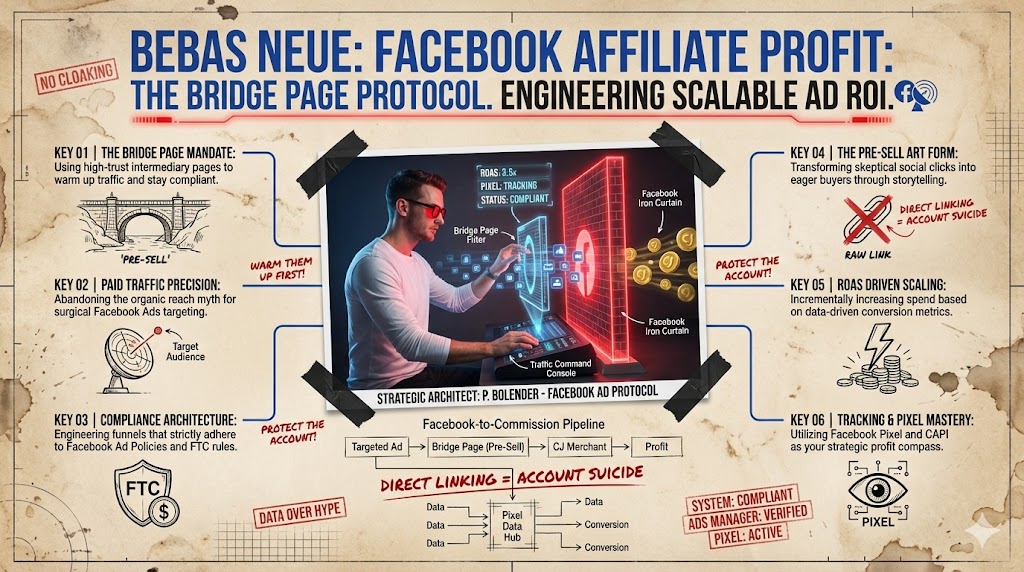
If direct linking is suicide, then the bridge page is your lifeline. This isn’t optional; it’s mandatory. A bridge page acts as an intermediary between your Facebook content and the vendor’s offer page. Its primary purpose is to pre-sell the product, build rapport, and warm up the traffic before sending them to the final destination. Think of it as a crucial filter: it educates, persuades, and qualifies your audience, ensuring that only genuinely interested prospects click through to the affiliate link. This strategy not only improves conversion rates but, more importantly, keeps you compliant with Facebook’s stringent policies.
Building an effective bridge page requires strategic thinking, not just throwing up a quick landing page. It needs compelling copy that addresses pain points, highlights benefits, and creates desire. It should include clear calls to action, but without the aggressive sales language often found on vendor pages. Crucially, your bridge page must also host your affiliate disclosure prominently, fulfilling FTC requirements and building trust with your audience. This isn’t about tricking Facebook; it’s about providing value and context, making the transition from social media to sales funnel seamless and legitimate. Without a solid bridge page, you’re just sending cold traffic to a cold offer, a recipe for disaster.
Mastering Facebook’s Algorithm: Organic Reach is a Myth, Unless…
Let’s be brutally honest: relying on organic reach for affiliate marketing on Facebook is a pipe dream for most. The algorithm is designed to prioritize content from friends and family, and highly engaging posts from pages. Affiliate links, even wrapped in a bridge page, rarely achieve the viral traction needed to generate significant commissions organically. If your strategy hinges on free traffic from your Facebook page or group, prepare for disappointment. The platform has systematically throttled organic reach for business pages over the years, making it incredibly difficult to get your content seen without paying for it. This isn’t a conspiracy; it’s a business model.
However, there’s a nuanced exception: highly engaged, niche communities. If you’ve spent years building a genuine, active Facebook group around a specific passion, and you consistently provide immense value, then strategically placed, compliant bridge page links *might* generate some organic traction. But this is the exception, not the rule. For 99% of affiliates, chasing organic reach for direct sales is a fool’s errand. Your time is better spent understanding how to leverage Facebook’s *paid* advertising platform, where you can control visibility and target your audience with precision. Stop hoping for a miracle; start investing in a proven strategy.
Paid Traffic Power Play: Dominating Facebook Ads for CJ Offers
This is where the real money is made. If you want consistent, scalable results with CJ Affiliate offers on Facebook, you must embrace paid advertising. Facebook Ads Manager provides unparalleled targeting capabilities, allowing you to reach specific demographics, interests, and behaviors that are most likely to convert. This isn’t about throwing money at the wall; it’s about precision marketing. By running targeted ad campaigns that drive traffic to your compliant bridge page, you bypass the organic reach limitations and put your offers directly in front of the right eyes. This is the unfair advantage that separates serious affiliates from the hobbyists.
However, running Facebook Ads for affiliate offers isn’t a set-it-and-forget-it operation. It requires continuous optimization, A/B testing of ad creatives, headlines, and landing page elements. You need to understand your metrics: click-through rates, conversion rates, cost per click, and return on ad spend. Without this data-driven approach, you’re just gambling. The power of Facebook Ads lies in its ability to scale. Once you find a winning campaign, you can increase your budget and exponentially grow your commissions. But remember, the foundation is always a compliant bridge page and a deep understanding of Facebook’s ad policies, which are notoriously strict for affiliate marketing.
Compliance or Catastrophe: Navigating Facebook’s Ad Policies and FTC Demands
Ignoring Facebook’s ad policies and the FTC’s disclosure requirements is not just risky; it’s a direct path to catastrophe. Facebook has zero tolerance for advertisers who violate their terms, especially concerning misleading claims, prohibited content, or circumventing their review process. Affiliate marketers are often under intense scrutiny because of past abuses. Your ads must be truthful, transparent, and accurately represent the product. Any hint of clickbait, exaggerated claims, or deceptive practices will trigger an immediate ad rejection, account suspension, or worse, a permanent ban. This isn’t a game where you can bend the rules; you must play by them, or you’re out.
Beyond Facebook’s rules, the Federal Trade Commission (FTC) mandates clear and conspicuous disclosures for any affiliate relationship. This means your audience must know that you receive a commission if they purchase through your link. Burying a disclosure in tiny text or on a separate page that’s hard to find is not compliant. Your disclosure needs to be prominent on your bridge page, ideally above the fold, and even within your Facebook ad copy if space allows. Failure to comply with FTC guidelines can result in hefty fines and legal action, making your affiliate dreams a nightmare. Prioritize compliance over short-term gains; it’s the only way to build a sustainable business.
The Art of Pre-Selling: Turning Cold Traffic into Commission Gold
Pre-selling isn’t just a tactic; it’s an art form that transforms skeptical clicks into eager buyers. When traffic arrives from Facebook, they are typically ‘cold’ – meaning they have little to no prior knowledge or trust in you or the product. Your bridge page’s role is to warm them up, to bridge that gap between curiosity and conversion. This involves crafting compelling narratives, highlighting specific benefits that resonate with your target audience, and addressing potential objections *before* they even think of them. A well-executed pre-sell makes the vendor’s sales page feel like a natural, logical next step, not a jarring commercial interruption.
Effective pre-selling means understanding the psychology of your prospect. What problem are they trying to solve? What desires drive them? Your content should speak directly to these points, positioning the affiliate product as the ultimate solution. This isn’t about hype; it’s about genuine value proposition. By providing insightful information, testimonials, or even a mini-review, you build credibility and trust. This trust is the currency of affiliate marketing. Without it, you’re just another voice in the noise. Master the art of pre-selling, and you’ll see your conversion rates soar, turning otherwise cold traffic into consistent commission gold.
Tracking Beyond the Click: The Data That Fuels Real Affiliate Empires
Any affiliate who isn’t meticulously tracking their campaigns is flying blind, and that’s a recipe for financial ruin. Simply knowing how many clicks your CJ Affiliate link gets is utterly insufficient. You need to understand the entire user journey: where the clicks came from, which ads generated sales, what demographic responded best, and crucially, your return on ad spend (ROAS). This isn’t optional; it’s the bedrock of any profitable affiliate business. Without granular data, you can’t optimize, you can’t scale, and you’re leaving money on the table, guaranteed.
Implementing robust tracking involves more than just the basic CJ Affiliate reporting. You need to integrate Facebook Pixel on your bridge page to track conversions, initiate events, and build custom audiences for retargeting. UTM parameters are essential for understanding traffic sources. Server-side tracking (like Facebook’s Conversions API) is becoming increasingly vital to combat privacy changes and ensure data accuracy. The affiliates who win are the ones who treat data as their most valuable asset, constantly analyzing, testing, and refining their campaigns based on what the numbers tell them. Stop guessing; start measuring. That’s how you build an empire, not just a side hustle.
| Strategy | Facebook Compliance | Conversion Potential |
|---|---|---|
| Direct CJ Link Post | Extremely Low (High Risk) | Near Zero |
| Organic Post to Bridge Page | Medium (Low Reach) | Low to Medium |
| Paid Ad to Bridge Page | High (If Compliant) | High (Scalable) |
Scaling Smart, Not Spamming: Expanding Your CJ Reach Without Getting Banned
The temptation to scale fast by spamming multiple groups or creating numerous low-quality ads is a trap that will get you banned faster than you can say ‘commission.’ True scaling isn’t about volume; it’s about efficiency and precision. Once you’ve identified a winning ad creative, a high-converting bridge page, and a profitable audience segment, scaling means incrementally increasing your ad spend while closely monitoring your key performance indicators. It’s a delicate balance: push too hard, too fast, and your costs will skyrocket, or Facebook’s algorithms will flag your sudden, aggressive behavior. Smart scaling is a gradual, data-driven process.
Furthermore, smart scaling involves diversifying your ad creatives and targeting. Don’t put all your eggs in one basket with a single ad. Continuously test new images, videos, headlines, and ad copy to prevent ad fatigue and discover new winning combinations. Expand your audience targeting to similar demographics and interests, but always with a controlled budget. This methodical approach allows you to expand your reach without triggering Facebook’s spam filters or diluting your profitability. Remember, sustainable growth trumps explosive, short-lived gains every single time in affiliate marketing.
Diversification is Survival: Why Facebook Can’t Be Your Only Affiliate Channel
Relying solely on Facebook for your CJ Affiliate traffic is akin to building your house on quicksand. While Facebook offers immense potential, it’s also a volatile platform. Policy changes, algorithm updates, and unexpected account bans can wipe out your entire business overnight. This isn’t hypothetical; it happens constantly. A smart affiliate understands that diversification is not just a good idea; it’s a survival imperative. You need multiple traffic sources to mitigate risk and ensure consistent income, even if one channel experiences a downturn or outright failure.
Think beyond Facebook. Explore other paid traffic platforms like Google Ads, TikTok Ads, or native advertising networks. Invest in building an email list, which is an asset you truly own and control. Develop content marketing strategies through blogging or YouTube to generate organic traffic that isn’t beholden to social media algorithms. The goal is to create a robust ecosystem of traffic generation, where the loss of one channel doesn’t mean the end of your business. True affiliate strategists build resilient models, not fragile dependencies. Your future depends on it.
Future-Proofing Your Funnel: Adapting to Social Media’s Relentless Evolution
The digital landscape, especially social media, is in a constant state of flux. What works today might be obsolete tomorrow. Algorithms shift, user behaviors change, and new platforms emerge. To future-proof your CJ Affiliate funnel, you must cultivate a mindset of continuous learning and adaptation. Sticking to outdated strategies is a guaranteed path to irrelevance. This means staying informed about industry trends, experimenting with new ad formats, and being willing to pivot when a strategy stops delivering results. The most successful affiliates aren’t just good at marketing; they’re masters of adaptation.
This relentless evolution also means investing in your skills and tools. Learn advanced analytics, master new ad platforms, and stay updated on compliance regulations. Build relationships with other successful affiliates to share insights and strategies. Your affiliate business isn’t a static entity; it’s a living, breathing system that requires constant nurturing and adjustment. Those who embrace change and proactively seek out new opportunities will thrive. Those who resist will be left behind, watching their commissions dwindle. Adapt or die – that’s the brutal reality of affiliate marketing on social media.
The Unforgiving Reality of Facebook’s Policy Enforcement
Many affiliates underestimate the severity and speed of Facebook’s policy enforcement. It’s not a gentle slap on the wrist; it’s often an immediate, irreversible ban. Facebook’s automated systems, backed by human review, are constantly scanning for violations. If you’re caught trying to sneak direct affiliate links past them, or using deceptive ad copy, your account can be shut down without warning, taking all your campaigns and data with it. There’s often no appeal, no second chance. This isn’t a platform where you can learn by breaking the rules; the cost of failure is simply too high.
The unforgiving reality means that proactive compliance is your best defense. Understand every line of Facebook’s advertising policies. Review your ad creatives and landing pages with a critical eye, imagining how a strict Facebook reviewer would interpret them. Err on the side of caution, always. The affiliates who thrive on Facebook are not the ones who push the boundaries, but the ones who master the rules and innovate within them. Anything less is a gamble you simply cannot afford to lose.
📋 Your Facebook Affiliate Profit Blueprint
- ✓Build a Compliant Bridge Page: This is non-negotiable. Pre-sell the offer, provide value, and host your FTC disclosure prominently.
- ✓Master Facebook Ads: Focus on targeted paid traffic. Organic reach for direct affiliate sales is a myth for most.
- ✓Implement Robust Tracking: Use Facebook Pixel, UTMs, and server-side tracking to understand your data and optimize.
- ✓Prioritize Policy Compliance: Adhere strictly to Facebook’s ad policies and FTC disclosure requirements to avoid bans.
- ✓Diversify Your Traffic Sources: Never rely on a single platform. Build an email list and explore other paid and organic channels.
- ✓Embrace Continuous Testing: The digital landscape changes constantly. Always be testing new creatives, audiences, and strategies.
Common Affiliate Objections Debunked
Can’t I just use a link shortener to hide my CJ link?
Absolutely not. Facebook’s algorithms are far too sophisticated for simple link shorteners. They can detect the final destination of the link, regardless of how many redirects are in between. This tactic is a red flag for their system and will likely lead to immediate suppression or a ban. It’s a short-sighted approach that offers no real protection and only increases your risk.
Is it really necessary to build a bridge page? It seems like extra work.
It’s not ‘extra work’; it’s foundational work for sustainable success. A bridge page is essential for compliance, pre-selling, and building trust. Without it, you’re sending cold traffic directly to a sales page, which rarely converts, and you’re violating Facebook’s terms, risking your entire operation. Consider it a mandatory investment, not an optional step.
What if I only use organic posts in Facebook groups? Is that safer?
While posting in groups *might* offer a slightly longer leash than direct page posts, it’s still a precarious strategy. Most groups have strict rules against self-promotion and affiliate links. Even if you manage to post, organic reach is minimal, and you’re still at the mercy of group admins and Facebook’s detection. It’s not a scalable or reliable path to consistent commissions.
How much budget do I need to start with Facebook Ads for CJ offers?
You don’t need a fortune, but you need enough to gather meaningful data. Start with a modest daily budget, perhaps $10-$20, and run campaigns for at least 3-5 days to collect enough data for optimization. Don’t expect immediate profits; the initial spend is an investment in learning what works for your specific offer and audience. Scale up only when you see positive ROAS.
Can I promote any CJ Affiliate product on Facebook Ads?
No. Facebook has strict policies on prohibited content, including certain health supplements, financial products, and anything that makes misleading claims. Always review both CJ Affiliate’s and Facebook’s policies for the specific product category. Promoting a prohibited product is a guaranteed way to get your ad rejected and your account suspended. Choose your offers wisely.