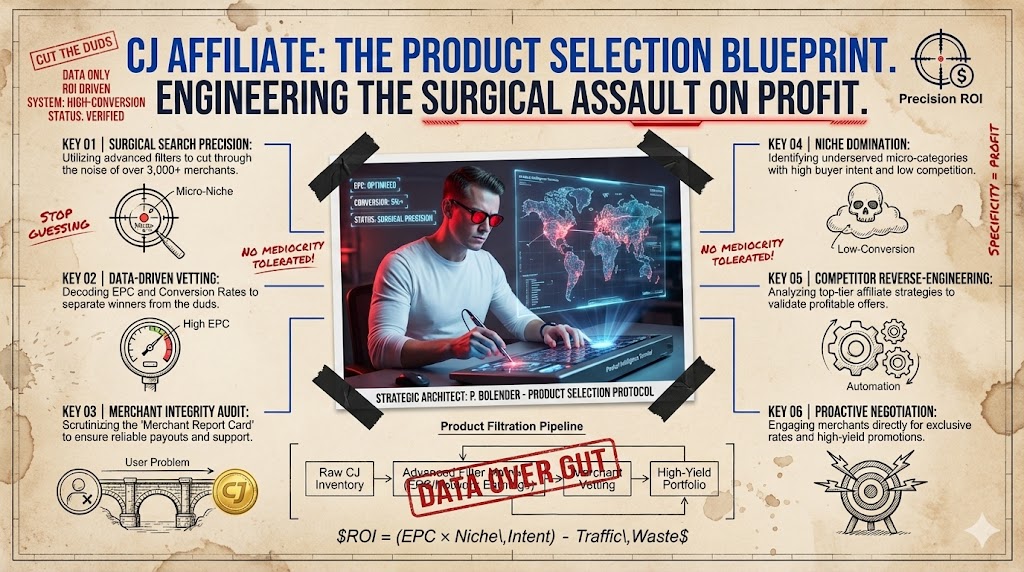
Cut the Noise: Your Direct Path to CJ Affiliate Product Profit
Forget endless scrolling and wishful thinking; finding profitable products on CJ Affiliate demands a strategic, data-driven assault. Most affiliates fumble, treating product search like a lottery. This isn’t about luck; it’s about deploying surgical precision to unearth high-converting offers that actually move the needle. Stop wasting time on dead-end promotions and start building a portfolio that generates real revenue.
- Pinpoint high-commission, high-conversion offers.
- Eliminate wasted effort on underperforming products.
- Build a resilient, profitable affiliate portfolio.
Stop Guessing: The Only Way to Find Winning Products on CJ Affiliate
Let’s get one thing straight: if your product search on CJ Affiliate feels like throwing darts in the dark, you’re already losing. The platform isn’t a playground for experimentation; it’s a battlefield where data and strategy dictate victory. Most affiliates dive in, blindly searching keywords, and wonder why their commissions barely cover their coffee budget. This isn’t about finding any product; it’s about identifying the specific, high-demand, high-profit offers that resonate with your audience and deliver undeniable ROI.
The common mistake is treating CJ’s vast inventory as a buffet. You pick what looks good, what’s trending, or what your gut tells you. That’s a recipe for mediocrity, if not outright failure. A true strategist understands that every product selection is a calculated risk, and the only way to mitigate that risk is through meticulous research, leveraging every tool CJ provides, and ruthlessly filtering out the duds before they cost you time and traffic.
CJ’s Hidden Arsenal: Mastering the Product Search Interface
The CJ Affiliate dashboard isn’t just a pretty face; it’s a powerful command center, but only if you know how to wield it. Most affiliates barely scratch the surface, typing a generic keyword and hoping for the best. That’s amateur hour. The real power lies in understanding the interface’s nuances, recognizing that each filter is a weapon in your arsenal designed to cut through the noise and reveal the true contenders. Ignore these tools at your peril; they are the difference between a scattershot approach and a laser-focused attack on profitability.
Your first move should always be to ditch the simplistic search. Instead, focus on the advanced options. Think about what your audience genuinely needs, not just what’s popular. Are they looking for solutions to specific problems? Are they in a high-intent buying cycle? The interface allows for this granularity, but it demands your attention. Treat the search bar as a scalpel, not a sledgehammer, and you’ll immediately see a higher caliber of potential products emerge from the depths of CJ’s massive database.
Beyond Keywords: Unleashing Advanced Filters for Surgical Precision
Keywords are a starting point, a mere suggestion. The real magic, the unfair advantage, comes from the advanced filters. This is where you separate the serious players from the hopefuls. Are you filtering by Category, Service Type, or even specific Countries? If not, you’re leaving money on the table. The ability to narrow down offers to a precise demographic or product type means you’re not just searching; you’re targeting. This drastically improves your conversion potential because you’re aligning offers with highly specific audience needs.
But it goes deeper. Don’t just tick boxes; understand what each filter implies for your strategy. Filtering by ‘Commission Rate’ is obvious, but what about ‘Network Earnings’ or ‘EPC’? These metrics are goldmines, indicating a product’s overall profitability and how well it converts for other affiliates. Ignoring these means you’re flying blind, potentially promoting offers that look good on paper but fail to convert in the real world. Leverage every available filter to sculpt your product list into a lean, mean, money-making machine.
The Merchant’s Report Card: Identifying Partners Who Actually Pay
A product is only as good as the merchant behind it. Many affiliates make the critical error of focusing solely on the product itself, neglecting the merchant’s track record. This is a rookie mistake that can cost you dearly. Before you commit to promoting anything, you must scrutinize the merchant’s ‘Report Card.’ Look for their reputation, payment history, and responsiveness. A high-converting product from a merchant notorious for delayed payments or poor customer service is a ticking time bomb for your business and your brand.
CJ provides metrics that give you insight into merchant performance. Pay close attention to their ‘Network Earnings’ and ‘7-Day EPC’ at the merchant level, not just the product level. These indicators reveal how well the merchant generally performs across the network. A low score here, even for a seemingly attractive product, is a massive red flag. Partner with proven winners; ditch the rest. Your time and traffic are too valuable to waste on unreliable partners.
Data Over Gut Feel: Deciphering EPC, Conversion, and Network Earnings
This is where the rubber meets the road. Forget intuition; your decisions must be forged in data. The three titans of CJ Affiliate metrics are EPC (Earnings Per Click), Conversion Rate, and Network Earnings. Most affiliates glance at these, but few truly understand their implications or how to use them to their advantage. EPC is not just a number; it’s a direct reflection of how much you can expect to earn for every click you send. A high EPC often indicates a well-optimized offer that converts effectively.
Conversion Rate tells you the percentage of clicks that turn into sales. A high conversion rate means the merchant’s landing page and offer resonate with traffic. Network Earnings, on the other hand, is a broader indicator of the merchant’s overall success on the CJ network, reflecting the total earnings generated by all affiliates. The brutal truth? You need all three to paint a complete picture. A high EPC with a low conversion rate might mean an expensive product with high commissions but poor sales funnel. A high conversion rate with low EPC could mean a cheap product with minimal payout. Balance is key; profit is the goal.
| Metric | What It Reveals | Strategic Implication |
|---|---|---|
| EPC (Earnings Per Click) | Average earnings for 100 clicks. | High EPC = Potentially high profit per visitor. Prioritize. |
| Conversion Rate | Percentage of clicks resulting in a sale. | High Conversion = Offer resonates with traffic. Good for scaling. |
| Network Earnings | Merchant’s overall success on CJ. | High Network Earnings = Reliable, popular merchant. Lower risk. |
Niche Domination: How to Unearth Untapped Product Categories
Everyone chases the obvious, the trending, the ‘hot’ products. That’s a fool’s errand. The real money isn’t in competing with thousands of other affiliates for saturated keywords; it’s in dominating specific, underserved niches. This requires a different mindset: instead of asking “What’s popular?” ask “What problem isn’t being adequately solved?” or “What specific demographic is being overlooked?” CJ’s vast inventory is a goldmine for niche products, but you have to dig deeper than the first page of results.
Think about micro-niches. Instead of “weight loss,” consider “weight loss for new mothers” or “plant-based meal prep for busy professionals.” These highly specific audiences often have a higher purchase intent and are less bombarded by generic ads. Use CJ’s advanced filters to combine categories, service types, and even geographic locations to pinpoint these opportunities. The less competition, the higher your potential ROI. This isn’t about finding a needle in a haystack; it’s about finding a smaller, richer haystack that others have ignored.
Spy Games: Reverse Engineering Competitor Product Strategies
The smartest affiliates don’t just guess; they observe. Your competitors are already doing the heavy lifting, testing products and refining their strategies. Why reinvent the wheel when you can learn from their successes and failures? This isn’t about copying; it’s about reverse engineering their product selection process to uncover what’s working in your niche. Identify top-performing affiliates in your space and analyze the products they consistently promote. If they’re pushing a specific offer hard, chances are it’s converting.
Look beyond just the product. Examine their landing pages, their content, and their calls to action. How are they positioning the product? What pain points are they addressing? This intelligence gives you a massive advantage, allowing you to validate potential products before you even send your first click. Use tools to see where their traffic goes and what offers they’re linking to. Emulate success, but always innovate to carve out your own unique angle.
The Automation Trap: Smart Tools vs. Blind Reliance in Product Discovery
In the quest for efficiency, many fall into the automation trap. They rely on tools that promise to find winning products instantly, without understanding the underlying mechanics. While automation can be a powerful ally, blind reliance is a recipe for disaster. No algorithm can fully replace human intuition, market understanding, and the nuanced analysis of affiliate metrics. Tools should augment your strategy, not dictate it.
Use product discovery tools to identify trends, track competitor activity, or monitor new offers. But always, always, cross-reference their findings with CJ’s internal data: EPC, conversion rates, and merchant reputation. A tool might flag a product as ‘trending,’ but if its EPC is abysmal on CJ, it’s a waste of your resources. Leverage technology for speed, but apply your strategic brain for accuracy. The goal is smart automation, not lazy delegation.
Fatal Flaws: Common Product Selection Mistakes That Kill Commissions
The path to affiliate riches is littered with the corpses of campaigns killed by avoidable mistakes. The most common fatal flaw? Emotional attachment to products. You might love a gadget or a service, but if the data screams ‘low conversion’ or ‘poor EPC,’ your personal preference means nothing. Your job is to generate profit, not to be a product evangelist for items that don’t convert. Detach your emotions and let the numbers guide every single decision.
Another critical error is ignoring the seasonality or trend cycles of products. Promoting winter coats in July is a guaranteed way to see zero conversions. Understanding market demand, current trends, and the lifecycle of a product is paramount. Furthermore, many affiliates fail to test. They pick a product, promote it, and then move on without A/B testing different angles, creatives, or landing pages. Testing is not optional; it’s the bedrock of optimization and the only way to truly unlock a product’s full earning potential. Stop making these amateur mistakes and start treating your affiliate business like the serious enterprise it is.
Proactive Profits: Direct Merchant Engagement for Exclusive Offers
The CJ dashboard is a starting point, but it’s not the finish line. The true veterans know that the biggest wins often come from proactive engagement with merchants. Don’t just wait for offers to appear; go out and create them. If you’ve identified a high-performing merchant, reach out directly. Express your interest, showcase your traffic quality, and negotiate for higher commission rates or exclusive promotions. Most merchants are eager to work with high-volume, quality affiliates.
This isn’t about begging; it’s about demonstrating value. Present a clear case for why a higher commission or a unique offer will benefit both parties. Highlight your audience demographics, your traffic sources, and your past performance with similar products. This direct approach can unlock opportunities that are simply not available to the average affiliate browsing the network. Forge direct relationships; they are your secret weapon in a crowded marketplace.
Portfolio Power: Building a Resilient, High-Yield Product Mix
Your affiliate product selection shouldn’t be a random assortment; it should be a carefully constructed portfolio, diversified and optimized for maximum yield. Just like a stock portfolio, you need a mix of ‘blue-chip’ stable performers, ‘growth’ products with high potential, and perhaps a few ‘speculative’ new launches. Reliance on a single product or merchant is a catastrophic risk. What happens if that offer gets pulled, or the commission rate drops overnight? Your entire income stream vanishes.
Diversification isn’t just about different products; it’s about different niches, different commission structures (e.g., lead gen, sales, recurring), and different merchant types. This creates resilience. If one segment of your portfolio underperforms, another can pick up the slack. Regularly audit your entire product mix, culling the weak and investing more heavily in the strong. Your goal is not just to find products, but to build a robust, self-sustaining ecosystem of profitable offers.
Your Next Move: Scaling Product Selection for Unstoppable Growth
Finding winning products is one battle; scaling that success is the war. Once you’ve identified your core, high-performing offers, the next step is to systematically expand your reach and optimize your promotions. This means not just finding more products, but finding more similar high-converting products within the same niche or adjacent ones. Leverage the data from your current winners to inform your future searches. What characteristics do they share? What audience segments respond best?
Scaling also involves automating parts of your research and outreach, but with a critical eye. Use tools to monitor competitor activity, track new merchant launches, and analyze market trends. But always, always, apply your strategic filter. The goal is to build a repeatable process for product discovery and integration, allowing you to consistently refresh your offers with new, profitable opportunities. Growth isn’t accidental; it’s engineered through continuous optimization and aggressive pursuit of new revenue streams.
📋 Your Product Selection Domination Plan
- ✓Master CJ’s Advanced Filters: Go beyond keywords; use category, service type, country, and performance metrics for surgical precision.
- ✓Scrutinize Merchant Performance: Prioritize partners with strong Network Earnings and reliable payment histories.
- ✓Decipher Data Ruthlessly: Focus on EPC, Conversion Rate, and Network Earnings to identify true profit potential.
- ✓Hunt for Niche Goldmines: Target underserved micro-niches for less competition and higher buyer intent.
- ✓Reverse Engineer Competitor Success: Analyze what top affiliates promote and how they position offers.
- ✓Engage Merchants Directly: Negotiate higher commissions or exclusive deals with high-performing partners.
- ✓Build a Diversified Portfolio: Never rely on a single product; spread your risk and maximize resilience.
- ✓Implement a 90-Day Performance Review: Ruthlessly cut underperforming products to optimize your portfolio.
Frequently Asked Questions About CJ Affiliate Product Selection
How often should I review my product selections on CJ Affiliate?
A quarterly review is the absolute minimum. For high-volume affiliates, a monthly or even bi-weekly check is prudent. Market conditions, merchant performance, and product trends can shift rapidly, so consistent auditing is non-negotiable for maintaining profitability. Don’t set it and forget it.
Is it better to promote many products or just a few high-performers?
Focus on a few high-performers. The “more is better” mentality is a trap that dilutes your efforts and traffic. Quality over quantity always wins. Concentrate your resources on driving targeted traffic to a select handful of offers that have proven their conversion power and profitability.
What if a high-performing product suddenly drops in conversion?
Investigate immediately. Check for changes in the merchant’s landing page, offer terms, or even competitor activity. Sometimes, it’s a temporary glitch; other times, it signals a deeper problem. Be prepared to pivot or replace the product if performance doesn’t recover quickly. Agility is key.
Can I negotiate better commission rates with CJ Affiliate merchants?
Absolutely. If you consistently deliver high-quality traffic and significant sales, you have leverage. Reach out to the merchant directly, present your performance data, and make a compelling case for a higher rate. Don’t be afraid to ask for what you’re worth; the worst they can say is no, and often, they’ll say yes.