Choosing Your Affiliate Marketing Traffic Strategy
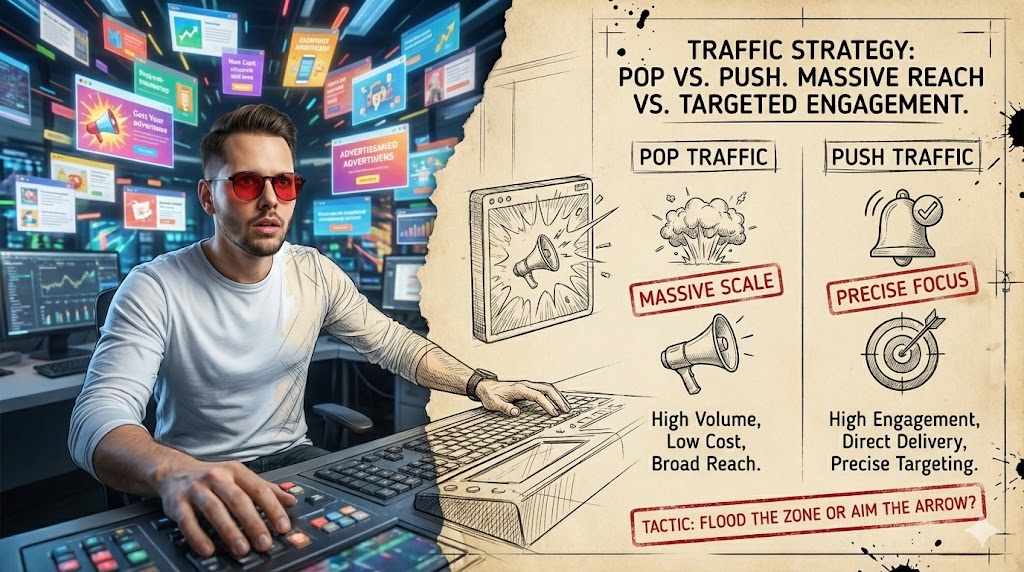
It depends on your specific campaign goals. Both Pop and Push affiliate marketing offer distinct advantages and disadvantages, making the ‘best’ choice highly situational and dependent on your budget, risk tolerance, and target audience engagement.
- Both strategies offer immense reach, but Push provides more targeted engagement.
- Pop traffic can be highly cost-effective for volume, while Push often yields higher conversion rates.
- Ideal for affiliates with a clear understanding of their offer and a willingness to test extensively.
Pop vs. Push Affiliate Marketing
| Criterion | Pop Affiliate Marketing | Push Affiliate Marketing |
|---|---|---|
| Use Case | Broad reach for mass-market offers, brand awareness, high-volume campaigns. | Targeted engagement for specific niches, lead generation, direct response offers. |
| Strengths | High traffic volume, lower cost per click (CPC), easier entry for beginners. | High engagement rates, direct audience reach, better targeting capabilities. |
| Limitations | Can be intrusive, lower engagement rates, higher fraud risk, requires extensive optimization. | Smaller traffic pools, higher CPCs, requires subscriber acquisition, potential for notification fatigue. |
What is Pop Affiliate Marketing?
Pop affiliate marketing involves displaying advertisements in new browser windows or tabs that ‘pop’ up or ‘pop’ under the user’s current browsing session. These ads are typically triggered when a user visits a website that has integrated pop ad scripts. The primary goal is to capture user attention by presenting an offer directly, often without explicit interaction from the user.
This method is renowned for its ability to deliver a vast amount of traffic at a relatively low cost, making it attractive for campaigns focused on volume rather than highly specific targeting. However, the intrusive nature of pop ads means that user engagement can be lower, and careful optimization is crucial to ensure profitability and avoid user frustration. Understanding the nuances of traffic sources and targeting options is key to success.
- Pop-up ads: Appear over the current browser window, demanding immediate attention.
- Pop-under ads: Load behind the current browser window, becoming visible only when the user closes or minimizes the active window.
- Direct navigation: Users are redirected to an offer page when they type a URL incorrectly or click a broken link.
Insider tip
When starting with pop traffic, focus on broad, high-converting offers that appeal to a wide audience. Test multiple landing pages and creative angles to quickly identify winning combinations before scaling your campaigns.
What is Push Affiliate Marketing?
Push affiliate marketing leverages push notifications, which are direct messages sent to a user’s device (desktop or mobile) even when they are not actively browsing the website that sent the notification. Users opt-in to receive these notifications, creating a highly engaged and receptive audience. This direct communication channel allows affiliates to send timely and personalized offers.
The strength of push notifications lies in their ability to bypass ad blockers and reach users directly, fostering a more personal connection than traditional display ads. This often translates to higher click-through rates (CTRs) and conversion rates, especially for offers that require immediate attention or are highly relevant to the subscriber’s interests. Building a quality subscriber list is paramount for long-term success.
- Opt-in model: Users explicitly agree to receive notifications, indicating higher interest.
- Direct delivery: Messages bypass email inboxes and social media feeds, appearing directly on the device.
- Personalization potential: Allows for highly segmented and tailored campaigns based on user behavior.
Insider tip
For push campaigns, prioritize building a segmented audience. Tailoring your offers to specific user interests and demographics within your subscriber list will significantly boost engagement and conversion rates.
Pros of Pop Affiliate Marketing
- Massive traffic volume: Provides access to millions of impressions daily, ideal for scaling.
- Lower entry barrier: Often has lower minimum bids, making it accessible for smaller budgets.
- Effective for broad offers: Works well for general products or services that appeal to a wide demographic.
Cons of Pop Affiliate Marketing
- Intrusive user experience: Can lead to user frustration and a negative perception of the ad.
- Lower engagement rates: Due to the unsolicited nature, users may be less receptive to the offer.
- Higher risk of ad fraud: Requires vigilant monitoring to filter out bot traffic and ensure quality.
Key Differences Between Pop and Push Campaigns
The fundamental distinction between Pop and Push affiliate marketing lies in how they acquire and engage users. Pop campaigns are largely interruptive, aiming for broad visibility by ‘popping’ up an ad regardless of user intent. This approach prioritizes volume and low cost per impression, often leading to a lower quality of interaction but a massive reach.
Conversely, Push campaigns are permission-based, targeting users who have explicitly opted in to receive notifications. This creates a more engaged audience, resulting in higher click-through and conversion rates. The trade-off is often a smaller, more expensive audience pool. Understanding these core differences is crucial for aligning your strategy with your campaign goals and budget.
- User Consent: Pop ads are often unsolicited, while push notifications require explicit user opt-in.
- Engagement Level: Push campaigns generally boast higher engagement due to user permission and direct delivery.
- Cost Structure: Pop traffic typically has lower CPCs but higher volume, while push traffic has higher CPCs for more qualified leads.
- Targeting Capabilities: Push offers more granular targeting based on user interests and behavior, whereas pop targeting is broader.
Engagement Rate Comparison
Industry averages suggest that push notification campaigns can achieve click-through rates (CTRs) ranging from 5% to 15%, significantly higher than the typical 0.1% to 1% for pop-under ads. This highlights the value of permission-based marketing in driving user interaction.
Advantages of Pop Affiliate Marketing
Pop affiliate marketing, despite its reputation, offers several compelling advantages for certain types of campaigns. Its most significant benefit is the sheer volume of traffic available. Advertisers can access millions of impressions daily across various geos and niches, making it an excellent choice for scaling campaigns quickly and efficiently. This broad reach can be particularly beneficial for offers with wide appeal or for building brand awareness.
Another key advantage is the relatively low cost per impression or click. Pop traffic can be significantly cheaper than other traffic sources, allowing affiliates to test a large number of offers and landing pages without exhausting their budget too quickly. This cost-effectiveness, combined with high volume, can lead to substantial profits if a winning combination is found through rigorous testing and optimization.
- High traffic volume: Access to millions of daily impressions ensures massive reach.
- Cost-effectiveness: Lower CPCs allow for extensive testing and scaling with a smaller budget.
- Broad audience reach: Ideal for offers that appeal to a general demographic or for market penetration.
Myth
Pop ads are dead and no longer effective for affiliate marketing.
Reality
While pop ads have evolved, they remain a viable and highly scalable traffic source. With careful targeting, frequency capping, and compelling landing pages, pop campaigns can still deliver significant ROI, especially for specific verticals and offers.
Disadvantages of Pop Affiliate Marketing
Despite its advantages, pop affiliate marketing comes with notable drawbacks that require careful consideration. The primary concern is the intrusive nature of pop ads, which can lead to a negative user experience. Many users find pop-ups and pop-unders annoying, often closing them immediately without engaging with the content. This can result in lower engagement rates and a higher bounce rate for your landing pages.
Another significant challenge is the prevalence of ad blockers. A large percentage of internet users employ ad-blocking software, which can significantly reduce the reach and effectiveness of pop campaigns. Furthermore, the quality of pop traffic can sometimes be questionable, with a higher risk of bot traffic or less engaged users. This necessitates robust tracking and optimization to filter out poor-performing sources and ensure your budget is spent effectively.
- Negative user experience: Intrusive ads can annoy users, leading to immediate closure.
- Ad blocker prevalence: Many users block pop ads, reducing potential reach and impressions.
- Traffic quality concerns: Higher potential for bot traffic or less engaged users requires diligent filtering.
Advantages of Push Affiliate Marketing
Push affiliate marketing offers a more refined approach to user engagement, primarily due to its permission-based nature. Users who opt-in to receive notifications are generally more receptive and interested in the content, leading to significantly higher engagement rates compared to interruptive ad formats. This direct line of communication allows affiliates to deliver highly relevant offers directly to a user’s device, bypassing common ad blockers and email spam filters.
The ability to segment audiences based on interests, demographics, and past behavior is another powerful advantage. This granular targeting ensures that offers are presented to the most relevant users, dramatically increasing the likelihood of conversion. Push notifications also benefit from a sense of urgency and immediacy, making them ideal for time-sensitive promotions or breaking news-related offers. The direct and personal delivery fosters a stronger connection with the audience.
- High engagement rates: Opt-in nature ensures a more receptive and interested audience.
- Direct delivery: Bypasses ad blockers and email filters, reaching users instantly.
- Granular targeting: Allows for precise segmentation based on user data, leading to higher relevance.
- Sense of urgency: Ideal for time-sensitive offers due to immediate notification delivery.
From Broad to Targeted Success
The trap An affiliate struggled with low ROI on a broad pop campaign for a weight loss offer, despite high traffic volume. The generic approach led to minimal conversions and significant ad spend waste.
The win By switching to a push notification campaign, the affiliate targeted users who had previously shown interest in health and fitness content. They segmented their audience by age and location, delivering personalized notifications. This shift resulted in a 3x increase in conversion rates and a profitable campaign within weeks, demonstrating the power of targeted engagement.
Disadvantages of Push Affiliate Marketing
While push affiliate marketing boasts high engagement, it is not without its challenges. One significant hurdle is the acquisition of subscribers. Unlike pop traffic, which can be bought in large volumes, push campaigns rely on users actively opting in, which can be a slower and more expensive process. Building a substantial and quality subscriber list requires consistent effort and often involves running other campaigns to drive opt-ins.
Another limitation is the potentially smaller traffic pool compared to pop ads. While the quality of push traffic is generally higher, the overall volume available can be more restricted, especially for niche audiences. This can make scaling campaigns to very large volumes more challenging. Furthermore, the cost per click (CPC) for push notifications is typically higher than for pop ads, reflecting the increased engagement and targeting capabilities. Affiliates must carefully manage their bids and optimize their campaigns to ensure profitability, as notification fatigue can also set in if messages are too frequent or irrelevant.
- Subscriber acquisition challenge: Building a quality opt-in list requires time and dedicated effort.
- Limited traffic volume: Smaller audience pools compared to pop, making massive scaling harder.
- Higher cost per click (CPC): Reflects the higher quality and engagement, requiring careful budget management.
Choosing the Right Strategy: Pop or Push?
Deciding between Pop and Push affiliate marketing strategies hinges on several critical factors, including your campaign objectives, available budget, target audience, and personal experience level. There is no universally ‘best’ option; instead, the optimal choice is the one that aligns most effectively with your specific offer and resources. Understanding these variables will guide you towards a more profitable and sustainable approach.
For affiliates with a limited budget or those new to paid traffic, Pop campaigns can offer an accessible entry point due to lower CPCs and vast traffic availability, allowing for extensive testing. However, if your offer requires a highly engaged audience, precise targeting, and you have a budget for higher quality traffic, Push notifications are likely to yield better conversion rates. Consider the user experience you want to create and the level of intrusiveness your offer can tolerate.
For affiliates looking to gain a competitive edge in campaign optimization and audience analysis, Affililabs.ai stands out as a top tool. It provides advanced insights that can significantly inform your decision-making process, whether you lean towards pop or push campaigns, helping you identify profitable angles and optimize your spend.
- Offer Suitability: Does your offer require broad reach (Pop) or highly targeted engagement (Push)?
- Budget Constraints: Can you afford higher CPCs for quality traffic (Push) or do you need volume at lower costs (Pop)?
- Audience Demographics: Is your audience receptive to direct notifications, or are you targeting a mass market?
- Experience Level: Are you prepared for extensive optimization required by Pop, or prefer the higher engagement of Push?
The Growth of Push Subscribers
Reports indicate that the global push notification subscriber base has grown by over 30% year-on-year, with some platforms managing billions of notifications daily. This demonstrates a clear trend towards user acceptance and the increasing potential for direct engagement, making push a continually expanding channel for affiliates.
Best Practices for Pop Affiliate Campaigns
To succeed with Pop affiliate campaigns, a strategic approach is essential to mitigate their inherent challenges. First, focus on optimizing your landing pages for speed and relevance. A slow or irrelevant landing page will quickly lead to high bounce rates and wasted ad spend. Ensure your landing page is mobile-friendly and clearly communicates the offer’s value proposition.
Second, implement aggressive frequency capping to avoid over-exposing users to your ads. Excessive repetition can lead to ad fatigue and negative sentiment. Third, leverage available targeting options, even if broad, to refine your audience. This includes geo-targeting, device targeting, and browser targeting. Finally, continuous A/B testing of creatives, landing pages, and offers is paramount. Pop traffic requires constant optimization to find and maintain profitable campaigns.
- Landing Page Optimization: Create fast-loading, mobile-responsive, and highly relevant landing pages.
- Frequency Capping: Limit how often users see your ads to prevent ad fatigue and negative perception.
- Targeting Refinement: Utilize geo, device, and browser targeting to narrow down your audience as much as possible.
- Continuous A/B Testing: Regularly test different elements of your campaign to identify winning combinations.
Insider tip
Always pre-landers for pop campaigns. A well-designed pre-lander can warm up cold traffic, qualify leads, and significantly improve conversion rates by setting expectations before the main offer page.
Best Practices for Push Affiliate Campaigns
Maximizing the effectiveness of Push affiliate campaigns requires a focus on personalization, timing, and compelling messaging. Since users have opted in, they expect relevant content. Segment your audience based on their interests, past interactions, and demographics to deliver highly personalized notifications. This ensures your messages resonate and avoid notification fatigue.
Craft engaging and concise notification copy. The headline and description must be compelling enough to entice a click within a limited character count. Use emojis judiciously to grab attention, but avoid overdoing it. Furthermore, consider the timing of your notifications. Sending messages during peak engagement hours for your target audience can significantly improve open and click-through rates. A/B test different timings and message variations to find what works best.
- Audience Segmentation: Divide your subscribers into groups based on interests, behavior, and demographics for tailored messages.
- Compelling Copy: Write concise, engaging headlines and descriptions that create urgency or curiosity.
- Optimal Timing: Schedule notifications to be sent when your target audience is most active and receptive.
- Personalization: Use dynamic elements to make notifications feel more individual and relevant to the user.
Myth
Push notifications are exclusively for mobile devices.
Reality
While highly effective on mobile, push notifications are also widely used and successful on desktop browsers. Users can opt-in from their computers, receiving notifications directly on their screens, making it a versatile channel for both mobile and desktop audiences.
Common Mistakes to Avoid in Both Strategies
Regardless of whether you choose Pop or Push, certain pitfalls can derail your affiliate marketing efforts. A critical mistake is neglecting data analysis. Without proper tracking and analysis, you cannot identify what’s working or what needs improvement. Relying on gut feelings instead of concrete metrics will lead to wasted ad spend and missed opportunities for optimization.
Another common error is using poor-quality landing pages. A compelling ad means nothing if the landing page fails to convert. Ensure your landing pages are fast, relevant, mobile-optimized, and have a clear call to action. Finally, a significant mistake is failing to match the offer to the traffic source and audience. An offer that performs well on Pop might flop on Push, and vice-versa. Always consider the user’s mindset and intent when they encounter your ad.
- Ignoring Data Analytics: Failing to track, analyze, and act on campaign data leads to inefficient spending.
- Subpar Landing Pages: Using slow, irrelevant, or unoptimized landing pages that deter conversions.
- Offer Mismatch: Promoting offers that are not suitable for the chosen traffic source or audience segment.
- Insufficient Testing: Launching campaigns without adequate A/B testing of creatives, landing pages, and targeting parameters.
The Cost of Skipping A/B Testing
The trap A new affiliate launched a Pop campaign with a single landing page and offer, assuming it would perform well. Without any A/B testing, they quickly burned through their budget with minimal conversions, unable to pinpoint the exact reason for failure.
The win After realizing their mistake, they implemented a rigorous A/B testing protocol. They tested three different headlines, two landing page designs, and two call-to-action buttons. This systematic approach revealed that one specific landing page design, combined with a unique headline, increased their conversion rate by 40%, turning a losing campaign into a profitable one.
Advanced Strategies and Hybrid Approaches
For experienced affiliates looking to maximize their ROI, combining Pop and Push strategies, or integrating them with other marketing channels, can unlock significant potential. One advanced approach involves using Pop traffic to build a Push subscriber list. By directing Pop traffic to a landing page designed to capture push opt-ins, you can convert lower-cost Pop impressions into highly engaged Push subscribers for future campaigns.
Retargeting is another powerful strategy. Users who interact with your Pop or Push ads but do not convert can be retargeted with different offers or more compelling messaging through either channel. This multi-touchpoint approach can significantly improve conversion rates by nurturing leads over time. Additionally, integrating these traffic sources with email marketing or social media can create a robust, multi-channel funnel, leveraging the strengths of each platform for comprehensive audience engagement and conversion optimization.
- Pop-to-Push Funnels: Use cost-effective Pop traffic to acquire highly engaged Push subscribers.
- Cross-Channel Retargeting: Retarget users who interacted with one ad format using a different, potentially more engaging, format.
- Funnel Optimization: Integrate Pop and Push with other channels like email or social media for a holistic marketing approach.
Insider tip
Consider using a pre-lander that offers a valuable piece of content (e.g., a free guide) in exchange for a push notification opt-in. This ‘soft’ approach can significantly increase your subscriber quality and long-term engagement.
Action Checklist for Launching Your Campaign
Your Affiliate Campaign Launch Checklist
- Define Your Offer & Audience: Clearly identify your offer’s target demographic and unique selling proposition within 24 hours.
- Select Traffic Source: Choose between Pop or Push (or both) based on your budget and offer suitability, committing to a platform within 48 hours.
- Create High-Converting Landing Page: Develop a mobile-responsive, fast-loading landing page with a clear call to action, completing it within 3-5 days.
- Implement Robust Tracking: Set up accurate tracking (e.g., Voluum, RedTrack) to monitor clicks, conversions, and ROI before launch.
- Launch Small & Test Aggressively: Start with a small budget, run A/B tests on creatives and landing pages, and analyze data daily for the first week.
- Optimize & Scale Wins: Cut losing campaigns, scale profitable ones, and continuously refine targeting and bids based on performance data.
Common Questions About Pop and Push Affiliate Marketing
Can I run Pop and Push campaigns simultaneously?
Yes, many affiliates run both Pop and Push campaigns concurrently. This can be an effective strategy to maximize reach and test different audience segments. Some even use Pop traffic to build Push subscriber lists, creating a synergistic approach.
Which strategy is better for beginners?
Pop affiliate marketing often has a lower entry barrier due to cheaper traffic, making it suitable for beginners to learn the ropes of paid traffic and optimization. However, Push can offer quicker wins with higher engagement if a beginner focuses on a niche with a clear audience.
How do I track conversions for Pop and Push ads?
You need a reliable tracking solution, such as a self-hosted tracker or a cloud-based platform like Voluum or RedTrack. These tools allow you to monitor clicks, conversions, and other key metrics, providing the data necessary for optimization.
What kind of offers work best with Pop traffic?
Pop traffic often performs well with broad appeal offers like sweepstakes, app installs, antivirus software, and certain e-commerce products. The key is to have an offer that can convert a high volume of less-targeted traffic.