
Viral Marketing vs. Affiliate Marketing: Which Strategy Fits Your Goals?
It depends on your objectives and resources. Both strategies offer distinct advantages for reaching new audiences, but they cater to different business models and growth phases.
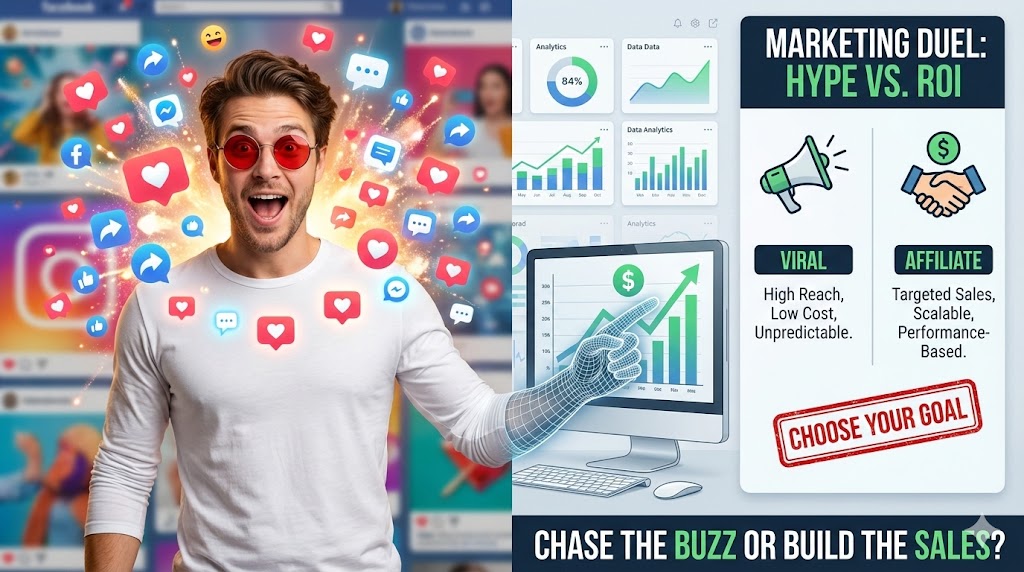
- Strongest Advantage: Viral marketing offers exponential reach and brand awareness at low cost, while affiliate marketing provides performance-based, measurable sales.
- Biggest Limitation: Viral success is unpredictable and hard to engineer, whereas affiliate marketing requires ongoing partner management and commission payouts.
- Concrete Use Case: Viral marketing is ideal for launching innovative products or content with inherent shareability; affiliate marketing excels for scalable sales of established products or services.
Viral Marketing vs. Affiliate Marketing: A Direct Comparison
| Criterion | Viral Marketing | Affiliate Marketing |
|---|---|---|
| Primary Goal | Rapid brand awareness and user acquisition through organic sharing. | Performance-based sales generation through third-party promoters. |
| Cost Structure | Low direct marketing spend; relies on content virality. | Commission-based; pay only for conversions (sales, leads, clicks). |
| Control & Predictability | Low control, high unpredictability; success is often serendipitous. | High control over offers and partners; predictable revenue streams. |
| Content Focus | Highly shareable, emotionally resonant, novel, or utility-driven content. | Product reviews, tutorials, comparisons, deals, and recommendations. |
| Relationship with Audience | Indirect, through shared content; often a one-to-many broadcast. | Direct, through trusted affiliates; often a one-to-one recommendation. |
What is Viral Marketing and How Does it Work?
Viral marketing is a strategy that encourages individuals to pass on a marketing message to others, creating exponential growth in the message’s exposure and influence. It’s named after how viruses spread, quickly infecting many hosts. The core idea is to design content or experiences that are so compelling, entertaining, or useful that people feel a natural urge to share them within their social networks.
The effectiveness of viral marketing hinges on the inherent shareability of the content itself, rather than paid promotion. This can lead to incredibly high reach at a significantly lower cost compared to traditional advertising. However, its success is often difficult to predict or replicate, making it a high-risk, high-reward strategy. Businesses often integrate viral elements into broader campaigns to maximize their potential reach.
- Content Creation: Develop highly engaging, unique, or controversial content that resonates deeply with a target audience.
- Seeding: Strategically launch the content through initial channels, often influencers or early adopters, to kickstart sharing.
- Network Effects: Rely on social networks and word-of-mouth for the message to spread organically from person to person.
- Tracking & Analysis: Monitor sharing metrics and audience engagement to understand the spread and impact of the campaign.
Pros of Viral Marketing
- Exponential Reach: Can achieve massive audience exposure in a short period, far beyond initial investment.
- High Credibility: Messages shared by friends or trusted sources are perceived as more authentic and trustworthy.
- Cost-Effective: Once content goes viral, the cost per impression or acquisition drops dramatically.
- Brand Building: Creates significant buzz and strengthens brand recognition and recall.
Cons of Viral Marketing
- Unpredictable Success: There’s no guaranteed formula for virality, making outcomes highly uncertain.
- Lack of Control: Once a message is out, its interpretation and spread are largely beyond the brand’s control.
- Short-Lived Impact: Viral trends can fade quickly, requiring continuous effort to maintain momentum.
- Potential for Negative Virality: Poorly received content can spread negatively, damaging brand reputation.
Understanding Affiliate Marketing: A Performance-Based Model
Affiliate marketing is a performance-based marketing strategy where a business rewards one or more affiliates for each visitor or customer brought by the affiliate’s own marketing efforts. It’s essentially outsourcing your sales force to a network of publishers, bloggers, and content creators who promote your products or services in exchange for a commission.
This model is highly attractive because it’s largely risk-free for the advertiser: you only pay when a desired action occurs, such as a sale, lead, or click. Affiliates, on the other hand, benefit from monetizing their audience without needing to create their own products. The relationship is built on tracking and transparency, ensuring both parties are compensated fairly for their contributions.
- Advertiser (Merchant): The company that sells the product or service and pays commissions.
- Affiliate (Publisher): An individual or company that promotes the merchant’s products and earns a commission.
- Affiliate Network: A platform that connects merchants with affiliates and handles tracking, reporting, and payments.
- Customer: The end-user who makes a purchase or completes an action through the affiliate’s link.
The Growing Impact of Affiliate Marketing
Reports indicate that affiliate marketing spending in the U.S. alone is projected to reach over $8 billion, highlighting its significant and sustained growth as a reliable revenue channel for many businesses.
Key Differences Between Viral and Affiliate Marketing
While both viral and affiliate marketing aim to expand reach and drive engagement, their fundamental mechanisms, control levels, and cost structures diverge significantly. Understanding these distinctions is crucial for selecting the most appropriate strategy for specific business goals.
Viral marketing is about creating a spark that ignites a wildfire of sharing, often relying on luck and the inherent appeal of the content. Affiliate marketing, conversely, is a more structured and predictable system, built on partnerships and measurable outcomes. The former seeks to surprise and delight into sharing, while the latter incentivizes direct promotion and conversion.
- Mechanism of Spread: Viral relies on organic, voluntary sharing; affiliate relies on incentivized, direct promotion.
- Cost Model: Viral has low direct cost (high content investment); affiliate is performance-based (commission on results).
- Predictability: Viral is highly unpredictable; affiliate offers more predictable ROI and scalability.
- Relationship Focus: Viral is content-centric, often anonymous; affiliate is relationship-centric, built on trust with partners.
- Goal Emphasis: Viral prioritizes brand awareness and rapid reach; affiliate prioritizes direct sales and lead generation.
Myth
“Viral marketing is free marketing.”
Reality
While the distribution cost can be minimal, creating truly viral content requires significant investment in creativity, production, and often initial seeding. It’s ‘free’ in distribution, not in creation or strategy.
When is Viral Marketing the Right Choice for Your Business?
Viral marketing is particularly effective for businesses that have a product, service, or message with a strong, inherent ‘wow’ factor or utility that naturally compels people to share. It’s often employed during product launches, awareness campaigns, or when a brand seeks to disrupt a market with a fresh idea. The goal is to generate massive buzz quickly, making it suitable for startups or innovative companies.
Consider viral marketing if your primary objective is to achieve widespread brand recognition and user acquisition without a large advertising budget. It’s also ideal when you have a creative team capable of producing highly original and emotionally resonant content. However, be prepared for the possibility of no significant viral uptake, as success is never guaranteed.
- Product Launches: To create immediate hype and widespread awareness for a new offering.
- Brand Awareness Campaigns: When the main goal is to get the brand name and message in front of as many people as possible.
- Content Marketing: For distributing engaging articles, videos, or infographics that are inherently shareable.
- Social Causes: To rapidly spread awareness and gather support for a movement or charity.
Insider Tip: The ‘Shareability’ Factor
To increase viral potential, focus on content that evokes strong emotions (joy, surprise, awe), offers practical utility, or provides social currency. People share what makes them look good, feel good, or helps others.
When Should You Opt for Affiliate Marketing?
Affiliate marketing is the preferred strategy for businesses focused on driving measurable sales and leads with a clear return on investment. It’s especially beneficial for e-commerce stores, SaaS companies, and service providers who have an established product and are looking for scalable growth without upfront advertising costs. This model thrives on long-term partnerships and consistent performance.
Choose affiliate marketing if your business requires a predictable revenue stream and you have the capacity to manage a network of partners. It’s also excellent for expanding into new markets or reaching niche audiences through specialized affiliates. The key is to have a compelling product and a competitive commission structure to attract high-quality publishers.
- E-commerce Sales: To drive direct purchases of physical or digital products.
- Lead Generation: For acquiring qualified leads for services, subscriptions, or software trials.
- Market Expansion: To tap into new demographics or geographical regions through local affiliates.
- Scalable Growth: When seeking a performance-based model that can grow with your business without fixed marketing overheads.
Common Challenges in Viral Marketing Campaigns
Despite its allure, viral marketing comes with a unique set of challenges that can derail even the most well-intentioned campaigns. The primary hurdle is the inherent unpredictability; there’s no magic formula to guarantee virality, and many attempts fall flat. This can lead to wasted resources if content doesn’t resonate as expected.
Another significant challenge is the lack of control once content goes viral. The message can be misinterpreted, taken out of context, or even generate negative sentiment, which can be difficult to manage. Additionally, the fleeting nature of viral trends means that even successful campaigns may have a short shelf life, requiring continuous effort to maintain brand visibility.
- Unpredictability: The biggest challenge is that virality cannot be guaranteed or consistently replicated.
- Message Dilution: As content spreads, its original message can become distorted or lose its intended impact.
- Measurement Difficulty: Tracking the true ROI of viral campaigns can be complex due to organic, unlinked shares.
- Brand Reputation Risk: Negative reactions or controversies can spread just as quickly as positive ones.
Case Study: The ‘Fail’ of a Viral Attempt
The trap: A major brand launched a social media campaign encouraging users to share personal stories with a specific hashtag, hoping for organic, positive engagement. However, the hashtag was quickly co-opted by users sharing negative experiences with the brand’s products and customer service.
The win: The brand learned the importance of anticipating potential negative sentiment and having a robust crisis management plan. They pivoted to direct customer service outreach, transforming some negative experiences into positive ones, but the initial viral attempt backfired significantly.
Navigating Challenges in Affiliate Marketing
Affiliate marketing, while more predictable than viral efforts, also presents its own set of challenges. One common issue is finding and recruiting high-quality affiliates who genuinely align with your brand and can drive relevant traffic. A large network of low-performing affiliates can consume significant management resources without yielding substantial results.
Another hurdle involves commission fraud or low-quality traffic. Some affiliates may employ questionable tactics to generate clicks or sales, which can damage your brand’s reputation and lead to wasted commission payouts. Effective tracking, clear terms and conditions, and diligent monitoring are essential to mitigate these risks and ensure the integrity of your affiliate program.
- Recruiting Quality Affiliates: Attracting partners who can genuinely drive conversions and represent your brand well.
- Commission Fraud: Dealing with fraudulent clicks or sales that can inflate costs and distort performance data.
- Brand Control: Ensuring affiliates maintain brand guidelines and messaging, preventing misrepresentation.
- Competitive Commissions: Offering attractive payouts to stand out in a crowded affiliate marketplace.
Insider Tip: Affiliate Program Management
Invest in an affiliate management platform or dedicated manager. Clear communication, regular performance reviews, and bonus incentives for top performers can significantly boost program success and affiliate loyalty.
Integrating Affiliate Marketing with Your Content Strategy
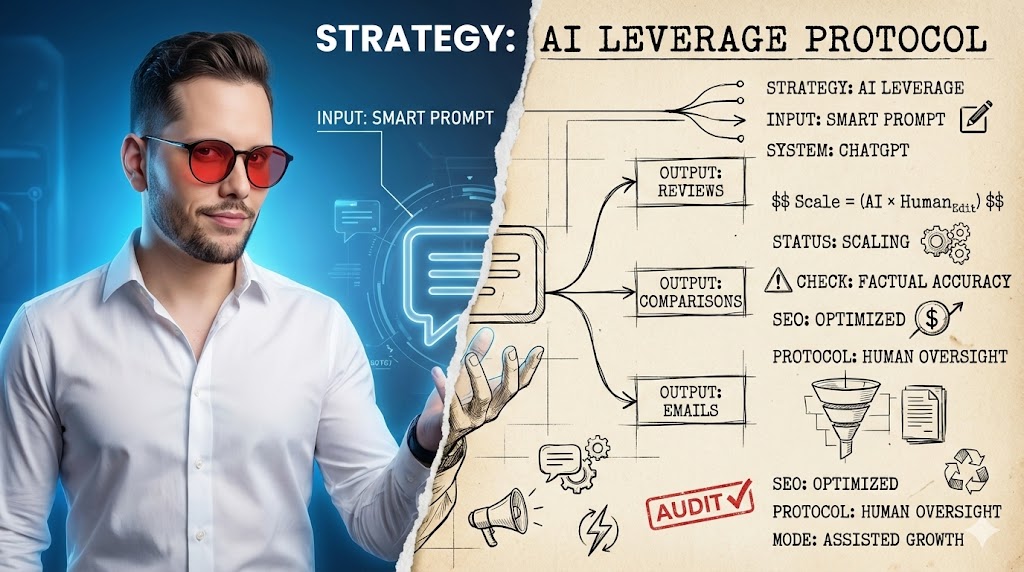
For businesses already investing in content, integrating affiliate marketing can provide a powerful monetization channel. By strategically placing affiliate links within valuable content like reviews, tutorials, or comparison guides, you can earn commissions while providing helpful information to your audience. This approach aligns well with content-driven businesses, as it leverages existing traffic and authority.
Effective integration requires careful keyword research to identify topics where your products or services naturally fit. It also means choosing relevant affiliate programs and ensuring that disclosures are clear and compliant. Tools like an Amazon affiliate plugin can streamline the process of managing links and tracking performance within a WordPress environment, making it easier to scale your efforts.
- Content Mapping: Identify content types (e.g., product reviews, buying guides) where affiliate links can be naturally integrated.
- Keyword Research: Target keywords with commercial intent where users are actively looking for product recommendations.
- Link Placement: Strategically place links within content to maximize visibility and click-through rates without being intrusive.
- Performance Tracking: Utilize analytics to monitor which content and links are driving the most conversions.
Myth
“Affiliate marketing is just spamming links everywhere.
Reality
Successful affiliate marketing is built on trust and value. Top affiliates provide genuine recommendations and helpful content, integrating links seamlessly rather than spamming, which would erode audience trust.
Actionable Steps for Launching Your Chosen Strategy
Deciding between viral and affiliate marketing, or even a hybrid approach, requires a clear understanding of your resources and desired outcomes. Once you’ve made that decision, a structured approach is essential to move from strategy to execution. These steps will help you lay a solid foundation for your chosen marketing path, ensuring you address critical setup and launch considerations.
For viral campaigns, the focus is on creative brainstorming and initial content seeding. For affiliate programs, the emphasis shifts to partner recruitment and robust tracking infrastructure. Regardless of the path, measurement and iteration are key to long-term success, allowing you to refine your approach based on real-world performance data.
Marketing Strategy Launch Checklist
- Define Clear Objectives (Day 1): Establish specific, measurable goals for either brand awareness (viral) or sales/leads (affiliate).
- Allocate Budget & Resources (Week 1): Commit financial and human resources for content creation (viral) or platform/affiliate management (affiliate).
- Develop Core Content/Offer (Week 2): Create your viral content masterpiece or finalize your affiliate product/commission structure.
- Identify Initial Distribution Channels (Week 3): Pinpoint key influencers for viral seeding or recruit your first batch of quality affiliates.
- Set Up Tracking & Analytics (Week 4): Implement robust systems to monitor performance, whether it’s social shares or affiliate conversions.
- Launch & Monitor Closely (Ongoing): Execute your campaign and continuously track performance, making real-time adjustments.
Common Questions
Can viral marketing and affiliate marketing be combined?
Yes, they can be complementary. A viral campaign might generate massive awareness, which affiliates can then leverage to drive conversions. For example, a viral video could feature a product that affiliates then promote with direct purchase links.
Which strategy is better for a small business with limited funds?
For small businesses, affiliate marketing often offers a more predictable ROI, as you only pay for results. Viral marketing, while potentially low-cost in distribution, requires significant creative investment and carries higher risk due to its unpredictable nature.
How do I measure the success of a viral marketing campaign?
Success in viral marketing is typically measured by metrics like reach, impressions, social shares, mentions, and website traffic spikes. While direct conversions can be difficult to attribute, the primary goal is often brand awareness and engagement.
What are typical commission rates in affiliate marketing?
Commission rates vary widely by industry and product. They can range from 1-5% for physical products (like Amazon Associates) to 20-50% or more for digital products, software, or high-value services. Researching industry averages is crucial.