
The Unvarnished Truth
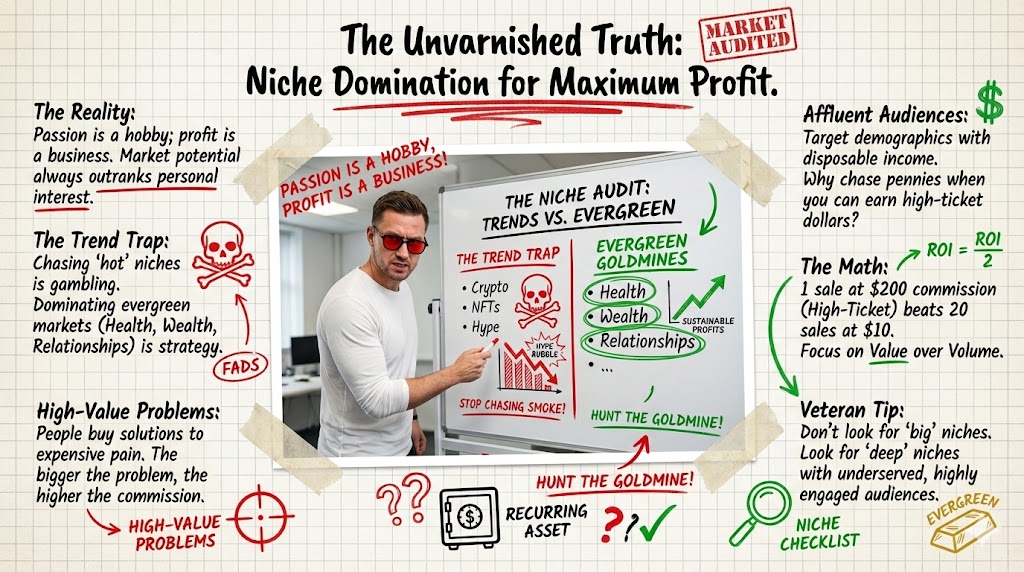
Forget the endless lists of ‘hot’ niches. The real money in affiliate marketing isn’t found in chasing trends, but in dominating evergreen markets where high-value problems meet affluent audiences. You need to stop looking for easy wins and start hunting for sustainable, high-commission opportunities where your expertise can truly shine.
- Evergreen Dominance: Focus on niches with perpetual demand, not fleeting fads.
- High-Value Problems: Solve significant pain points for audiences willing to pay.
- Affluent Audiences: Target demographics with disposable income for higher conversions.
- Commission Structure: Prioritize programs offering recurring revenue or high-ticket payouts.
Affiliate Marketing’s Untapped Goldmines: Dominating Niches for Maximum Profit
Let’s cut the crap. The internet is flooded with ‘best niche’ articles that offer nothing but recycled, generic advice. If you’re serious about making real money in affiliate marketing, you need to stop listening to the noise and start thinking like a predator. This isn’t about finding a ‘good’ niche; it’s about identifying a profit-rich territory you can absolutely dominate. We’re talking about strategic positioning, not just picking a topic you like. Are you ready to ditch the fluff and get down to brass tacks?
The common approach — picking a niche based on personal interest or perceived low competition — is a recipe for mediocrity, if not outright failure. You’re not building a hobby blog; you’re building a revenue-generating machine. This demands a ruthless focus on market demand, audience spending power, and commission potential. Anything less is just playing small. But here’s the kicker: most people are too afraid to make these tough choices, which leaves a wide-open field for those who dare.
The Affiliate Marketing Gold Rush: Separating Hype from Hard Cash
Why Most ‘Hot’ Niches Are a Waste of Your Time
Every year, some ‘guru’ declares a new ‘hot’ niche. Crypto, NFTs, AI tools – you name it. The problem? By the time you hear about it, the early adopters have already cashed out, and the market is either saturated with low-quality content or it’s a volatile bubble waiting to burst. Chasing these fleeting trends is like trying to catch smoke; you’ll burn a lot of resources for very little return. The real money isn’t in what’s ‘hot’ right now, but in what’s *always* in demand.
The allure of quick riches blinds many to the fundamental principles of sustainable business. They see a spike in interest and dive headfirst without understanding the underlying market dynamics or the long-term viability of the products. This isn’t strategy; it’s gambling. And in affiliate marketing, gambling rarely pays off unless you’re the house. So, let’s get real about where the consistent, high-margin opportunities truly lie.
The Unforgivable Sin: Chasing Saturated Markets Without a Unique Angle
The Illusion of ‘Easy’ Competition
Many beginners make the critical mistake of entering markets that appear ‘easy’ because they see a lot of other affiliates. This isn’t a sign of opportunity; it’s a red flag indicating saturation. If everyone is doing it, you’re not just competing against a few players; you’re fighting an army for scraps. Your content gets buried, your ads become prohibitively expensive, and your conversion rates plummet. Why does this matter? Because your time is your most valuable asset, and wasting it on a losing battle is unforgivable.
The only way to survive in a saturated market is to bring an absolutely unique, undeniable value proposition. Are you 10x better than the competition? Do you have an audience no one else can reach? If not, you’re just another voice in a crowded room, destined to be ignored. This isn’t about being discouraged; it’s about being strategic. Pick your battles wisely, or don’t fight at all.
Shattering the Myth
“You need to pick a niche you’re passionate about to succeed in affiliate marketing.”
The Undeniable Reality
Passion is great, but profit is better. While interest can help with consistency, a profitable niche with high demand and strong commission structures will always outperform a passion project with no market. Focus on market potential first; passion can be cultivated or applied strategically within a lucrative segment.
The Core Principles of Niche Selection for Maximum Profit
High-Value Problem Solving: The Foundation of Any Fortune
People don’t buy products; they buy solutions to their problems. The bigger the problem, the more they’re willing to pay for a solution. Think about it: someone struggling with chronic pain will invest far more than someone looking for a new coffee mug. Your niche must address a significant pain point, a deep desire, or an aspirational goal. This isn’t about selling trinkets; it’s about transforming lives, even in small ways. The best part? When you solve real problems, trust builds, and conversions soar.
Evergreen Demand & Longevity: Building a Future, Not a Fad
An evergreen niche is one where demand persists regardless of economic cycles or fleeting trends. Health, wealth, relationships, and self-improvement are classic examples. People will always want to be healthier, richer, happier, and more skilled. Building your affiliate business on these foundational human desires ensures a continuous stream of potential customers. This isn’t just about stability; it’s about compounding your efforts over time, creating an asset that grows in value rather than depreciating with the next market shift.
Affluent Audiences & High Commissions: The Smart Money Play
Why chase pennies when you can earn dollars? Targeting audiences with disposable income means higher average order values and, consequently, higher commissions per sale. Furthermore, seek out affiliate programs that offer recurring commissions (e.g., software subscriptions) or high-ticket items. Selling one $1,000 product with a 20% commission ($200) is infinitely more profitable than selling twenty $10 products with a 10% commission ($20). This is simple math, but it’s often overlooked by those fixated on volume over value. The real secret? Focus on quality over quantity, both in your audience and your offers.
Pro’s Playbook
Don’t just look for ‘big’ niches. Look for ‘deep’ niches. A smaller, highly engaged audience with a specific, expensive problem is far more valuable than a massive, general audience with vague interests. Think precision targeting, not broad strokes.
Niche Deep Dive 1: High-Ticket Digital Education (The Untapped Goldmine)
Why Online Courses & Coaching Convert Like Crazy
In an economy that constantly demands new skills, digital education is booming. People are hungry for knowledge, whether it’s learning a new language, mastering a software, or developing entrepreneurial skills. High-ticket courses, workshops, and coaching programs often come with substantial commission rates, sometimes 30-50% of a $500-$5000 product. This isn’t just about selling information; it’s about selling transformation. When you help someone acquire a skill that directly impacts their career or personal growth, they become loyal advocates. This is a market built on aspiration and tangible results, making conversions incredibly strong.
Finding the Right Platforms and Programs
Platforms like Teachable, Thinkific, and Kajabi host thousands of courses, many with affiliate programs. Beyond these, look for independent experts and coaches who run their own programs. The key is to vet the quality rigorously. Promote only programs that deliver genuine value and have strong testimonials. Your reputation is your currency. Focus on specific sub-niches within education, such as ‘AI for marketers,’ ‘advanced data science,’ or ‘high-performance leadership coaching.’ The more specialized, the better your targeting and the higher your conversion potential. Why settle for generic when you can be a specialist?
Niche Deep Dive 2: Sustainable Living & Eco-Conscious Products (Values-Driven Profit)
The Rise of Conscious Consumers and Their Wallet Power
Consumers are increasingly prioritizing ethical sourcing, environmental impact, and sustainable practices. This isn’t a trend; it’s a fundamental shift in consumer values. People are willing to pay a premium for products that align with their conscience, from zero-waste household items to ethically produced fashion and renewable energy solutions. This niche taps into a powerful emotional driver: the desire to do good and live responsibly. But it gets better: this audience is often highly engaged and fiercely loyal, making them ideal for long-term affiliate relationships.
Identifying Authentic Brands and Avoiding Greenwashing
The challenge here is distinguishing genuine sustainable brands from those merely ‘greenwashing.’ Your audience will be savvy and skeptical. Thorough research into a brand’s certifications, supply chain, and public reputation is non-negotiable. Look for companies with transparent practices and a clear commitment to sustainability, not just marketing buzzwords. Sub-niches could include ‘eco-friendly baby products,’ ‘sustainable travel gear,’ or ‘home energy efficiency solutions.’ Authenticity is your competitive edge here; anything less will be seen through immediately.
Niche Deep Dive 3: Personal Finance & Wealth Building (Recession-Proof Riches)
The Perpetual Demand for Financial Security and Growth
Money worries are universal, and the desire for financial freedom is evergreen. This niche covers everything from budgeting apps and credit cards to investment platforms, insurance, and real estate education. The beauty of personal finance is its broad appeal and the high value people place on securing their future. Products in this space often come with significant one-time or recurring commissions, especially for services like wealth management or specialized investment tools. The demand for clear, actionable financial advice only intensifies during economic uncertainty, making it a remarkably resilient niche.
Navigating Complex Financial Products and Building Trust
This niche demands a high degree of trust and accuracy. You’re dealing with people’s livelihoods. Focus on providing genuinely helpful, unbiased information. Partner with reputable financial institutions and platforms. Sub-niches could include ‘early retirement strategies,’ ‘debt consolidation for small businesses,’ ‘cryptocurrency investment for beginners,’ or ‘real estate crowdfunding.’ The more specific your angle, the easier it is to establish authority and attract an audience actively seeking those particular solutions. Remember, people are looking for guidance, not just links.
Niche Deep Dive 4: Health & Biohacking (The Performance Obsession)
Beyond Basic Supplements: Niche Within a Niche
The general health and wellness market is saturated, but ‘biohacking’ — the art and science of optimizing human performance through biology, technology, and lifestyle — is a high-growth, high-value sub-niche. This audience isn’t looking for quick fixes; they’re investing in longevity, cognitive enhancement, peak physical performance, and advanced recovery. Think smart devices, specialized supplements, genetic testing, and advanced fitness equipment. These products often carry premium price tags and excellent commission structures. The real secret? This audience is highly educated and willing to spend significantly on proven solutions.
Targeting Specific Health Goals with Precision
Instead of ‘general health,’ focus on specific outcomes. ‘Sleep optimization for executives,’ ‘cognitive enhancement for students,’ ‘gut health for athletes,’ or ‘anti-aging protocols for busy professionals.’ By narrowing your focus, you become the go-to expert for a specific problem. This allows you to create highly targeted content that resonates deeply with your audience, leading to higher engagement and conversion rates. Don’t just sell products; sell a better, optimized version of themselves.
Niche Deep Dive 5: Pet Care & Premium Pet Products (Emotional Spending Power)
The ‘Pet Parent’ Phenomenon: No Expense Spared
For many, pets aren’t just animals; they’re family members. This emotional connection drives enormous spending, often without budget constraints. From gourmet food and luxury accessories to advanced veterinary care and pet tech (trackers, automatic feeders), the pet industry is booming. This niche offers incredible diversity and a highly engaged audience. The best part? Pet owners are constantly looking for ways to improve their pet’s life, creating endless opportunities for product recommendations and recurring purchases.
Luxury & Specialized Pet Markets: Beyond the Basics
Go beyond basic dog food. Consider ‘raw food diets for specific breeds,’ ‘anxiety solutions for rescue dogs,’ ‘eco-friendly cat litter subscriptions,’ or ‘smart pet cameras for working owners.’ Look for premium, specialized products that cater to specific needs or desires. Subscription boxes for pet treats or toys are also excellent for recurring commissions. The emotional investment in pets means that once trust is established, loyalty is incredibly high, leading to repeat business and strong lifetime customer value. Why settle for generic pet supplies when you can tap into the luxury segment?
The Master’s Move
Always analyze the ‘customer journey’ in your chosen niche. Where do they start? What problems do they encounter? What’s their ultimate goal? Align your affiliate offers to guide them through this journey, providing solutions at every step. This isn’t just selling; it’s consulting.
Niche Deep Dive 6: Remote Work & Productivity Tools (The New Normal Economy)
The Permanent Shift to Remote: A Goldmine of Opportunity
The pandemic accelerated a shift that’s now permanent: remote and hybrid work. Millions of professionals and businesses are constantly seeking tools, software, and equipment to enhance productivity, collaboration, and work-life balance in a distributed environment. This niche is exploding, covering everything from project management software and communication platforms to ergonomic office furniture and noise-canceling headphones. Many software products offer lucrative recurring commissions, making this a highly attractive and sustainable market.
Software, Gadgets, and Services for the Modern Professional
Consider sub-niches like ‘virtual collaboration tools for creative teams,’ ‘time management software for freelancers,’ ‘home office setup guides,’ or ‘cybersecurity solutions for remote businesses.’ The key is to focus on solving specific pain points related to remote work: distractions, communication gaps, security concerns, or ergonomic issues. By positioning yourself as the expert who understands the unique challenges of remote work, you build authority and trust, leading to consistent conversions. This isn’t just about selling products; it’s about enabling a new way of working.
Niche Deep Dive 7: Hobby & Passion-Based Communities (Deep Engagement, High Trust)
From Gaming to Specialized Crafts: Tapping into Obsession
When people are passionate about a hobby, they spend money. A lot of money. Whether it’s high-end gaming peripherals, specialized photography equipment, rare collectible items, or niche crafting supplies, these communities are often tight-knit, highly engaged, and eager to invest in their passions. The beauty of these niches is the deep level of trust you can build by genuinely understanding and participating in the community. Your recommendations aren’t just sales pitches; they’re informed suggestions from a fellow enthusiast. But here’s the catch: you need to actually *be* an enthusiast, or at least sound like one.
Leveraging Niche Forums and Social Groups for Authority
Instead of trying to reach everyone, focus on specific forums, Reddit communities, Facebook groups, or Discord servers dedicated to your chosen hobby. Provide genuine value, answer questions, and build your reputation as a helpful expert *before* you ever drop an affiliate link. Sub-niches could include ‘vintage camera restoration,’ ‘competitive esports gear,’ ‘model train building,’ or ‘gourmet coffee brewing.’ The deeper you go, the less competition you’ll face, and the more impactful your recommendations will be. This is where authenticity translates directly into affiliate income.
The Critical Niche Validation Checklist: Don’t Launch Blind
Audience Size vs. Competition: The Sweet Spot
Don’t just look for a large audience; look for a large *underserved* audience or a smaller, *highly engaged* one. Use tools like Google Keyword Planner, Ahrefs, or Semrush to gauge search volume for niche-specific terms and analyze competitor strength. A niche with moderate search volume but low competition for high-value keywords is often far more profitable than a massive niche where you’re fighting giants. The goal isn’t to be the biggest fish in the ocean, but the biggest fish in a profitable pond.
Commission Structure & Payout Frequency: Your Bottom Line
Before committing, thoroughly research the affiliate programs available in your chosen niche. What are the commission rates? Are they one-time or recurring? What’s the cookie duration? How often do they pay out? A high-converting niche with low commissions or infrequent payouts is a revenue killer. Prioritize programs with generous, recurring commissions and reliable payment schedules. This isn’t just about making sales; it’s about building a predictable income stream. Don’t leave money on the table by ignoring the math.
Product Depth & Upsell Potential: Maximizing Lifetime Value
A truly great niche offers a range of products or services at different price points, allowing for upsells and cross-sells. Can you promote an entry-level product, then an intermediate one, and finally a high-ticket coaching program? This ‘value ladder’ approach maximizes the lifetime value of each customer you acquire. If a niche only has one or two products, your earning potential is severely limited. Look for ecosystems of products that cater to your audience’s evolving needs. This is how you turn a single sale into a continuous revenue stream.
| Niche Type | Pros (Strategic Imperatives) | Cons (Potential Landmines) |
|---|---|---|
| High-Ticket Digital Education | High commissions, evergreen demand for skills, strong transformation appeal. | Requires strong trust, high content quality, and careful vetting of programs. |
| Personal Finance & Wealth | Perpetual demand, high-value products, recession-resistant, recurring options. | High competition, requires deep expertise/credibility, regulatory considerations. |
| Pet Care & Premium Products | Emotional spending, loyal audience, diverse product range, subscription potential. | Can be competitive for generic products, requires genuine understanding of pet needs. |
Monetization Strategies: Beyond the Single Link
Content Marketing That Converts: Educate, Don’t Just Sell
Simply dropping affiliate links into thin content is a rookie mistake. Your content must educate, inform, and solve problems. Create in-depth reviews, comparison guides, tutorials, and case studies that genuinely help your audience make informed decisions. Position yourself as a trusted advisor, not a salesperson. The more value you provide upfront, the more likely your audience is to trust your recommendations and click your links. This isn’t just about SEO; it’s about building a relationship that leads to consistent conversions. Why would anyone buy from you if you’re not offering anything of substance?
Email List Building: Your True Asset for Long-Term Revenue
Your website traffic is rented land; your email list is your owned asset. Building an email list allows you to communicate directly with your audience, nurture leads, and promote offers repeatedly without relying on search engine algorithms or social media platforms. Offer a valuable lead magnet (e.g., an exclusive guide, checklist, or mini-course) in exchange for their email address. This is where the real money is made in the long run. An engaged email list is a direct line to your most valuable customers, allowing you to build a sustainable, resilient affiliate business. Neglecting your list is leaving money on the table, plain and simple.
The Fatal Flaw: Ignoring Your Own Expertise
Leveraging Personal Experience for Unshakeable Authority
Many affiliates try to be generic experts in generic niches. This is a losing game. What unique experiences, skills, or insights do you possess? Even if you’re not a world-renowned expert, your personal journey, challenges, and successes can be incredibly powerful. If you’ve successfully navigated a specific health issue, mastered a complex software, or built a profitable side hustle, that’s your unfair advantage. Leverage it. Your authentic voice and genuine experience will resonate far more deeply than any regurgitated content. This isn’t about faking it; it’s about finding where your genuine knowledge intersects with market demand.
Building Trust in a Skeptical Market: Your Reputation is Everything
The internet is rife with snake oil salesmen. To stand out, you must build unshakeable trust. Be transparent about your affiliate relationships. Provide honest reviews, even if it means highlighting downsides. Respond to comments and questions. Your reputation is your most valuable asset, and once it’s compromised, it’s incredibly difficult to rebuild. Focus on long-term relationships over short-term gains. This means consistently delivering value, being authentic, and always putting your audience first. The payoff? A loyal following that trusts your every recommendation.
Insider’s Edge
Don’t just promote products. Promote solutions. Frame your content around solving specific problems your audience faces, and then introduce the affiliate product as the ultimate tool or resource for that solution. This shifts the focus from ‘buy this’ to ‘solve your problem with this.’
Scaling Your Affiliate Empire: From Niche to Multi-Niche Dominance
Diversification vs. Deep Specialization: The Strategic Balance
Once you’ve successfully dominated one niche, the question becomes: expand or deepen? Deep specialization means becoming the absolute authority in a very narrow field, attracting premium traffic. Diversification means expanding into related, complementary niches to capture a broader market share. The smart move is often to deepen first, extracting maximum value from your established authority, then strategically diversify into closely related areas. For example, if you dominate ‘biohacking for sleep,’ you might expand into ‘biohacking for cognitive function’ – a natural progression. Don’t spread yourself too thin too early; focus on mastery before expansion.
Automation and Team Building: Reclaiming Your Time
To truly scale, you cannot do everything yourself. Identify repetitive tasks that can be automated (e.g., email sequences, social media scheduling) or outsourced (e.g., content writing, SEO, graphic design). Building a small, efficient team allows you to focus on high-leverage activities like strategy, partnership building, and new content ideation. This isn’t about being lazy; it’s about being a CEO. Your goal is to build a system that generates revenue, not just a job for yourself. The more you automate and delegate, the faster you can grow.
The Future is Niche: Adapting to Market Shifts
AI’s Impact on Content Creation: Friend or Foe?
AI tools are rapidly changing the content landscape. They can generate outlines, draft articles, and even optimize for SEO. This isn’t a threat to human content creators; it’s a tool for leverage. Use AI to accelerate your research and drafting process, freeing you up to focus on adding unique insights, personal anecdotes, and strategic angles that AI cannot replicate. The future of content isn’t about *more* content; it’s about *smarter, more authoritative* content. Embrace AI as an assistant, not a replacement for your strategic brain. The real value still comes from human judgment and unique perspective.
Emerging Trends to Watch: Staying Ahead of the Curve
While we advocate for evergreen niches, staying aware of emerging trends within those niches is crucial. For example, within health, personalized medicine and wearable tech are growing. In finance, decentralized finance (DeFi) is gaining traction. These aren’t ‘hot’ niches to chase blindly, but rather opportunities to find new, high-value products and services within your established, profitable territory. Continuously monitor industry news, consumer behavior shifts, and technological advancements to identify new angles and maintain your competitive edge. The market is always moving; your strategy should too.
📁 Battlefield Report
The Pitfall: An affiliate launched a site targeting ‘general fitness supplements,’ a highly saturated market. Despite consistent content, traffic was low, and conversions were abysmal due to intense competition and low-margin products.
The Strategic Triumph: After a year of minimal returns, they pivoted to ‘strength training supplements for women over 40.’ This specific sub-niche had less competition, a highly motivated audience with specific needs, and higher-ticket products. Within 6 months, their traffic quadrupled, and revenue increased by 800% because they focused on a high-value problem for an affluent, underserved audience.
📋 Your Affiliate Action Blueprint
- ✓Identify High-Value Problems: Pinpoint pain points or aspirations where people are actively seeking and willing to pay for solutions.
- ✓Vet for Evergreen Demand: Ensure your chosen niche isn’t a fleeting trend but has consistent, long-term relevance.
- ✓Analyze Audience Affluence: Target demographics with disposable income to maximize average order value and commissions.
- ✓Scrutinize Commission Structures: Prioritize programs with high percentage rates, recurring commissions, and long cookie durations.
- ✓Assess Product Depth: Look for niches with a range of products/services for upsell and cross-sell opportunities.
- ✓Leverage Your Unique Expertise: Find where your personal knowledge or experience provides an unfair advantage.
- ✓Build an Email List: Focus on capturing leads to build a direct, owned communication channel with your audience.
- ✓Create Value-Driven Content: Educate and solve problems first; affiliate links are secondary to genuine assistance.
Frequently Asked Questions: Clearing the Air
Is it too late to get into affiliate marketing?
Absolutely not. While the landscape has evolved, the core principles of identifying demand and providing value remain. The key is to stop chasing saturated markets and focus on deep, underserved niches with high-value products. It’s never too late to dominate a specific segment if you apply a strategic, profit-first mindset.
How much money can I realistically make from affiliate marketing?
There’s no cap. Beginners might make a few hundred dollars a month, but successful affiliates in high-ticket niches can easily generate five, six, or even seven figures annually. Your income directly correlates with your strategic niche selection, the value of products you promote, and your ability to drive targeted traffic and convert it. Don’t aim for ‘some money’; aim for maximum profit.
Do I need a huge audience to succeed in affiliate marketing?
No. A smaller, highly targeted, and engaged audience in a profitable niche is far more valuable than a massive, general audience. Focus on quality over quantity. A few thousand dedicated followers who trust your recommendations will generate more sales than a hundred thousand casual visitors who don’t.
Should I always choose a niche I’m passionate about?
While passion can be a motivator, it should never be the primary driver for niche selection. Profitability, market demand, and commission potential come first. You can cultivate interest or hire experts to create content for a lucrative niche. Don’t let a lack of ‘passion’ for a high-profit market deter you from building a successful business.
How long does it take to see results in affiliate marketing?
This isn’t a get-rich-quick scheme. Building a sustainable affiliate business takes consistent effort. Expect to put in 6-12 months of dedicated work before seeing significant, consistent income. Those who promise overnight success are selling you a fantasy. Focus on building a solid foundation, and the results will follow.