ClickBank: The Unvarnished Truth – Profit or Pitfall?
The Unfiltered Verdict
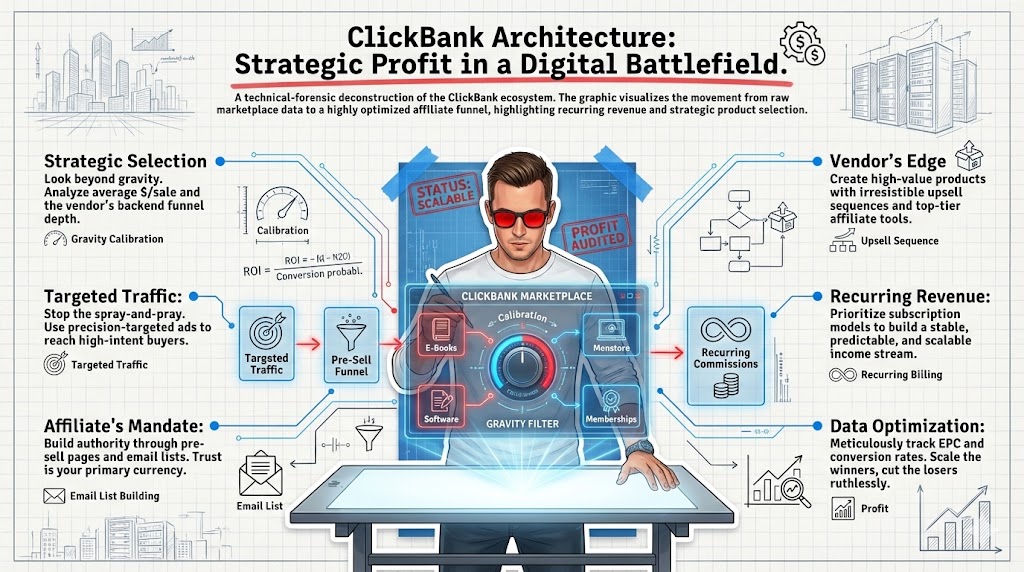
ClickBank isn’t a magic bullet; it’s a battleground. For the sharp, decisive marketer, it’s a direct path to substantial profit. For the naive or lazy, it’s a quick way to waste time and money. Success isn’t about luck; it’s about strategic product selection, laser-focused traffic, and an unyielding commitment to optimization. Stop chasing shiny objects and start building a real business.
- Strategic Selection: Forget ‘gravity’ as your sole metric. Dig deeper for true value and conversion potential.
- Targeted Traffic: Spray-and-pray marketing is dead. Pinpoint your audience with precision or bleed cash.
- Vendor’s Edge: Create high-value products with irresistible funnels and generous affiliate commissions.
- Affiliate’s Mandate: Pre-sell, build lists, and offer bonuses. Don’t just link and hope.
What is ClickBank, Really? (Beyond the Hype)
Let’s cut through the noise: ClickBank is a global e-commerce platform and affiliate marketplace, primarily for digital products. Think of it as a massive digital storefront where product creators (vendors) list their eBooks, courses, software, and memberships, and marketers (affiliates) promote them for a commission. It’s been around for decades, which means it’s proven, but also fiercely competitive. This isn’t your grandma’s online shop; it’s a direct response marketing ecosystem.
The core appeal? Low barrier to entry for affiliates and massive reach for vendors. You don’t need your own product to start earning, and vendors get an army of marketers promoting their wares. But here’s the catch: this accessibility also means a flood of low-effort, low-return attempts. To win here, you need to understand it’s a serious business, not a hobby. It demands strategy, execution, and a willingness to outwork the competition.
The Two Sides of the ClickBank Coin: Affiliates vs. Vendors
ClickBank thrives on a symbiotic relationship between two distinct user groups: affiliates and vendors. Each plays a critical role, but their strategies, risks, and rewards differ dramatically. Understanding both perspectives is crucial, even if you only plan to operate on one side, because it informs how you approach the marketplace. The affiliate seeks products that convert, while the vendor seeks affiliates who can drive volume.
For affiliates, the allure is clear: no product creation, no customer support, just promotion. You drive traffic, make a sale, and ClickBank handles the rest, sending you a commission. Vendors, on the other hand, shoulder the product development, sales page optimization, and customer service. Their reward is leveraging a vast network of affiliates to scale sales far beyond what they could achieve alone. But it gets better: a smart vendor also builds a robust affiliate program that attracts the best talent, offering high commissions and compelling sales assets.
| Aspect | Affiliate Marketer | Product Vendor |
|---|---|---|
| Primary Role | Promote products, drive traffic | Create products, manage sales/support |
| Barrier to Entry | Low (start with minimal capital) | High (product development, sales funnel, legal) |
| Profit Potential | Scalable, but dependent on traffic & conversions | Massive, leveraging affiliate network |
| Key Challenge | Finding converting products & traffic sources | Product validation, sales page optimization, affiliate recruitment |
| Revenue Model | Commission per sale | Product sales (minus affiliate commissions & fees) |
Why Most ClickBank Affiliates Fail (And How to Not Be One)
Stop believing this
“Just pick a high-gravity product, slap a link on social media, and watch the money roll in.”
The Truth
This approach is a guaranteed path to failure and frustration. Success on ClickBank, especially as an affiliate, demands a sophisticated strategy that goes far beyond simple link dropping. Most fail because they treat it like a lottery ticket instead of a business requiring skill, effort, and continuous optimization.
The brutal truth is that most aspiring ClickBank affiliates crash and burn because they lack a fundamental understanding of marketing. They pick a product based solely on its ‘gravity’ score, blast untargeted traffic at a raw affiliate link, and then wonder why they’re not making sales. This isn’t marketing; it’s digital panhandling. You need to provide value, build trust, and pre-sell the offer.
Another critical mistake is neglecting the power of a pre-sell page or a review site. Sending cold traffic directly to a vendor’s sales page is often inefficient. Your job as an affiliate is to warm up the prospect, address their pain points, and build desire for the solution the product offers. This intermediary step, often overlooked, is where the real conversion magic happens. Without it, you’re just a traffic director, not a marketer.
The Strategist’s Edge
Always, and I mean ALWAYS, build an email list from day one. Your list is your most valuable asset. Even if a prospect doesn’t buy immediately, you have the opportunity to nurture them, build rapport, and promote related offers over time. Relying solely on direct sales means leaving massive amounts of money on the table.
Cracking the Code: Identifying High-Converting ClickBank Products
Product selection is not a guessing game; it’s a science. While ‘gravity’ is a common metric, indicating how many unique affiliates have made a sale in the last 12 weeks, it’s merely a starting point. High gravity can mean high demand, but it also means high competition. You need to look beyond the surface to find products with true profit potential and a sustainable edge. This means scrutinizing the sales page, the product’s value proposition, and the overall sales funnel.
What truly matters is the average dollar per conversion, recurring commissions, and the quality of the vendor’s sales assets. A product with a lower gravity but a high average sale and a strong upsell path can be far more lucrative than a high-gravity product with low average earnings. Furthermore, products with recurring billing models (subscriptions) are gold. Why? Because you do the work once, and you get paid repeatedly, building a stable, predictable income stream. This is where smart money focuses.
The Hard Proof
Analysis of top-performing ClickBank products reveals a consistent pattern: products with an average conversion value exceeding $50 and offering recurring commissions (even if gravity is moderate) consistently outperform those with high gravity but low initial payouts. The real profit is in the lifetime value of a customer, not just the first sale.
Traffic Generation That Actually Works (Forget the BS)
You can have the best product in the world, but without targeted traffic, it’s worthless. The internet is awash with ‘free traffic’ gurus peddling outdated or ineffective strategies. Let’s be clear: truly effective traffic generation, especially for high-converting ClickBank offers, often involves a budget. This isn’t a cost; it’s an investment in your business, and it needs to be treated as such. The challenge isn’t just getting clicks; it’s getting the *right* clicks.
The solution lies in understanding your audience intimately and meeting them where they are. Paid traffic sources like Facebook Ads, Google Ads, and native advertising platforms allow for hyper-targeting, ensuring your offer is seen by people most likely to convert. However, simply running ads isn’t enough. You need compelling ad copy, optimized landing pages, and a clear understanding of your conversion metrics. For long-term play, search engine optimization (SEO) and content marketing can build organic authority and traffic, but this is a marathon, not a sprint. Email marketing, built from your paid and organic efforts, remains the most powerful tool for sustained conversions.
The Vendor’s Playbook: Launching a Product That Sells
If you’re considering becoming a ClickBank vendor, understand that this is a different beast entirely. It’s not enough to have a ‘good idea.’ You need a *market-validated* product that solves a real problem, a sales funnel that converts like crazy, and an affiliate program that makes top marketers salivate. Many vendors fail because they focus too much on the product and too little on the marketing and affiliate support.
Your sales page is your digital storefront; it must be a masterclass in direct response copywriting. High-quality video sales letters (VSLs) often outperform static text. Beyond the initial sale, you need a robust upsell, downsell, and cross-sell sequence to maximize average order value. But here’s the kicker: your affiliate tools page is almost as important as your sales page. Provide high-converting email swipes, banner ads, social media posts, and detailed targeting instructions. The easier you make it for affiliates to promote, the more they will. This is a partnership, not a transaction.
Real World Example
The Trap
A new vendor launched an excellent fitness program but offered only 30% commissions and provided generic, low-quality affiliate banners. Their sales stagnated despite positive product reviews.
The Win
After a strategic overhaul, the vendor increased commissions to 75%, added a high-converting VSL, and built an extensive affiliate tools page with pre-written email sequences, Facebook ad creatives, and detailed audience targeting guides. Within three months, their sales exploded, attracting super affiliates who saw the clear path to profit.
ClickBank’s Commission Structure: Where the Real Money Is
ClickBank’s commission structure is one of its most attractive features, offering affiliates up to 75% of the sale price. This is significantly higher than many other affiliate programs, which often hover around 5-15%. But don’t just look at the percentage; look at the entire sales funnel. The real money isn’t always in the initial front-end product. It’s in the backend, the upsells, the downsells, and crucially, the recurring billing products.
Imagine earning 75% on a $47 product, but then also getting 50% on a $97 upsell, and a recurring 60% on a $29/month membership. That’s where you build true wealth. Smart affiliates prioritize products with well-optimized sales funnels that maximize customer lifetime value. Always review the vendor’s affiliate page for details on their entire product ecosystem. If a vendor isn’t transparent about their upsells, that’s a red flag. Why does this matter? Because a single customer can generate multiple commissions for you, turning a one-time effort into a continuous revenue stream.
Navigating the ClickBank Marketplace: Filters, Gravity, and Beyond
The ClickBank marketplace can feel overwhelming, a vast ocean of products. Most beginners make the mistake of simply sorting by ‘gravity’ and picking the top few. This is a rookie error. While gravity indicates recent sales activity, it doesn’t tell the whole story about profitability or market saturation. You need to use the advanced filters to your advantage, narrowing down your search to uncover hidden gems and underserved niches.
Focus on categories you understand or have an interest in. Filter by ‘Avg $/conversion’ to see the real money potential per sale. Look for products with recurring billing. Don’t shy away from products with moderate gravity if they have a strong sales page and a clear, high-value offer. Sometimes, a slightly less popular product in a niche you can dominate with targeted traffic will outperform a highly competitive, high-gravity product where you’re just one fish in a massive pond. The best part? This strategic filtering allows you to identify opportunities before the masses catch on.
Veteran Secret
Don’t just look for high gravity. Actively seek out products with a ‘low gravity’ (e.g., 10-30) but a high ‘Avg $/conversion’ and a compelling offer. These are often newer products or those in emerging niches. If you can be among the first to drive quality traffic, you can establish dominance before the competition floods in. It’s a higher risk, higher reward play, but that’s where the real profit lies.
The Hidden Costs and Common Pitfalls of ClickBank
Why you need this
- Access to a vast product library
- High commission rates (up to 75%)
- No product creation or customer support for affiliates
- Global reach for vendors
- Reliable payment processing
Dealbreakers
- High competition in popular niches
- Risk of low-quality products
- Refunds and chargebacks impact earnings
- Steep learning curve for effective marketing
- Platform fees for vendors
While ClickBank offers immense opportunity, it’s not without its drawbacks and hidden costs. For affiliates, the biggest pitfall is the potential for high refund rates. ClickBank has a generous 60-day money-back guarantee, which is great for customers but can eat into your commissions if the product quality is poor or expectations are mismanaged. You earn a commission, then it’s clawed back. This is why vetting products thoroughly is non-negotiable.
For vendors, the costs are more direct: initial activation fees, transaction fees, and a reserve policy to cover potential refunds and chargebacks. While necessary for platform integrity, these can impact your immediate cash flow. Furthermore, both affiliates and vendors must contend with the cost of traffic. Whether it’s paid ads, SEO efforts, or content creation, there’s an investment required to get eyeballs on your offers. Don’t underestimate these expenses; factor them into your profit calculations from the outset.
Scaling Your ClickBank Empire: From Side Hustle to Serious Income
Making a few sales on ClickBank is one thing; building a sustainable, scalable income stream is another. The transition from a side hustle to a serious income demands a shift in mindset and strategy. You need to move beyond single campaigns and start thinking about systems, automation, and diversification. Relying on one product or one traffic source is a recipe for disaster. The market shifts, algorithms change, and competition intensifies.
To scale, you must automate repetitive tasks, delegate where possible, and continuously reinvest a portion of your profits back into your business. This means expanding your product portfolio, testing new traffic channels, and building multiple sales funnels. Focus on building assets: your email list, your content sites, your social media presence. These assets generate leads and sales long after your initial effort. The goal is to create a machine that generates revenue predictably, allowing you to focus on strategic growth rather than day-to-day firefighting.
The Profit Multiplier
Once you have a winning funnel for one ClickBank product, replicate the process. Don’t reinvent the wheel. Find similar high-converting products in related niches, adapt your proven funnel, and launch. This systematic approach allows you to multiply your income streams without starting from scratch every time.
Is ClickBank Still Relevant in 2024? (The Brutal Truth)
Absolutely, but not in the way many old-school marketers might remember it. ClickBank has evolved, and so has the digital marketing landscape. The days of spamming forums with affiliate links are long gone, and frankly, good riddance. Today, ClickBank is a platform for sophisticated digital marketers who understand the nuances of audience targeting, value-driven content, and conversion optimization. It’s not a relic; it’s a robust marketplace that demands modern marketing skills.
The brutal truth is that if you approach ClickBank with a 2005 mindset, you will fail. But if you come armed with a solid understanding of current digital advertising, content marketing, and funnel building, it remains an incredibly powerful vehicle for generating significant income. The opportunity is still massive for those willing to adapt, learn, and execute with precision. It’s a testament to its resilience and continued utility for both product creators and affiliates who are serious about their business.
Your First 90 Days: A Profit-Driven Action Plan
Forget the overwhelm. Your first 90 days on ClickBank should be about focused action and measurable results, not aimless browsing. This isn’t a time for experimentation with every shiny object; it’s a period for establishing a foundational, profit-generating system. The goal is to get your first consistent sales, understand the mechanics, and build momentum. Deviate from this plan at your own peril.
Start by intensely researching one niche and identifying 2-3 high-quality products within it that meet our criteria (strong sales page, good average $/conversion, potential for recurring). Next, build a simple, high-converting pre-sell page or review site. Don’t overcomplicate it; focus on clear benefits and a strong call to action. Finally, launch a targeted paid traffic campaign (e.g., Facebook Ads) with a small, controlled budget. Track everything. Optimize daily. Learn from every click and every conversion. This disciplined approach will separate you from the masses who dabble and fail.
The ClickBank Profit Accelerator
- Niche Domination: Select ONE profitable niche and become an expert in its audience’s pain points.
- Product Vetting: Identify 2-3 ClickBank products with high average $/conversion, strong sales pages, and ideally, recurring commissions.
- Pre-Sell Funnel: Develop a compelling pre-sell page or review site that warms up prospects before sending them to the vendor’s offer.
- Targeted Traffic: Launch a hyper-targeted paid ad campaign (e.g., Facebook, Google) with a daily budget, focusing on precise audience demographics.
- Track & Optimize: Implement robust tracking (ClickBank analytics, ad platform pixels) and commit to daily analysis and optimization of your campaigns.
- Email Capture: Integrate an opt-in form on your pre-sell page to build your email list from day one.
- Analyze & Scale: Once profitable, analyze your data to identify winning elements and strategically scale your budget or replicate the funnel for new products.
Frequently Asked Questions: Clearing the ClickBank Fog
Is ClickBank legitimate or a scam?
ClickBank is absolutely legitimate. It’s a long-standing e-commerce platform that has processed billions in sales. The ‘scam’ perception often comes from individuals who fail due to lack of effort or misguided expectations, not from the platform itself. It’s a tool; its effectiveness depends on the user.
How much money can I realistically make on ClickBank?
There’s no upper limit, but also no guarantee. Beginners might struggle to make consistent sales, while experienced marketers can generate five to six figures monthly. Your earnings directly correlate with your marketing skill, product selection, and traffic generation efforts. It’s a performance-based business.
Do I need a website to promote ClickBank products?
While technically you can promote directly with some traffic sources, having a website or a dedicated landing page (pre-sell page) is highly recommended. It allows you to build trust, pre-sell the product effectively, capture leads (email list), and comply with advertising platform policies. It’s an essential asset for serious affiliates.
What are the best niches on ClickBank right now?
Evergreen niches like Health & Fitness, Wealth & Self-Help, and E-Business & E-Marketing consistently perform well. However, the ‘best’ niche is one you understand, can provide value in, and where you can find high-converting products with less direct competition. Don’t chase trends; build in stable markets.
How do I get paid from ClickBank?
ClickBank offers several payment methods, including direct deposit, wire transfer, and checks. Payments are typically made weekly or bi-weekly, provided you meet their minimum payment threshold and have cleared any refund reserve periods. It’s a reliable system, but understand the terms.
Is ClickBank suitable for complete beginners?
While the barrier to entry is low, the learning curve for *effective* marketing is steep. Complete beginners will need to invest significant time in learning digital marketing fundamentals (copywriting, traffic, funnels, analytics) to succeed. It’s not a ‘push-button’ solution, but a rewarding one for those committed to learning.