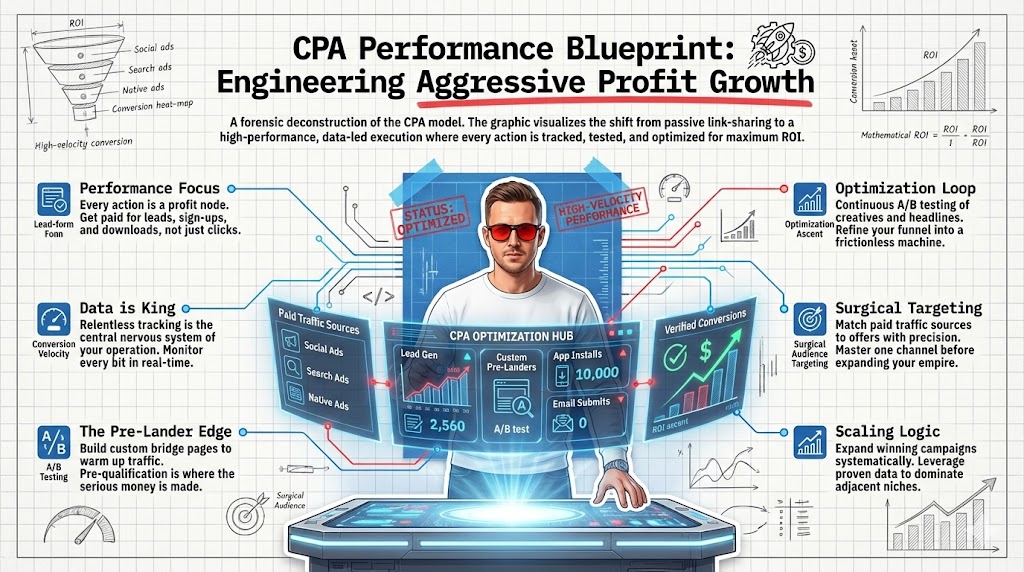
CPA Affiliate Marketing: Your Blueprint for Aggressive Profit Growth
The Unvarnished Truth
CPA (Cost Per Action) affiliate marketing isn’t some passive income fantasy; it’s a high-octane, performance-driven game where every click and conversion is meticulously tracked. It’s about direct response, ruthless optimization, and understanding human psychology to drive specific actions. Forget the fluff, this is where real money is made by those who dare to be decisive and data-driven.
- Performance Focus: You get paid for specific actions (leads, sign-ups, downloads), not just clicks or sales.
- High-Risk, High-Reward: Requires upfront investment in traffic, but offers significant profit margins if optimized correctly.
- Data is King: Relentless tracking and A/B testing are non-negotiable for success.
- Offer & Niche Selection: The right offer in the right niche is 80% of the battle; choose wisely or fail fast.
Alright, listen up. You’re here because you’re tired of the noise, the gurus peddling dreams, and the endless stream of ‘easy money’ schemes. You want to know how to actually make a killing in affiliate marketing, not just dabble. And I’m telling you, CPA (Cost Per Action) is where the serious players operate. This isn’t about hoping someone buys a product after clicking your link; it’s about driving a specific, measurable action, and getting paid handsomely for it.
Many talk about affiliate marketing, but few truly grasp the raw power and profit potential of CPA. It’s a direct, no-nonsense approach that cuts through the BS. You’re not waiting for a sale; you’re generating leads, sign-ups, app installs, or even just email submissions. The barrier to conversion is often lower, meaning your traffic can convert faster and more frequently, if you know what you’re doing. But it gets better: this model demands precision, and those who master it dominate.
What is CPA Affiliate Marketing, Really? (Beyond the Hype)
Let’s strip away the marketing jargon. CPA affiliate marketing is a performance-based advertising model where an affiliate earns a commission for a specific action taken by a user. This ‘action’ isn’t always a sale. It could be a lead form submission, a quote request, an email opt-in, a software download, or even a simple app install. The advertiser pays only when that predefined action is completed, making it a highly attractive model for businesses seeking tangible results.
The core principle here is alignment: advertisers get qualified leads or specific user engagements, and affiliates get paid for delivering those exact results. This contrasts sharply with traditional affiliate models that often pay only on a completed sale (CPS – Cost Per Sale) or per click (CPC – Cost Per Click), which can be far less efficient. With CPA, the focus shifts from mere exposure to concrete outcomes, demanding a more strategic and results-oriented approach from the affiliate. Why does this matter? Because it means less wasted effort and a clearer path to profitability if you can consistently deliver.
Why CPA Trumps Other Affiliate Models (The Profit Edge)
Now, you might be wondering why I’m so bullish on CPA. Simple: conversion rates. Getting someone to fill out a short form is inherently easier than convincing them to pull out their credit card and make a purchase. This lower barrier to entry for the user translates directly into higher conversion rates for you, the affiliate. While the payout per action might be lower than a high-ticket sale, the volume of conversions can easily eclipse the revenue from other models, leading to significantly higher net profits.
Consider the alternatives. CPC is a race to the bottom, often requiring astronomical traffic volumes for meager returns. CPS, while offering higher payouts, demands a much more committed user, meaning fewer conversions and often longer sales cycles. CPA, on the other hand, hits that sweet spot: tangible actions that are valuable to the advertiser, yet relatively easy for the user to complete. This efficiency is your unfair advantage, allowing you to scale campaigns faster and with greater predictability than almost any other model out there. The best part? You’re often paid for actions that are just the beginning of a customer’s journey, making your contribution incredibly valuable.
Your Profit Levers
- Higher conversion rates due to lower user commitment.
- Faster cash flow compared to sale-based models.
- Diverse range of offers across countless niches.
Critical Roadblocks
- Requires upfront ad spend and risk tolerance.
- Vulnerable to offer changes or network policy shifts.
- Intense competition in profitable niches.
The Core Mechanics: How CPA Campaigns Actually Work
Understanding the nuts and bolts of a CPA campaign is non-negotiable. First, you partner with a CPA network (think MaxBounty, PeerFly, or AdCombo) that acts as an intermediary between you and advertisers. These networks host a plethora of offers, each with specific payout rates, target demographics, and conversion requirements. Your job is to select an offer that aligns with your traffic sources and marketing strategy. This isn’t a passive selection; it’s a strategic decision that can make or break your campaign.
Once you’ve chosen an offer, you receive a unique tracking link. This link is critical; it’s how the network attributes conversions to you. You then drive targeted traffic to a landing page (either provided by the advertiser or, more often, one you’ve built yourself) that promotes the offer. When a user completes the desired action through your link, the network records the conversion, and you get paid. It sounds simple, but the devil is in the details: pre-landers, ad creatives, targeting parameters, and conversion funnel optimization are all pieces of this intricate puzzle that demand your full attention.
Pro’s Playbook
Never rely solely on the advertiser’s landing page. Always build your own pre-lander. This allows you to pre-qualify traffic, build rapport, and warm up visitors, significantly boosting your conversion rates. It’s an extra step, but it’s where the serious money is made.
Identifying High-Converting CPA Offers (Separating Gold from Garbage)
This is where most beginners crash and burn. They pick offers based on the highest payout, ignoring crucial factors like offer EPC (Earnings Per Click), conversion flow, and target audience. A high payout means nothing if the offer doesn’t convert. Your primary objective should be to find offers with a proven track record, strong EPCs, and a clear, simple conversion path. Look for offers that solve a genuine problem or tap into a strong desire.
Furthermore, scrutinize the offer’s terms and conditions. Some offers have strict geo-targeting, device restrictions, or traffic source limitations. Ignoring these can lead to wasted ad spend and even account bans. Talk to your affiliate manager; they are a goldmine of information on what’s performing well and what’s dead in the water. Don’t be afraid to test multiple offers within the same niche. The market is dynamic, and what works today might be obsolete tomorrow. This isn’t about guesswork; it’s about calculated experimentation.
| Offer Type | Conversion Action | Typical Payout Range |
|---|---|---|
| Email Submit | User submits email address | $1.00 – $5.00 |
| Zip Submit | User submits postal code | $2.00 – $10.00 |
| Lead Form | User fills out multi-field form | $10.00 – $50.00+ |
| App Install | User installs mobile application | $0.50 – $5.00 |
| Trial Sign-up | User signs up for a free trial | $20.00 – $100.00+ |
Traffic Generation for CPA: The Only Strategies That Matter
You can have the best offer in the world, but without targeted traffic, it’s worthless. Forget organic SEO or social media ‘engagement’ if you’re looking for rapid, scalable results. For CPA, paid traffic is king. This means platforms like Facebook Ads, Google Ads, native advertising (Taboola, Outbrain), push notifications, and display networks. The key is to match your traffic source to your offer and target audience with surgical precision. Each platform has its nuances, its rules, and its sweet spots.
Your strategy isn’t just about buying clicks; it’s about buying conversions. This requires deep understanding of audience targeting, ad creative optimization, and bid management. Don’t spread yourself thin trying to master every traffic source at once. Pick one or two, become an expert, and then scale. The common blunder here is chasing shiny objects, jumping from one traffic source to another without giving any a real chance to prove profitability. Focus, optimize, and dominate that channel before moving on. That’s how you build a sustainable, profitable CPA business.
Insider Edge
When starting with a new traffic source, begin with small, controlled budgets. Your goal isn’t immediate profit, but data collection. Identify what works, what doesn’t, and then scale up aggressively. Too many newbies blow their entire budget trying to hit a home run on their first swing.
Tracking & Optimization: The Unsung Heroes of CPA Success
If you’re not tracking every single data point, you’re essentially gambling with your money. Professional CPA marketers live and breathe data. You need a robust tracking solution (like Voluum, RedTrack, or Binom) to monitor clicks, conversions, costs, and profit margins in real-time. This isn’t optional; it’s the central nervous system of your entire operation. Without it, you cannot identify winning campaigns, cut losing ones, or scale what’s working.
Optimization is the continuous process of refining your campaigns based on the data you collect. This means A/B testing everything: ad creatives, headlines, landing page copy, call-to-actions, targeting parameters, and even bid strategies. A small improvement in your conversion rate or a slight reduction in your cost per click can dramatically impact your profitability. This isn’t a one-time task; it’s an ongoing battle against diminishing returns and rising ad costs. Those who embrace relentless optimization are the ones who consistently stay in profit.
Undeniable Metrics
A study of top-performing affiliate campaigns revealed that those utilizing advanced tracking and daily optimization saw an average 30-50% higher ROI compared to campaigns with infrequent or no optimization. Data isn’t just information; it’s your competitive advantage.
Common CPA Pitfalls and How to Sidestep Them (Don’t Be a Loser)
The path to CPA profit is littered with the corpses of failed campaigns. Most failures stem from predictable mistakes. The biggest one? Lack of research. Diving into an offer or niche without understanding the target audience, competition, or advertiser’s terms is a recipe for disaster. Another critical error is neglecting compliance. Ad networks and CPA networks have strict rules; violating them can lead to account suspensions and lost earnings. Read the fine print, always.
Furthermore, many beginners fall into the trap of ‘set it and forget it.’ CPA marketing is not passive. It requires constant monitoring, testing, and adjustment. Ignoring your campaigns for even a day can lead to significant losses. Finally, don’t chase every shiny new offer. Focus on mastering one or two profitable campaigns before expanding. Spreading yourself too thin is a surefire way to achieve mediocrity across the board. Be disciplined, be strategic, and be ruthless in cutting what doesn’t work.
Stop believing this
“CPA marketing is easy money; just send traffic and collect checks.”
The Unfiltered Reality
CPA marketing demands significant strategic thinking, upfront investment, relentless testing, and a high tolerance for risk. It’s incredibly profitable for those who treat it like a serious business, but it’s far from ‘easy’ and requires constant effort.
Scaling Your CPA Operations: From Side Hustle to Empire
Once you’ve found a profitable campaign, the next step is to scale it. This isn’t just about throwing more money at it; it’s about smart expansion. First, look for opportunities to expand your targeting within the same traffic source. Can you reach similar audiences in different demographics or geographies? Can you create new ad creatives that appeal to different segments of your existing audience? Incremental expansion reduces risk while maximizing proven success.
Next, consider replicating your winning formula across different traffic sources. If a campaign is crushing it on Facebook Ads, can you adapt it for native ads or push notifications? Be mindful that each traffic source has unique characteristics, so direct copy-pasting rarely works. You’ll need to adapt your creatives and landing pages. Finally, explore similar offers within the same niche or adjacent niches. Leverage your existing audience and data to find new opportunities. Scaling is about intelligent growth, not reckless spending.
Strategic Advantage
When scaling, always maintain a ‘control’ campaign that you know is profitable. When testing new variables or traffic sources, compare their performance against your control. This ensures you always have a baseline of profitability to fall back on and prevents you from accidentally killing a golden goose.
The Future of CPA: What’s Next for Savvy Marketers
The landscape of online advertising is constantly evolving, but the core principles of CPA remain steadfast: drive measurable actions, optimize relentlessly, and understand your audience. Looking ahead, expect increased scrutiny on data privacy (think iOS 14.5+ changes), which will demand more sophisticated tracking solutions and a greater reliance on first-party data. Those who adapt to these changes, embracing server-side tracking and robust CRM integrations, will maintain their edge.
Furthermore, the rise of AI and automation will play a significant role. Smart marketers will leverage AI for creative generation, audience segmentation, and even bid optimization, freeing up time for higher-level strategy. The future isn’t about fighting technology; it’s about harnessing it. The CPA model itself is resilient because it’s performance-based, aligning advertiser goals with affiliate efforts. Those who stay agile, data-obsessed, and willing to experiment will not just survive, but thrive in this ever-changing environment. The game is always changing, but the rules of profit remain the same.
Your Profit Blueprint
- Research Relentlessly: Before launching, deeply understand your niche, offer, and target audience.
- Build a Pre-Lander: Always use your own pre-lander to warm up traffic and improve conversion rates.
- Master One Traffic Source: Don’t spread yourself thin; become an expert in one paid traffic channel first.
- Implement Robust Tracking: Use a dedicated tracker to monitor every click, cost, and conversion in real-time.
- Optimize Daily: Continuously A/B test ad creatives, landing pages, and targeting parameters.
- Scale Smartly: Expand winning campaigns incrementally, testing new variables and traffic sources systematically.
Is CPA marketing still profitable in 2023?
Absolutely. While the landscape has evolved with increased competition and privacy changes, CPA remains one of the most direct and profitable affiliate models for those who are strategic, data-driven, and willing to adapt. The core principle of paying for specific actions ensures its continued relevance and profitability.
How much money do I need to start CPA marketing?
You need a realistic budget for ad spend and tracking tools. While you can start with a few hundred dollars, a budget of $1,000 – $2,000 is more realistic to allow for proper testing and optimization without running out of capital too quickly. Treat it as an investment, not a gamble.
What are the best CPA networks for beginners?
For beginners, networks like MaxBounty, PeerFly, and AdCombo are often recommended due to their wide range of offers and relatively accessible entry requirements. However, always research and read reviews before committing, and don’t be afraid to apply to several to find the best fit for your niche.
Can I do CPA marketing without paid traffic?
While technically possible through organic methods like SEO or social media, it’s significantly slower, harder to scale, and less predictable for CPA. For serious, aggressive profit growth, paid traffic is the industry standard and the most effective way to generate consistent conversions.