AI-Powered YouTube Affiliate Marketing: A Viable Strategy?
It depends significantly on execution and ethical considerations. This approach is highly suitable for content creators seeking efficiency but requires careful oversight to maintain authenticity.
- Significant advantage in content creation speed and script generation.
- Major limitation is the potential for generic or inauthentic content without human refinement.
- Concrete use case for generating high-volume product review videos in evergreen niches.
What is AI-Powered YouTube Affiliate Marketing?
AI-Powered YouTube Affiliate Marketing: A strategy leveraging artificial intelligence tools to automate or assist various stages of YouTube content creation, primarily scriptwriting, video production, and optimization, with the goal of promoting affiliate products and earning commissions.
AI-powered YouTube affiliate marketing involves using sophisticated algorithms and machine learning models to streamline the entire content creation process. This can range from generating initial video ideas and detailed scripts to producing voiceovers and even basic video edits. The core idea is to drastically reduce the time and effort traditionally required to create engaging YouTube content, allowing creators to focus on strategy and refinement rather than manual labor.
The integration of AI tools aims to make the process more accessible for individuals without extensive video production experience, lowering the barrier to entry for affiliate marketers. By automating repetitive tasks, creators can potentially scale their operations much faster, producing a higher volume of videos across various niches. This efficiency is a significant draw for those looking to maximize their affiliate earnings.
- Script Generation: AI can write compelling video scripts based on keywords and product descriptions.
- Voiceover Production: Text-to-speech AI generates natural-sounding narration.
- Video Editing Assistance: Some AI tools can automate scene selection and add background music.
- SEO Optimization: AI helps identify trending topics, keywords, and optimize video titles and descriptions.
Pros of AI in YouTube Affiliate Marketing
- Accelerated Content Production: Create videos significantly faster, enabling higher publishing frequency.
- Reduced Production Costs: Minimize expenses associated with hiring scriptwriters, voice actors, or editors.
- Enhanced Scalability: Easily expand into multiple niches or produce a large volume of content without proportional effort.
- Improved SEO Potential: AI can identify high-ranking keywords and optimize video metadata for better visibility.
Cons of AI in YouTube Affiliate Marketing
- Risk of Generic Content: AI-generated content can lack unique personality or deep human insight, leading to lower engagement.
- Quality Control Challenges: Requires significant human review and editing to ensure accuracy and natural flow.
- Ethical and Trust Concerns: Over-reliance on AI without disclosure can erode audience trust and potentially violate platform guidelines.
- Limited Creativity and Nuance: AI struggles with subtle humor, emotional depth, or truly innovative storytelling.
Why Use AI for YouTube Affiliate Marketing?
The primary motivation for integrating AI into YouTube affiliate marketing is the pursuit of efficiency and scale. Traditional video production is time-consuming, requiring scriptwriting, filming, editing, and optimization. AI tools can automate many of these steps, allowing marketers to produce more content in less time. This means more videos promoting more products, potentially leading to a higher volume of affiliate sales.
Beyond speed, AI offers capabilities that enhance content quality and reach. For instance, AI can analyze vast amounts of data to identify trending topics, optimal keywords, and audience preferences, which can significantly improve a video’s chances of ranking and attracting viewers. This data-driven approach removes much of the guesswork from content strategy, providing a more reliable path to affiliate success.
- Time Savings: Automate scriptwriting, voiceovers, and basic editing tasks.
- Cost Reduction: Avoid expenses for human scriptwriters, voice actors, and video editors.
- Data-Driven Decisions: Leverage AI for keyword research and trend analysis.
- Consistent Output: Maintain a regular publishing schedule with automated content creation.
The Power of Automation in Content Creation
Studies suggest that AI can reduce content creation time by up to 80% for initial drafts, freeing up creators to focus on refinement and strategic oversight. This significant time saving directly translates to increased publishing frequency.
How Does AI Generate Video Scripts?
AI script generation relies on advanced natural language processing (NLP) models, often large language models (LLMs), that have been trained on massive datasets of text. When prompted with a topic, keywords, or a product description, these AI models can generate coherent, structured, and often engaging video scripts. The quality of the output heavily depends on the specificity and detail of the input prompt, often referred to as prompt engineering.
A typical workflow involves providing the AI with details such as the video’s purpose (e.g., product review, tutorial), target audience, key selling points of the affiliate product, and desired tone. The AI then crafts an outline, develops dialogue, suggests visuals, and even incorporates calls to action for affiliate links. Iterative refinement, where the user provides feedback and the AI revises the script, is crucial for achieving high-quality results that resonate with a human audience.
- Prompt Engineering: Crafting detailed instructions for the AI to generate specific content.
- Outline Generation: AI creates a logical structure for the video, including introduction, body, and conclusion.
- Content Expansion: Fills out the outline with detailed explanations, product benefits, and examples.
- Call to Action Integration: Naturally embeds prompts for viewers to click affiliate links or subscribe.
Insider tip: Refine Your Prompts
To get the best scripts from AI, don’t just give it a topic. Provide specific details like target audience, desired tone (e.g., informative, enthusiastic, critical), key product features to highlight, and a clear call to action. The more context, the better the output.
What is the Workflow for AI Video Creation?
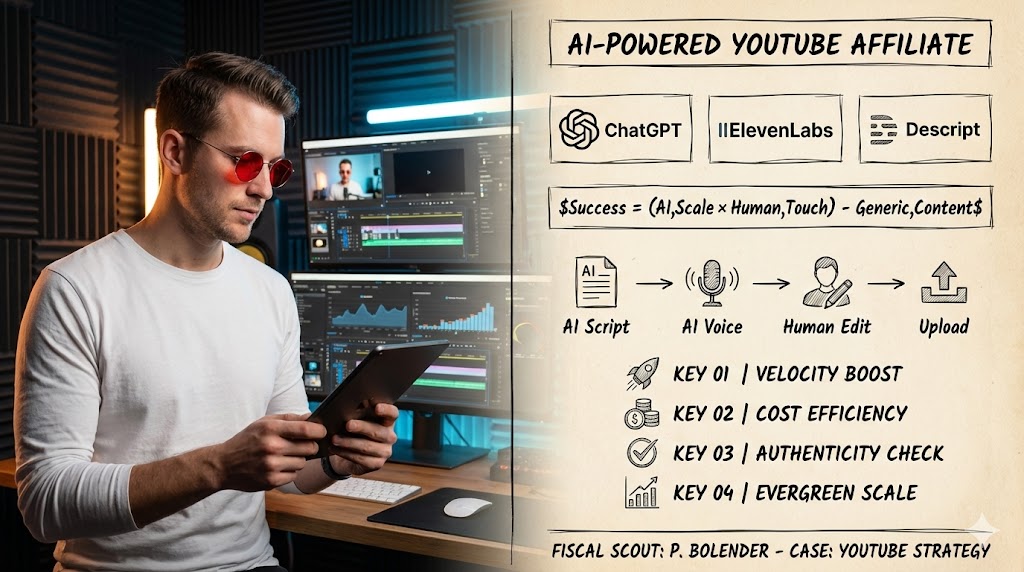
The workflow for creating YouTube affiliate videos with AI typically begins with niche and product selection, often aided by AI for market research. Once a product is chosen, an AI tool generates a script based on product features, benefits, and target audience insights. This script is then reviewed and refined by a human to ensure accuracy, authenticity, and a natural flow.
Following script finalization, AI text-to-speech generators convert the script into a professional voiceover. Some advanced AI video tools can then combine this voiceover with stock footage, images, and basic animations, creating a preliminary video draft. The human element remains critical for adding unique visual elements, fine-tuning the editing, and ensuring the video aligns with brand identity and YouTube’s best practices. Finally, AI can assist with optimizing the video title, description, and tags for maximum search visibility.
- Niche & Product Research: Identify profitable affiliate opportunities.
- Script Generation & Human Review: Create and refine video narratives.
- Voiceover Production: Convert text to natural-sounding audio.
- AI-Assisted Video Assembly: Combine audio, visuals, and text overlays.
- Human Editing & Branding: Add unique touches and ensure quality.
- SEO Optimization: Use AI for titles, descriptions, and tags.
Case Study: Scaling Product Reviews
The trap: A small affiliate marketer struggled to keep up with new product releases, limiting their review video output to one per week due to scriptwriting and editing bottlenecks.
The win: By implementing an AI script generator and text-to-speech tool, they increased their video production to three per week. After human review and minor edits, their channel saw a 150% increase in monthly views and a 70% rise in affiliate commissions within three months, demonstrating the power of scaled content.
Which AI Tools are Best for Scripting and Voiceovers?
Essential AI Tools for YouTube Affiliate Content
Context label: These tools are crucial for automating the most time-consuming aspects of video creation, namely script generation and voice narration.
- ChatGPT/Bard (or similar LLMs) – Positioning: Versatile Script Generators. Concrete benefit: Excellent for brainstorming ideas, generating outlines, and drafting full video scripts quickly.
- Descript – Positioning: All-in-one Audio/Video Editor with AI. Concrete benefit: Allows editing video by editing text, includes high-quality AI voices, and screen recording.
- ElevenLabs – Positioning: Advanced AI Voice Synthesis. Concrete benefit: Produces highly realistic and customizable voiceovers with emotional range, ideal for professional narration.
- Postlabs.ai – Positioning: AI SEO Writer & Autoblogger. Concrete benefit: While primarily for text, its content generation capabilities can be adapted to create detailed video outlines and research-backed content for scripts, enhancing SEO for your YouTube descriptions.
Decision help label: When choosing, consider your budget and the level of realism required for voiceovers. If you need highly emotive narration, invest in advanced voice synthesis. If your primary need is rapid script generation and basic voice, a general LLM combined with a simpler text-to-speech tool might suffice. Avoid tools that offer only robotic voices, as they can significantly detract from viewer engagement.
How to Optimize YouTube Videos with AI for Affiliate Success?
Optimizing YouTube videos with AI goes beyond just creating content; it involves strategically positioning your videos to be discovered by potential buyers. AI tools can analyze YouTube’s algorithm and user behavior data to suggest optimal titles, descriptions, and tags. This ensures your videos appear in search results and recommended feeds, driving more organic traffic to your affiliate offers.
Furthermore, AI can help in identifying the best times to publish, understanding audience demographics, and even predicting content performance. By leveraging these insights, creators can fine-tune their content strategy, focusing on topics that have high search demand and engagement potential. This data-driven optimization is a powerful advantage for maximizing affiliate conversions.
- Keyword Research: AI identifies high-volume, low-competition keywords for titles and descriptions.
- Title & Description Generation: AI crafts compelling, SEO-friendly text that includes affiliate links.
- Tag Suggestions: AI recommends relevant tags to improve video discoverability.
- Thumbnail Optimization: Some AI tools can analyze and suggest effective thumbnail designs.
- Audience Insights: AI helps understand viewer demographics and engagement patterns.
Myth: AI-Generated Content is Always Penalized by YouTube
Myth statement: YouTube’s algorithm automatically detects and penalizes videos created using AI, leading to demonetization or reduced reach.
Reality: Quality and Value are Paramount
Fact explanation: YouTube’s guidelines focus on the quality and value of the content, not solely on its creation method. If AI-generated content is refined, provides genuine value, and adheres to community guidelines, it is generally not penalized. The key is to ensure human oversight, add unique value, and maintain transparency where appropriate. Poorly executed, spammy AI content will be penalized, just like any low-quality human-made content.
What are Common Mistakes in AI Affiliate Video Production?
One of the most common pitfalls in AI affiliate video production is the over-reliance on automation without sufficient human oversight. This often leads to content that feels generic, lacks personality, or contains factual inaccuracies. Viewers quickly detect a lack of human touch, which can erode trust and significantly reduce engagement and conversion rates. Authenticity remains a critical factor in building a loyal audience on YouTube.
Another significant mistake is neglecting the ethical implications and disclosure requirements. While AI can generate content, failing to disclose its use (especially for voiceovers or entirely AI-generated narratives) can be misleading. Additionally, focusing solely on quantity over quality, churning out numerous low-effort videos, often results in poor performance and can even lead to channel penalties from YouTube for spammy behavior. A balanced approach, where AI augments human creativity, is essential.
- Lack of Human Review: Publishing raw AI output without editing for accuracy or tone.
- Generic Voiceovers: Using robotic or unexpressive AI voices that deter viewers.
- Ignoring SEO Best Practices: Failing to optimize titles, descriptions, and tags despite using AI for content.
- No Value Proposition: Creating videos that merely list product features without offering genuine insights or solutions.
- Inconsistent Branding: Videos lacking a cohesive visual style or brand voice.
Warning: The Authenticity Trap
Critical mistake to avoid: Producing videos that are entirely AI-generated without any human refinement or unique perspective. Explanation of consequence: This often results in content that feels impersonal, lacks credibility, and fails to build a connection with the audience, ultimately leading to low engagement, poor affiliate conversions, and potential channel stagnation.
How to Choose Profitable Affiliate Niches with AI?
Selecting a profitable niche is foundational to any affiliate marketing success, and AI can significantly enhance this process. Instead of manual research, AI tools can analyze market trends, search volume data, and competitor activity across various platforms, including YouTube. This allows marketers to identify niches with high demand, low competition, and a strong potential for affiliate product integration. The goal is to find a sweet spot where audience interest aligns with available, high-commission affiliate products.
AI can also help in segmenting audiences within a niche, identifying specific pain points or desires that can be addressed through video content. By understanding these micro-niches, creators can tailor their content more precisely, increasing relevance and engagement. This targeted approach ensures that the videos produced are not just seen, but resonate deeply with viewers who are actively looking for solutions or product recommendations.
- Trend Analysis: AI identifies emerging and evergreen topics with high search interest.
- Competitor Analysis: AI assesses existing YouTube channels in a niche to find content gaps.
- Audience Segmentation: AI helps pinpoint specific viewer needs and preferences.
- Product-Market Fit: AI suggests affiliate products that align well with identified niche demands.
Insider tip: Look for ‘Problem/Solution’ Niches
AI is excellent at identifying common problems people search for. Focus your niche research on areas where affiliate products offer clear solutions. For example, ‘best noise-cancelling headphones for remote work’ is more effective than just ‘headphones’.
Can AI Help with Video Editing and Production?
While AI excels at script generation and voiceovers, its capabilities in video editing and production are rapidly advancing. Modern AI video editors can automate tasks such as cutting out silences, adding subtitles, selecting relevant stock footage based on script content, and even generating basic animations or transitions. These tools significantly reduce the manual effort involved in post-production, making it easier for creators to produce polished videos.
However, it’s important to note that AI-powered video editing is still largely assistive rather than fully autonomous for complex projects. Human editors remain crucial for adding creative flair, ensuring seamless transitions, color grading, and incorporating unique visual storytelling elements. AI streamlines the mundane, repetitive tasks, allowing human creativity to focus on the artistic and strategic aspects that truly make a video stand out.
- Automated Cuts: AI can remove filler words and dead air from recordings.
- Subtitle Generation: Automatically transcribes audio into accurate captions.
- Stock Footage Integration: AI suggests and inserts relevant video clips from libraries.
- Basic Effects & Transitions: Automates simple visual enhancements.
- Background Music Selection: AI can recommend royalty-free music to match video tone.
“The most effective use of AI in creative fields isn’t to replace human artists, but to empower them to achieve more with less effort, allowing them to focus on the unique human elements of storytelling.”
— Andrew Ng, Co-founder of Coursera and Google Brain, AI Expert
How to Scale Your YouTube Affiliate Channel with AI?
Scaling a YouTube affiliate channel with AI involves leveraging automation at every possible stage to increase output without a proportional increase in resources. This means not just generating individual videos faster, but creating a systematic process where AI handles the heavy lifting from content ideation to initial production. By establishing clear workflows and integrating various AI tools, creators can manage multiple channels or produce content across a broader range of niches simultaneously.
A key aspect of scaling is the ability to analyze performance data efficiently. AI can process vast amounts of analytics to identify what’s working and what’s not, allowing for rapid adjustments to content strategy. This iterative improvement cycle, fueled by AI insights, ensures that resources are continuously directed towards the most profitable content types and affiliate products, driving sustainable growth for the channel.
- Batch Content Creation: Generate multiple scripts and voiceovers in one session.
- Template-Based Production: Use AI to fill pre-designed video templates.
- Automated A/B Testing: AI can help test different titles, thumbnails, and calls to action.
- Performance Analysis: AI identifies top-performing content and audience engagement patterns.
- Multi-Channel Management: Apply AI workflows across several niche channels.
Scaling Efficiency with AI
Channels that effectively integrate AI into their content pipeline report being able to produce 3-5 times more videos per week compared to traditional methods, significantly accelerating their growth and monetization potential.
What are the Ethical Considerations for AI in Affiliate Marketing?
The ethical use of AI in affiliate marketing is paramount for maintaining trust and long-term success. One primary concern is transparency: viewers should ideally be aware when content, especially voiceovers or entire narratives, is AI-generated. Failing to disclose this can be seen as deceptive, potentially leading to a loss of audience trust and even violating platform terms of service.
Another consideration is the potential for misinformation or biased content. AI models learn from existing data, which can sometimes contain biases or inaccuracies. Without careful human review, AI-generated content might inadvertently spread false information or promote products unfairly. Responsible AI use demands rigorous fact-checking and a commitment to providing genuine value, ensuring that the technology serves the audience’s best interests rather than solely maximizing profit.
- Transparency: Clearly disclose when AI is used for content generation.
- Accuracy: Human review is essential to prevent the spread of misinformation.
- Bias Mitigation: Actively check AI output for unintended biases in product recommendations.
- Authenticity: Ensure content still feels genuine and provides real value, not just automated sales pitches.
- Data Privacy: Be mindful of how AI tools handle user data and content inputs.
Actionable Steps to Launch Your AI Affiliate Channel
Your AI Affiliate Marketing Launch Checklist
- Define Your Niche (Within 1 week): Research and select a specific, profitable niche using AI trend analysis tools.
- Select Core AI Tools (Within 3 days): Subscribe to an AI script generator (e.g., ChatGPT), a voiceover tool (e.g., ElevenLabs), and an AI-assisted video editor.
- Generate First 5 Scripts (Within 1 week): Use AI to draft five video scripts for your chosen niche, focusing on product reviews or tutorials.
- Human Review & Refine Scripts (Within 3 days per script): Meticulously edit each AI-generated script for accuracy, tone, and authenticity.
- Produce Voiceovers & Initial Videos (Within 2 weeks): Create voiceovers and assemble initial video drafts using your chosen AI tools.
- Perform Final Human Edits (Within 1 week per video): Add unique visual elements, fine-tune pacing, and ensure brand consistency.
- Publish First Video & Optimize (Immediately after editing): Upload your first video, ensuring AI-optimized titles, descriptions, and tags are in place.
- Set Up Affiliate Links (Before publishing): Secure and integrate your affiliate links into video descriptions and comments.
Common Questions About AI & YouTube Affiliate Marketing
Can AI completely replace human creators on YouTube?
No, AI cannot fully replace human creators. While AI can automate many tasks, the unique creativity, emotional intelligence, and authentic connection that human creators bring are irreplaceable for building a loyal audience and fostering trust.
Is it expensive to use AI tools for YouTube?
The cost varies significantly. Many AI tools offer free tiers or trials, while advanced features and higher usage limits come with subscription fees. However, the investment can often be offset by the time savings and increased content output, making it cost-effective in the long run.
How do I ensure my AI-generated content doesn’t sound robotic?
To avoid robotic-sounding content, use advanced AI voice generators like ElevenLabs that offer realistic voices with emotional nuances. Additionally, always review and edit the AI-generated script to ensure natural language flow and human-like phrasing before generating the voiceover.
Will YouTube penalize me for using AI in my videos?
YouTube’s policies focus on the quality and intent of the content, not solely on the tools used to create it. If your AI-generated videos provide value, are accurate, and adhere to community guidelines, you are unlikely to be penalized. However, spammy, low-effort, or deceptive AI content can lead to penalties.