
Optimize for Conversion. Period.
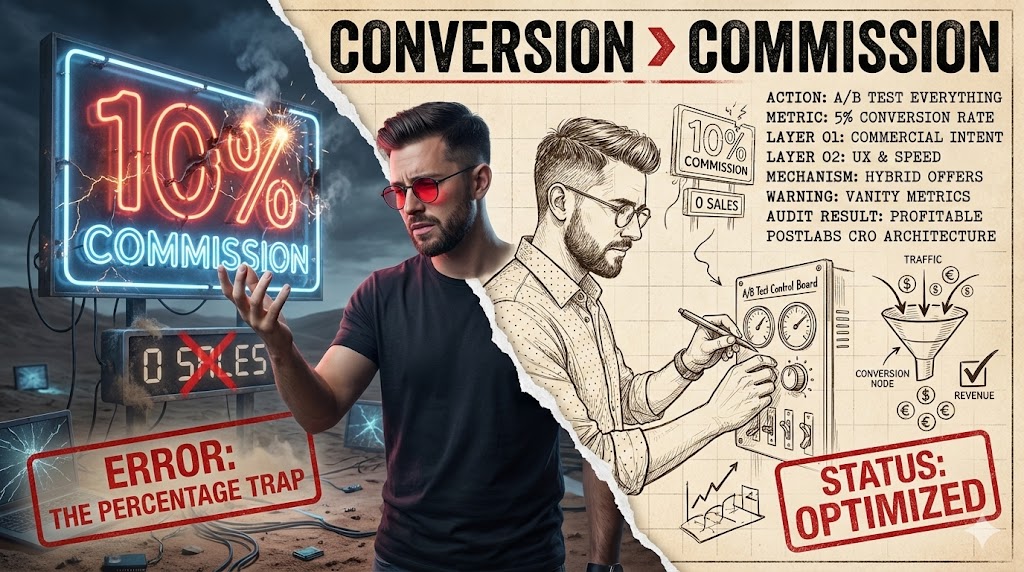
If you chase high commissions on low-converting products, you’ll lose. Focus on what converts, not just what pays the most per sale. This approach works for beginners and seasoned pros alike.
- Prioritize conversion rate over raw commission percentage.
- Requires consistent A/B testing and audience understanding.
- Best for affiliates ready to analyze data and refine content.
If you have zero traffic or haven’t even picked a niche yet, stop reading. Focus on getting eyeballs first.
Okay, quick knowledge check before we dive in. This one trips up a lot of folks:
What’s the biggest mistake beginners make when choosing Amazon affiliate products?
Stop Chasing High Commissions: The Conversion Trap
Honestly, this is where most beginners screw up. They see a product with a 10% commission rate and think, 'Jackpot!' But if that product has low demand or a terrible conversion rate, you’re just spinning your wheels. I once spent weeks writing a detailed review for a niche gadget, thinking that 12% commission would make me rich. After all that effort, I got three sales. Total crap. Your revenue fails when you prioritize commission percentage over actual sales volume and conversion rate.
The real money isn’t in the highest percentage. It’s in the highest *effective* percentage. That means a product with a 3% commission that converts 5% of your visitors will always outperform a 10% commission product converting at 0.5%. Do the math. It’s not rocket science. Focus on products that people are actively searching for and are ready to buy. Look for established brands with good reviews, even if the commission is lower. Volume and trust beat greed every single time.
This isn’t just about Amazon either. The same principle applies across the board. If you’re building out your affiliate strategy, you need to think about the bigger picture. Are you just linking, or are you building a real business? The difference is huge. A good strategy, like the one discussed at Affililabs’ ultimate Amazon affiliate strategy guide, emphasizes this balance.
Pros of Conversion-First
- Higher overall revenue from fewer clicks.
- Builds more trust with your audience.
- More predictable and scalable income streams.
Cons of Conversion-First
- Requires more initial research and testing.
- May mean lower per-sale commission rates.
- Can be slower to see initial big wins.
The Bullshit of 'Just Write More Content'
I’ve seen this advice thrown around like candy: "Just write 100 articles a month!" That’s pure garbage. Pumping out generic, low-quality articles without a clear commercial intent is a fast track to burnout and zero sales. I watched a guy try this; he wrote 200 posts in a month, all thin content. He got zero sales and damn near quit affiliate marketing. Your content strategy fails when you prioritize quantity over quality and commercial intent.
Instead, focus on fewer, higher-quality pieces that target specific buying keywords. Think 'best X for Y', 'X vs. Y', or 'X review'. These are commercial intent keywords. People searching these terms are close to making a purchase. Your job is to guide them. Don’t just list features; explain benefits, address pain points, and provide genuine recommendations. This builds authority and trust, which are critical for conversions.
Every piece of content should have a purpose. Before you even type a single word, ask yourself: what problem does this solve? What question does it answer? Is the user ready to buy? If not, you might be targeting the wrong keyword for an affiliate sale. It’s about being a helpful guide, not a glorified catalog. This approach is fundamental to scaling income, as highlighted by Affililabs.
Myth
More content always equals more affiliate sales.
Reality
Quality content targeting commercial intent keywords drives sales. Generic, high-volume content often leads to wasted effort and no conversions.
Conversion Rate Optimization (CRO) Isn’t Optional
Ignoring how users interact with your page is like opening a store and never watching how customers move around. You’re leaving money on the table, plain and simple. I had a page ranking #3 for a high-value term. It was getting decent traffic, but the conversion rate was a pathetic 0.5%. After A/B testing headlines, call-to-action buttons, and product image placements, it jumped to 3% in about two months. That’s a huge difference in revenue without needing more traffic. This part absolutely sucks if you don’t pay attention. Your affiliate revenue will stagnate if you don’t actively work to improve your site’s conversion rate.
CRO isn’t just for big e-commerce sites. Even a beginner affiliate can implement basic CRO tactics. Start by looking at your Google Analytics. Where are people dropping off? What elements are they ignoring? Are your buttons clear? Is your page loading fast enough? These small tweaks can have a massive impact. Don’t just set it and forget it. Your audience’s behavior changes, and your site needs to adapt.
Think about the user experience. Are your product recommendations clear? Is it easy to click through to Amazon? Are there too many distractions? Sometimes, just simplifying the layout or making your 'Buy Now' button more prominent can move the needle. It’s an ongoing process, but one that pays dividends. Every little bit of friction you remove helps push a visitor closer to a purchase.
Warning: The 'Set It and Forget It' Trap
Never assume your content is optimized forever. Ignoring user behavior data means you’ll miss opportunities to fix conversion blockers, leading to stagnant or declining revenue.
Hybrid Offers: The Real Game Changer
Sticking only to Amazon links is like bringing a knife to a gunfight. You’re limiting your earning potential big time. We saw a 2x revenue jump on one of our niche sites just by adding a digital product alongside our Amazon links. This is what we call a hybrid offer, and it’s a powerful strategy. Your income potential is severely capped if you rely solely on a single affiliate program.
A hybrid offer means you promote both physical products (like from Amazon) and digital products (like an ebook, course, or software) related to the same niche. For example, if you review coffee makers, you could also offer an ebook on 'Mastering Your Home Brew' or a subscription to a coffee bean club. This diversifies your income and often offers higher commissions on the digital side. It also builds a stronger relationship with your audience, because you’re providing more value.
This strategy is a cornerstone of advanced affiliate marketing. It allows you to capture value at different stages of the buyer’s journey and provides multiple income streams. It’s not just about selling; it’s about providing comprehensive solutions. Many successful affiliates are leveraging this. You can learn more about this approach and how to implement it effectively by checking out the ultimate Amazon affiliate strategy guide.
Hybrid Offer: An affiliate strategy combining promotions for both physical products (e.g., Amazon) and digital products (e.g., ebooks, courses) within the same niche to diversify revenue and increase value.
The Power of Product Comparison Tables
Just listing products with links is lazy. It doesn’t help your reader make a decision, and frankly, it doesn’t convert well. I built a simple comparison table for a 'best gaming mouse' article. The conversion rate jumped from 1.2% to 2.8% in just one month. That’s a huge bump from a relatively small effort. Your content fails to convert effectively when it doesn’t provide clear, scannable comparisons for buying decisions.
Comparison tables are fantastic because they allow readers to quickly compare key features, pros, and cons of different products. This helps them make an informed decision without having to click back and forth between multiple product pages. Always include your affiliate link directly in the table. Make it easy for them to buy once they’ve decided.
When creating a table, focus on the most important criteria for your niche. For electronics, it might be price, battery life, and specific features. For home goods, it could be material, size, and ease of cleaning. Don’t overload the table with too much information. Keep it concise, clear, and actionable. It’s about simplifying the buying process, not complicating it. Here’s an example of how we track some of our content performance:
Affiliate Content Performance Review (2026)
| Content Type | Avg. Traffic | Avg. Conv. % | Est. Monthly Rev. |
|---|---|---|---|
| Simple Listicle | 1500 | 0.8% | $120 |
| Detailed Review | 800 | 2.5% | $180 |
| Comparison Table | 1200 | 3.1% | $300 |
Leveraging AI for Content & CRO
Using AI to just churn out generic text is a fast track to garbage. I tried a tool that promised "one-click articles." Total crap. The output was useless, required heavy editing, and sounded like a robot wrote it (because it did). Your AI efforts will fail if you use it as a replacement for human insight and strategic thinking.
However, AI can be a powerful assistant. Use it for brainstorming content outlines, generating headline ideas for A/B tests, or summarizing competitor reviews. For example, I’ll feed it 10 competitor articles and ask for common themes or unique selling propositions. This saves hours of manual research. It’s about augmenting your work, not automating it entirely. Think of it as a super-fast intern, not the CEO.
You can also use AI to help with CRO. Ask it to suggest different call-to-action phrases or variations for a product description. Then, test these suggestions. The key is to always apply your human judgment and test the results. Never just copy and paste. Here’s a prompt I use for this. Just copy and paste it into ChatGPT or Gemini to get started:
Understanding Your Audience’s Buying Journey
Assuming everyone landing on your page is ready to buy right now is a huge mistake. I once optimized a page for 'best XYZ' but completely forgot that many users were still in the research phase. My conversion funnel was broken because I was pushing a hard sale too early. Your strategy will fall flat if you don’t tailor your content to where your audience is in their buying journey.
People go through stages: awareness, consideration, and decision. At the awareness stage, they’re just looking for information. 'What is X?' At consideration, they’re comparing options. 'X vs Y.' At decision, they’re ready to buy. 'Best X to buy.' Your content needs to match these stages. A blog post for awareness might not have direct affiliate links, but it builds trust and guides them to your consideration-stage content.
Understanding this journey helps you create a more effective content strategy and place your affiliate links strategically. Don’t hit them with a 'Buy Now' button when they’re still asking 'What is it?' This estimated model, based on our experience, illustrates typical conversion drop-offs at different stages of the buyer’s journey. It’s not a universal benchmark, but it shows where you might be losing potential customers.
Estimated Affiliate Funnel Performance
Conversion Drop-offs by Buyer Journey Stage (Illustrative Model)
The Hidden Gold in Low-Competition Keywords
Everyone chases the big, high-volume keywords. That’s a damn trap. Only targeting high-volume keywords means you’re fighting giants with massive budgets and authority. You’ll get crushed. I once found a keyword with only 50 searches per month. It converted at 10%. That’s 5 sales. Better than 1 sale from a 1000-search keyword converting at 0.1%. Your efforts will be wasted if you only target keywords where you can’t realistically rank.
These low-competition, long-tail keywords are often incredibly specific. Think 'best noise-canceling headphones for small ears' instead of just 'best noise-canceling headphones.' The search volume is lower, but the intent is much higher. People searching for these terms know exactly what they want, and they’re usually ready to buy. They’re easier to rank for, too, meaning you can see results faster.
Use tools like Ahrefs or Semrush to find these gems. Look for keywords with low Keyword Difficulty (KD) scores but clear commercial intent. Don’t be afraid to go deep into sub-niches. That’s where the real, scalable income is. It might feel counterintuitive at first, but it works. This isn’t just my opinion; it’s a common thread among successful affiliates.
"The riches are in the niches. Don’t fight for scraps in crowded markets; dominate a small, hungry one."
— General Consensus, Experienced Affiliate Marketers
Speed & User Experience: Not Just for SEO Geeks
A slow site or a bad mobile experience will kill your conversions. Plain and simple. I optimized a site that loaded in a sluggish 6 seconds. After some image compression and caching tweaks, I got it down to 1.5 seconds. The bounce rate dropped by 15%, and conversions saw a noticeable bump. That’s more eyeballs on your offers and more money in your pocket. Your conversion rates will tank if your site is slow or hard to use on mobile.
Google cares about page speed, sure, but so do your visitors. If your site takes too long to load, they’ll hit the back button faster than you can say 'affiliate commission.' This is especially true on mobile devices, where people are often on the go. Use Google’s PageSpeed Insights or GTmetrix to check your site’s performance. Address any critical issues they flag.
Beyond speed, think about overall user experience (UX). Is your site easy to navigate? Is the font readable? Are there annoying pop-ups everywhere? A clean, intuitive design makes it easier for visitors to find what they’re looking for and click your links. Don’t overcomplicate things. Simple often wins. This is a foundational element of any successful online venture.
Building Trust Beyond the Review
Just slapping affiliate links on a product review makes you look like a shill. I used to just copy manufacturer specs and call it a day. My audience didn’t trust it, and my conversions were mediocre. Adding personal experience, real pros and cons, and even a 'why I chose this' section changed everything. Your audience won’t convert if they don’t trust your recommendations.
To build trust, you need to be authentic. Share your own experiences with the product. If you haven’t used it, be transparent about that and rely on extensive research and user reviews. Highlight both the good and the bad. No product is perfect. When you’re honest about limitations, your positive points become much more credible. This is about being a helpful friend, not a salesperson.
Consider adding a 'Verdict' or 'Who is this for?' section. Help your reader understand if the product is right for them. This level of detail and honesty builds a loyal audience that will come back for more recommendations. Here’s a quick tool to help you craft compelling product descriptions that build trust. Use it to generate ideas for your next review:
What I Would Do in 7 Days to Boost Amazon Affiliate Revenue
- Day 1: Audit Your Top 5 Pages. Identify your highest traffic pages. Check their current conversion rates.
- Day 2: Keyword Intent Check. For those top pages, confirm the primary keyword has commercial intent. If not, consider optimizing for a better keyword or adding a hybrid offer.
- Day 3: CRO Quick Wins. Look at headlines, button colors, and calls-to-action on your top pages. Make one small, testable change on each.
- Day 4: Implement a Comparison Table. Pick one product category where you recommend multiple items. Build a simple comparison table for it.
- Day 5: Research Hybrid Offer. Find one digital product (ebook, course, tool) that complements an existing Amazon product you promote.
- Day 6: Draft Hybrid Content. Write a short section on an existing page introducing the hybrid offer.
- Day 7: Speed Check & Mobile Review. Run your site through PageSpeed Insights. Test your site on your phone. Fix any glaring issues.
Affiliate Optimization Checklist
- Have I prioritized conversion rate over raw commission?
- Is my content targeting commercial intent keywords?
- Am I actively testing and improving my page’s CRO?
- Have I explored hybrid offers beyond just Amazon?
- Do my product pages include clear comparison tables?
- Am I using AI as an assistant, not a full content generator?
- Is my content tailored to the buyer’s journey stage?
- Am I targeting low-competition, high-intent keywords?
- Is my website fast and mobile-friendly?
- Am I building trust through authentic reviews and transparency?
Frequently Asked Questions
What is a good conversion rate for Amazon affiliates?
A 'good' conversion rate varies by niche, but aiming for 1-3% is a solid starting point. Highly optimized content in specific niches can reach 5% or more. Don’t compare yourself to e-commerce stores, as affiliate conversions are generally lower.
Should I always choose the cheapest product to promote?
Not necessarily. Focus on value for money and what genuinely solves your audience’s problem. Sometimes a slightly more expensive product offers better quality, leading to happier customers and fewer returns, which can indirectly benefit your long-term trust and conversions.
How often should I update my affiliate content?
You should review and update your content at least once a year, or whenever products are discontinued, new models are released, or market trends shift significantly. Outdated content loses trust and conversions.