


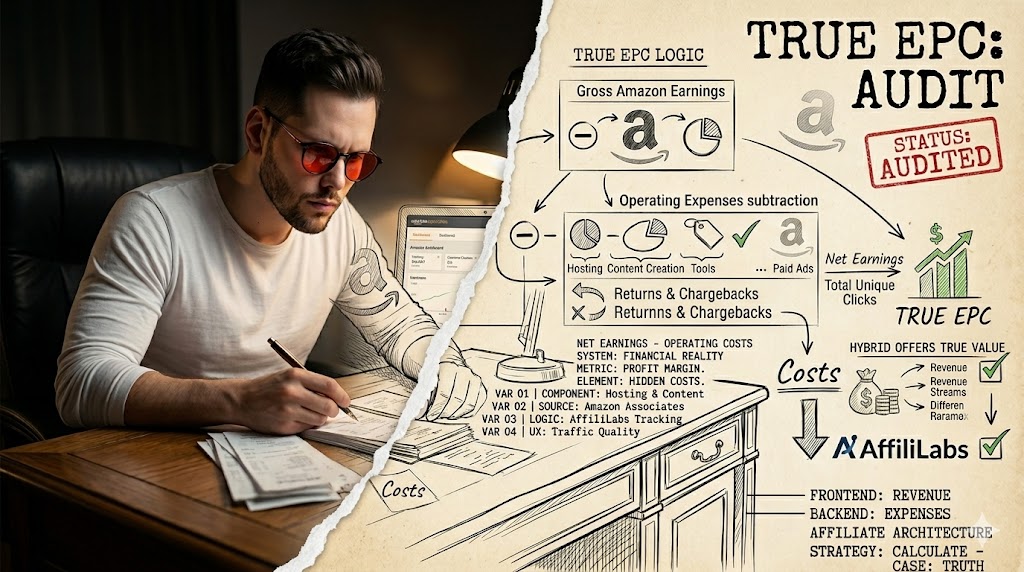
Stop Guessing Your Affiliate Profit
Calculate your true EPC. Don’t rely on Amazon’s basic numbers. Your actual earnings per click are likely much lower than you think. Ignoring real costs and conversion factors is a surefire way to bleed money, not make it.
- Accurate EPC reveals true campaign profitability.
- Hidden costs and traffic quality are often overlooked.
- Optimizing for true EPC drives sustainable growth.
If you’re only looking at Amazon’s reported EPC, stop reading right now. That number is pure garbage for understanding your actual business. It leaves out too much. You need to dig deeper.
Which factor is most commonly ignored when calculating Amazon affiliate EPC?
Why Your ‘Simple’ EPC is Bullshit
Most affiliate marketers glance at the Amazon Associates dashboard. They see an ‘EPC’ number there. They think, ‘Okay, that’s my earnings per click.’ Honestly, that’s a huge trap. I’ve seen countless folks (myself included, early on) make decisions based on this surface-level metric. It’s a recipe for disaster.
The problem is, Amazon’s EPC only tells you what *they* think you earned per click *on their platform*. It doesn’t factor in a single dime of your actual operating costs. You know, the stuff that keeps your website running. Your true profitability fails when you trust Amazon’s numbers without adding your own.
Think about it. You spend money on content, hosting, tools, maybe even ads. If Amazon says you made $0.20 EPC, but you spent $0.15 per click to get that traffic and maintain the site, your actual profit is a measly $0.05. That’s a massive difference. This basic EPC is just one piece of a much larger, more complex puzzle. It’s not fun to realize you’ve been chasing phantom profits.
We need to move beyond this. We need a calculation that includes everything. Otherwise, you’re just playing a guessing game with your business. That’s not how you build something sustainable. It’s how you burn out and wonder where all your effort went.
Pros of True EPC Calculation
- Identifies genuinely profitable content and traffic sources.
- Allows for smarter budget allocation on tools and ads.
- Provides a clear, actionable path to increase overall revenue.
Cons of Ignoring True EPC
- Misallocates resources to seemingly profitable, but actually losing, efforts.
- Leads to burnout from chasing low-value traffic.
- Hinders long-term business growth and financial stability.
The Hidden Costs That Screw Your EPC
Okay, let’s talk about the elephant in the room: all the money you spend to make money. Amazon doesn’t care about your hosting bill. They don’t care about the hundreds you drop on content writers. But you absolutely should. Your true EPC gets screwed when you ignore these real-world expenses.
I once worked with a site that had a great Amazon EPC on paper, around $0.35. Sounded good, right? But when we factored in their content budget ($5,000/month), their premium hosting ($150/month), and their SEO tools ($200/month), their actual EPC plummeted to $0.08. They were barely breaking even. This kind of oversight is common and it’s damn frustrating.
Here’s a breakdown of costs you absolutely must include:
- Content Creation: This is huge. Whether you write it yourself (your time has value!) or outsource, every article, review, and comparison guide costs money. A 2000-word review might cost $200-$400. You need to amortize that over its lifetime clicks and earnings.
- Website Hosting & Maintenance: Reliable hosting isn’t free. Neither are security plugins, backups, or a CDN. These are fixed costs that get spread across all your traffic.
- SEO Tools & Software: Ahrefs, Semrush, Surfer SEO, Grammarly, image optimization tools – they add up. These are essential for ranking and creating good content, so they’re part of your cost of doing business.
- Email Marketing & Outreach: If you’re building an email list or doing link outreach, those services and efforts cost money. They contribute to your traffic and conversions, so they belong in the calculation.
- Paid Advertising: Running Google Ads, Facebook Ads, or Pinterest Ads? This is a direct cost per click or impression. It’s probably the easiest to track, but often forgotten in the ‘overall’ EPC.
- Your Time: This is the big one. If you’re doing everything yourself, you’re investing time. What’s your hourly rate? Factor it in. If you’re not paying yourself, you’re not truly profitable.
Each of these costs chips away at your gross earnings. If you don’t account for them, you’re living in a fantasy land. Your true EPC is the only metric that shows if your efforts are actually paying off. Otherwise, you’re just spinning your wheels.
Traffic Quality: Not All Clicks Are Equal
It’s easy to get obsessed with traffic numbers. ‘More visitors equals more money,’ right? Well, that’s a load of crap. I’ve seen sites with millions of clicks making less than sites with a fraction of that traffic. The trap is thinking all traffic is created equal. Your strategy fails when you treat every click as having the same value, regardless of its source or intent.
A click from someone searching ‘best noise-cancelling headphones for travel’ is worth a hell of a lot more than a click from ‘how to fix broken headphones.’ The first person is ready to buy. The second is looking for a DIY solution. They have completely different intents, and their likelihood to convert into an Amazon sale varies wildly.
Qualified Traffic: Visitors who demonstrate a high intent to purchase or engage with a specific product/service, typically identified by specific search queries, referral sources, or on-site behavior.
You need to segment your traffic. Look at where your clicks are coming from. Are they organic searchers? If so, what keywords are they using? Are they coming from social media? Which platforms? Are they from an email list? Each source will have a different conversion rate and, therefore, a different EPC.
For instance, I had a client getting tons of Pinterest traffic. High volume, low cost. But the conversion rate to Amazon sales was abysmal, like 0.5%. Meanwhile, their long-tail organic search traffic, while lower volume, converted at 5%. The organic traffic had a significantly higher true EPC, even if it cost more to acquire initially. Focus on the quality, not just the quantity. That’s where the real money is made.
Conversion Rate Traps and How They Tank Your Earnings
You can drive all the traffic in the world, but if your site doesn’t convert, your EPC will tank. It’s that simple. I’ve seen perfectly good content get wasted because of conversion rate traps. Your earnings fail when you ignore the user’s journey from click to purchase.
Many affiliates just assume their job is done once the user clicks their Amazon link. That’s a huge mistake. The journey *before* the Amazon click is critical. Is your review clear? Is it persuasive? Does it build trust? If not, users will bounce back to Google, or worse, find another affiliate’s link.
Here are some common conversion rate killers:
- Slow Page Load Times: Users are impatient. If your page takes more than 2-3 seconds to load, they’re gone. This directly impacts how many people even see your content, let alone click an affiliate link.
- Poor Mobile Experience: Most traffic is mobile these days. If your site looks like crap on a phone, you’re losing money. Buttons too small? Text unreadable? Fix it.
- Lack of Clear Calls to Action (CTAs): Don’t make users hunt for the ‘Buy Now’ button. Make it obvious, compelling, and strategically placed. Use strong action verbs.
- Overwhelming Ads: Too many pop-ups, banner ads, or intrusive elements will send users running. They’re there for information, not an assault on their senses.
- Outdated Content: If your product recommendations are from 2022, users won’t trust you in 2026. Keep your reviews fresh and updated. This is non-negotiable.
I once optimized a review page that had a decent amount of traffic but a terrible conversion rate. We sped up the page, added clear comparison tables, and made the ‘Check Price on Amazon’ buttons pop. Within a month, the conversion rate jumped from 1.5% to 3.2%. Same traffic, double the clicks to Amazon. That’s a huge win for EPC.
Affiliate Site Performance Audit (2026)
| Project/Item | Cost/Input | Result/Time | ROI/Verdict |
|---|---|---|---|
| Content Update (Old Reviews) | $500 | +15% Conv. Rate (2 weeks) | High |
| Page Speed Optimization | $300 | -1.2s Load Time (1 week) | Excellent |
| Mobile UX Redesign | $1200 | +20% Mobile Clicks (4 weeks) | Good |
The Real Impact of Returns and Chargebacks
Here’s a fun one that nobody talks about: returns. You make a sale, you see the commission pending, you do a little happy dance. Then, a few weeks later, poof! It’s gone. Because the customer returned the item. Your EPC takes a hit when you only track initial sales and ignore these post-sale adjustments.
Amazon’s return policy is super customer-friendly, which is great for buyers, but can be a real pain for affiliates. That pending commission isn’t truly yours until the return window closes. And chargebacks? Even rarer, but they can happen. Both eat into your final earnings, often weeks or months after the initial click.
Warning: Don’t Count Your Chickens
Never assume pending commissions are final earnings. Returns and chargebacks can significantly reduce your actual payout, making your initial EPC estimates wildly inaccurate.
I once had a month where a high-ticket item, a $1500 laptop, was returned. That single return wiped out a good chunk of my expected commission for that period. It was a damn wake-up call. You have to factor in an estimated return rate based on your niche and product categories. Electronics, for example, often have higher return rates than, say, kitchen gadgets.
To get a true picture, you need to look at your *net* earnings after returns, not just the gross. Amazon provides reports that show returned items. Dig into them. Calculate your average return rate over a few months. Then, apply that percentage to your gross earnings to get a more realistic figure. This might sound like a pain, but it’s crucial for understanding your actual profit margins. Otherwise, you’re building a business on sand.
Beyond Amazon: Hybrid Offers and True Value
Limiting yourself to only Amazon commissions is like leaving money on the table. Seriously, it’s a huge mistake. The real pros are looking at hybrid offers. This means combining Amazon links with other monetization strategies. Your overall value fails when you stick to a single income stream.
Think about it: a user clicks your link, buys a $50 item on Amazon, and you get a few bucks. What if that same user also signs up for a free trial of a related software through another link on your site? Or requests a quote for a service? That’s additional revenue from the same click. This drastically changes your true EPC.
I’ve seen affiliates pivot from purely Amazon to a hybrid model and double their earnings per visitor. For example, a tech review site might link to Amazon for product sales but also offer a lead generation form for a related B2B software. Or a home improvement blog could link to Amazon for tools, but also promote a local contractor service for a higher commission per lead.
This approach diversifies your income and often captures more value from each visitor. The key is finding complementary offers that genuinely benefit your audience. It’s not about spamming links; it’s about providing comprehensive solutions. This is where the real scalability comes into play. You’re not just a one-trick pony anymore.
This illustrative model shows how a hybrid approach can impact your overall value per visitor, even if Amazon conversions remain constant. It’s about maximizing the value of every single click you generate.
Affiliate Value Funnel: Amazon vs. Hybrid Offers
Estimated value capture across different monetization strategies
Calculating Your True EPC: The Formula You Need
Alright, enough talk about what’s wrong. Let’s get to the actual numbers. The true EPC isn’t some mystical beast; it’s a straightforward calculation once you have all your data. Your analysis fails when you use simplified formulas that miss crucial data points. This is the formula that actually matters:
True EPC = (Total Net Affiliate Earnings + Other Monetization Earnings – Total Operating Costs) / Total Unique Clicks
Let’s break down each part:
- Total Net Affiliate Earnings: This is your Amazon commission *after* returns and chargebacks. Get this from your Amazon reports.
- Other Monetization Earnings: Any revenue from other affiliate programs, display ads, lead generation, or direct sales on your site. Don’t forget these.
- Total Operating Costs: Everything we discussed earlier: hosting, tools, content, ads, your time. Sum it all up for the period you’re analyzing (e.g., a month).
- Total Unique Clicks: The total number of unique visitors who clicked *any* affiliate link on your site during that period. You can usually get this from Google Analytics or your affiliate link tracker.
This formula gives you a clear, honest picture. It shows you exactly how much you’re making per click after all your efforts and expenses. It’s the only way to truly understand your profitability. You can use this to compare different content types, traffic sources, or even entire websites. This is how you make smart, data-driven decisions.
Here is a prompt I use for this. Just copy and paste it into ChatGPT or Gemini to get started:
Use the calculator below to quickly estimate your true EPC. Just plug in your numbers and see where you stand. It’s a quick way to get a reality check on your current efforts.
Benchmarking and Optimization: What Good Looks Like
So, you’ve calculated your true EPC. Now what? Is $0.15 good? Is $0.50 amazing? The honest truth is, ‘good’ looks different for everyone. Your efforts fail when you chase arbitrary EPC numbers without understanding your specific niche and costs.
A true EPC of $0.10 might be fantastic for a high-volume, low-cost niche like cheap kitchen gadgets. But it would be terrible for a site reviewing expensive enterprise software. It all depends on your average commission, traffic cost, and conversion rates. Don’t compare your numbers directly to some random guru’s claims. Compare them to your own historical data.
Myth
There’s a universal ‘good’ EPC benchmark for all Amazon affiliates.
Reality
A ‘good’ EPC is highly dependent on your niche, product price points, traffic acquisition costs, and overall business model. Focus on improving your own numbers over time.
The goal isn’t just to hit a number. The goal is to continuously improve your own EPC. Here are some strategies:
- Optimize Content for Intent: Focus on keywords that show strong buying intent. These users are closer to making a purchase, leading to higher conversion rates and better EPC.
- Improve On-Page Conversion: A/B test your CTAs, review layouts, and internal linking. Even small tweaks can make a big difference in how many people click your affiliate links.
- Reduce Operating Costs: Can you find cheaper hosting? More efficient tools? Can you streamline your content creation process? Every dollar saved on costs directly boosts your true EPC.
- Diversify Monetization: As discussed, explore hybrid offers beyond just Amazon. Add lead generation, display ads, or other affiliate programs where appropriate.
- Analyze Traffic Sources: Double down on the traffic sources that bring in the highest converting visitors. Cut back on the ones that just generate noise and low-value clicks.
This isn’t a one-time fix. It’s an ongoing process. You calculate, you analyze, you optimize, and then you repeat. That’s how you build a sustainable, profitable affiliate business. Anything less is just guesswork. And guesswork, frankly, sucks for your bottom line.
“What gets measured gets managed. What gets managed gets improved.”
— General Consensus, Business Strategy
What I would do in 7 days to improve True EPC
- Day 1: Audit Current Costs. List every single expense related to your affiliate site for the last month. Hosting, tools, content, ads. Don’t miss anything.
- Day 2: Analyze Amazon Reports. Download your detailed earnings reports. Identify total gross earnings and actual net earnings after returns. Calculate your return rate.
- Day 3: Review Traffic Sources. Use Google Analytics to see which traffic sources (organic, social, direct) are driving clicks to your affiliate pages. Note their volume.
- Day 4: Calculate Initial True EPC. Plug all your numbers into the formula: (Net Earnings – Costs) / Total Clicks. Get your baseline.
- Day 5: Identify Low-Performing Content. Look for pages with high traffic but low Amazon clicks or sales. These are your conversion traps.
- Day 6: Brainstorm Hybrid Offers. Identify 1-2 complementary products or services you could promote alongside Amazon links. Think outside the box.
- Day 7: Plan Optimization. Choose one cost to reduce, one traffic source to double down on, and one content piece to optimize for better conversion. Start small, but start.
True EPC Optimization Checklist
- Calculate all monthly operating costs (hosting, tools, content).
- Verify net Amazon earnings after returns and chargebacks.
- Segment traffic by source and keyword intent.
- Identify and fix slow-loading pages and poor mobile UX.
- Optimize calls to action on high-traffic affiliate pages.
- Explore and integrate complementary hybrid monetization offers.
- Regularly review and update outdated product reviews.
Frequently Asked Questions
What is a good True EPC for Amazon affiliates?
There’s no universal ‘good’ number. It depends heavily on your niche, product prices, and traffic costs. Focus on improving your own True EPC over time rather than chasing arbitrary benchmarks.
How often should I calculate my True EPC?
Ideally, you should calculate it monthly. This allows you to track trends, identify seasonal changes, and quickly react to drops or spikes in profitability. Consistency is key for accurate analysis.
Can I automate True EPC calculation?
Partially, yes. Tools can track traffic and some costs. However, integrating all data (especially content costs and returns) often requires manual input or custom spreadsheets. The widget above gives you a quick estimate.





