


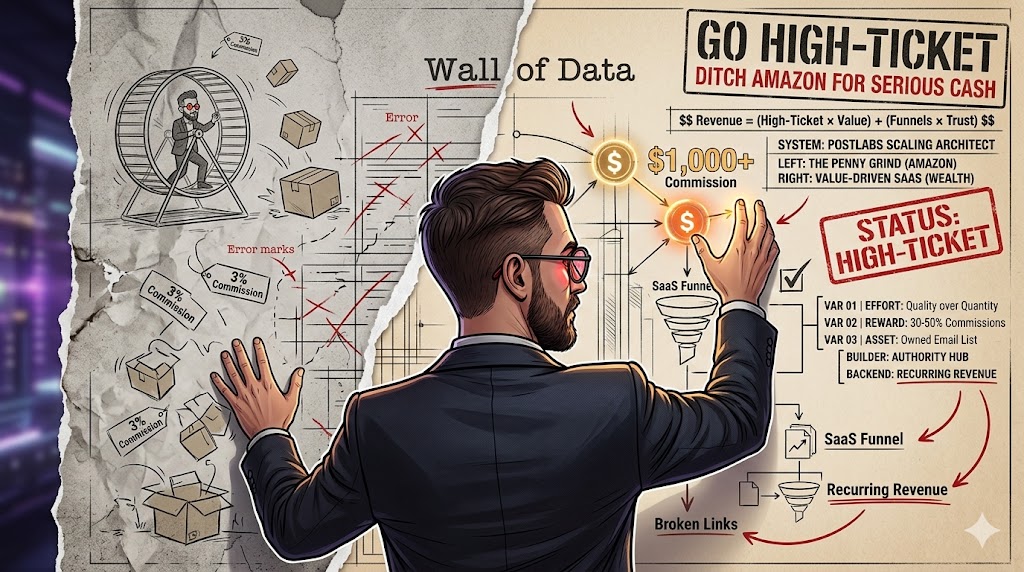
Go High-Ticket. Ditch Amazon for serious cash.
Focus on high-ticket affiliate networks. Amazon’s commission rates are a joke for anyone trying to build a real business. High-ticket offers pay actual money per sale, making your efforts worthwhile.
- High-ticket offers provide significantly higher payouts per conversion.
- They often require a steeper learning curve for audience qualification.
- Best suited for B2B, SaaS, or high-value educational niches.
If you’re happy with pocket change, stop reading now. This isn’t for you.
Okay, quick detour. Before we dive deep, let’s test your gut feeling.
What’s the biggest killer of profit margins in Amazon Associates?
Amazon Associates vs. High-Ticket Affiliate Networks
| Criterion | Amazon Associates | High-Ticket Networks |
|---|---|---|
| Primary Use Case | Volume-based consumer product sales. | Value-driven solution sales (SaaS, courses). |
| Commission Rates | Typically 1-5%, rarely higher. | Often 20-50% of high-value products. |
| Product Type | Physical goods, low average order value. | Digital products, services, high average order value. |
| Audience Focus | Price-sensitive shoppers, impulse buyers. | Problem-aware individuals, businesses seeking solutions. |
| Effort per Sale | Low individual effort, high volume needed. | Higher individual effort, fewer sales needed. |
| Scalability | Scales with product quantity and traffic volume. | Scales with funnel optimization and lead quality. |
The Amazon Associates Grind: Why You’re Leaving Money on the Table
I once spent 80 hours building an Amazon review site. It was a damn nightmare. I wrote dozens of articles and optimized everything. After a month, I made $120. Total crap.
This is the reality for many. Amazon Associates promises easy entry. It delivers minuscule commissions. Your efforts fail when you chase volume over value. You’re essentially building a business on pennies.
The commission rates are brutal. Most categories hover around 3-5%. Some are even lower. Imagine selling a $100 product and getting $3. You need thousands of sales to see real money. It’s a hamster wheel.
Then there’s the cookie duration. It’s a measly 24 hours. If someone clicks your link and buys something a day later, you get nothing. This part absolutely sucks. It makes conversion tracking a constant headache.
Affiliate Marketing: A performance-based marketing strategy where businesses reward affiliates for each customer brought by the affiliate’s own marketing efforts. Affiliates earn a commission on sales, leads, or clicks.
Many new affiliates fall into this trap. They think Amazon is the path of least resistance. Honestly, it’s often the path of least profit. You’re trading your time for crumbs. That’s not a business; it’s a hobby.
Warning: Relying Solely on Amazon
Do not build your entire affiliate business around Amazon Associates. The low commission rates and short cookie windows make it incredibly difficult to generate a sustainable, scalable income. You’ll constantly be chasing volume, leading to burnout and minimal returns.
High-Ticket Affiliate Marketing: The Real Gold Rush
My first high-ticket sale was a $2,000 software subscription. I got a 30% commission. That’s $600 from one sale. Blew my damn mind. Suddenly, all those hours felt worth it.
This is where the real money is. High-ticket affiliate marketing focuses on products or services with a high price point. We’re talking anything from $500 to several thousand dollars. Your commission per sale can easily be hundreds or even thousands of dollars. You won’t see these payouts if you only promote cheap consumer goods.
Think SaaS products, online courses, coaching programs, or high-end services. These aren’t impulse buys. They solve significant problems for businesses or individuals. The value proposition is clear. That means the buyer is already motivated to spend money on a solution.
Many high-ticket offers also come with recurring revenue. Imagine getting 20% of a $500 monthly subscription. That’s $100 every month for one customer. That’s scalable income. This is how you build a real business. For more on finding these opportunities, check out Affililabs.ai.
The effort per sale is higher, sure. But the reward is exponentially greater. You need fewer conversions to hit your income goals. This frees up your time. You can focus on quality over quantity. It’s a game-changer.
The Commission Conundrum: Pennies vs. Paychecks
Imagine needing 1,000 Amazon sales to make $500. Now picture one high-ticket sale giving you $500. It’s a no-brainer, right? The math isn’t complicated. Your business model is unsustainable if your average commission is under $50.
Amazon’s variable commission structure is a mess. One category might pay 4%, another 1%. It’s a race to the bottom. You’re constantly fighting for tiny margins. This makes planning your income incredibly difficult. It’s like trying to fill a bucket with a leaky faucet.
Pros of High-Ticket Affiliate Marketing
- Higher Payouts: Earn hundreds or thousands per sale, boosting your profit margin significantly.
- Scalable Income: Many programs offer recurring commissions, building a stable monthly revenue stream.
- Fewer Sales Needed: Achieve income goals with fewer conversions, reducing pressure and effort.
Cons of High-Ticket Affiliate Marketing
- Longer Sales Cycle: Buyers need more nurturing and information before committing to a high-value purchase.
- Higher Competition: Top-tier programs can be harder to get into, requiring proven experience.
- More Complex Funnels: Requires more sophisticated content and email marketing strategies to convert.
High-ticket programs, conversely, often offer fixed, generous percentages. 20%, 30%, even 50% isn’t uncommon. This clarity helps you forecast earnings. It allows you to invest more in marketing. You know your efforts will pay off.
This isn’t just about money. It’s about efficiency. Would you rather work ten times harder for the same outcome? Or work smarter, not harder? The choice is obvious. Stop chasing pennies. Start chasing paychecks.
Myth
High-ticket products are too hard to sell; nobody buys expensive stuff online.
Reality
People buy expensive solutions online every single day. They’re not buying impulse items. They’re investing in solutions to significant problems. The key is targeting the right audience with the right value proposition, not just pushing products.
Audience & Trust: Selling to Shoppers vs. Solvers
My Amazon audience just wanted the cheapest gadget. They’d compare three blenders and pick the lowest price. High-ticket buyers are different. They want solutions to big problems. They’re willing to pay for quality and results.
You’ll burn out trying to convince budget shoppers to buy premium solutions. It’s like trying to sell a luxury car to someone looking for a used hatchback. The mindset is completely different. Amazon thrives on impulse and convenience. High-ticket thrives on trust and expertise.
High-ticket audiences are problem-aware. They’re actively searching for ways to improve their business, skills, or life. They do their research. They read reviews. They compare features. They want to understand the value.
This means you need to build authority. You need to be seen as an expert. This isn’t about pushing products. It’s about guiding people to the best solution. That takes time and effort, but it pays dividends. Trust me on this.
“Trust is the currency of high-value transactions. Without it, you’re just another salesperson.”
— General Consensus, Affiliate Marketing Experts
You become a trusted advisor. This relationship is far more valuable than a quick click. It leads to repeat business. It leads to referrals. That’s how you build a sustainable, long-term affiliate business. It’s not just about the one sale. It’s about the lifetime value of a customer.
The Content Game: Review Sites vs. Authority Hubs
I used to write 10 short Amazon reviews a day. It was a content mill. Now I write one deep-dive guide a week for high-ticket offers. The quality difference is night and day. Your content won’t convert high-ticket sales if it’s just surface-level product specs.
Amazon content is often about quick comparisons and feature lists. It’s designed for someone ready to buy. They just need a nudge. It’s transactional. You’re not building a brand. You’re just a conduit.
High-ticket content is different. It’s educational. It’s problem-solving. It’s long-form guides, case studies, and detailed tutorials. You’re addressing pain points. You’re demonstrating expertise. You’re building an authority hub.
This kind of content ranks for high-intent keywords. People searching for ‘best CRM for small business’ are ready to invest. They’re not looking for a cheap gadget. They’re looking for a solution. This is where you shine. You can also explore hybrid approaches, like those discussed at Affililabs.ai’s ultimate Amazon affiliate strategy, but always prioritize high-value content.
You become the go-to resource in your niche. This positions you as an expert. People trust experts. They buy from experts. This is the foundation of a successful high-ticket strategy. It’s about providing immense value upfront. That builds goodwill and conversions.
Here is a prompt I use for this. Just copy and paste it into ChatGPT or Gemini to get started:
Traffic Strategies: Volume vs. Qualification
I once blew $500 on Facebook ads for an Amazon product. I got clicks, sure, but zero sales. Total garbage. It was a painful lesson. You’re just throwing money away if you don’t qualify your traffic for high-value offers.
Amazon traffic is often broad. People click on product ads or search for general terms. They’re browsing. They’re not always ready to buy. You need massive volume to convert a tiny percentage. This part sucks. It’s a different beast entirely.
High-ticket traffic is about qualification. You’re targeting people who are already problem-aware. They have a need. They have a budget. They’re actively seeking a solution. This means more specific keywords, more targeted ads, and more niche communities.
Think about it. Someone searching for ‘best project management software for remote teams’ is a much hotter lead than someone searching for ‘cheap headphones.’ The intent is completely different. You want to attract buyers, not just browsers.
This often involves organic search for problem-solution keywords. It means using platforms like LinkedIn for B2B offers. It means building an email list and nurturing leads. It’s about quality over quantity. That’s the key to success here. Don’t chase vanity metrics. Chase qualified leads.
Conversion Rates: The Numbers Don’t Lie
Amazon conversion rates hover around 1-3%. That means for every 100 clicks, you might get one to three sales. High-ticket, with the right funnel, can hit 5-10% or even higher. The difference is stark. You’ll never hit your income goals if you expect high-ticket conversion rates from low-ticket traffic.
The sales cycle for high-ticket items is longer. People don’t just click and buy a $1,000 course. They need information. They need reassurance. They need to trust you. But once they’re convinced, they’re much more likely to convert. The perceived risk is higher, but so is the commitment.
This is why your content and nurturing process are so crucial. You’re not just presenting a product. You’re building a case for it. You’re addressing objections. You’re demonstrating value. This leads to a more committed buyer. And a more committed buyer means a higher conversion rate.
Let’s look at an illustrative model based on experience. This isn’t a universal benchmark, but it highlights the typical differences in effort and outcome. This radar chart compares Amazon Associates and High-Ticket Affiliate Networks across several key performance indicators. It’s an estimated model, not exact data, but it shows the general trends we observe in the field.
Affiliate Program Performance Comparison
Estimated Model: Amazon Associates vs. High-Ticket Networks (2026)
As you can see, the radar chart visually represents the strengths and weaknesses. High-ticket networks generally score much higher on commission, conversion, scalability, and trust. Amazon, while requiring less ‘effort per sale’ in terms of individual nurturing, demands massive volume and offers poor cookie duration. This visual model helps understand why focusing on high-ticket is a smarter play for long-term growth.
Affiliate Program Performance Audit (2026)
| Metric | Amazon Associates | High-Ticket Affiliate | Verdict |
|---|---|---|---|
| Avg. Commission Rate | 2.5% | 30% | High-Ticket Wins |
| Cookie Duration | 24 hours | 30-90 days | High-Ticket Wins |
| Avg. Conversion Rate | 1-3% | 5-10% | High-Ticket Wins |
| Effort for $1000 | High volume | Few sales | High-Ticket Wins |
Building an Asset: Disposable Sites vs. Long-Term Value
My old Amazon sites felt disposable. They were built for a trend, a specific product. Once that trend died, so did the site. My high-ticket sites, though, are actual businesses. I could sell them. They have intrinsic value beyond immediate sales.
Amazon sites often rely on fleeting trends. You’re constantly chasing the next hot product. This means building new content, new pages, and new traffic sources. It’s a never-ending cycle. Your efforts are wasted if you build assets with no intrinsic value beyond immediate sales.
High-ticket affiliate marketing builds real assets. You’re building an authority site. You’re cultivating an email list. You’re establishing a brand. These are things that grow in value over time. They become a sustainable source of scalable income.
An email list, for example, is gold. It’s direct access to your audience. You can promote new offers. You can nurture leads. You own that audience. Amazon doesn’t give you that. You’re always at their mercy. That’s a huge difference.
Insider tip
I always recommend building an email list from day one, regardless of your affiliate niche. It’s the only asset you truly own. It protects you from algorithm changes and platform restrictions. Start collecting emails immediately.
Think long-term. Do you want to build a series of disposable websites? Or do you want to build a valuable business? The choice impacts your future. It impacts your sanity. It impacts your bank account.
The Support & Sales Funnel: Set It and Forget It vs. Nurture
Most gurus preach ‘set up a funnel and forget it.’ That’s bullshit for high-ticket. You need to nurture. You need to engage. Your high-ticket sales will tank if you treat your leads like Amazon shoppers.
Amazon sales are often direct. A click, a purchase, done. Minimal pre-sell. It’s a transactional model. There’s no relationship. There’s no trust-building. It’s just a quick conversion.
High-ticket requires a different approach. It’s about building a relationship. It’s about nurturing leads through an email sequence. It’s about offering webinars. It’s about personalized outreach. It’s more work, yes, but the payoff is huge.
You’re guiding someone through a decision-making process. They have questions. They have concerns. You need to address them. This isn’t a one-click sale. It’s a journey. And you’re their guide. This is where you differentiate yourself.
This is where automation helps. You can automate email sequences. You can use chatbots for initial questions. But the core principle remains: nurture, educate, and build trust. That’s how you convert high-ticket leads. That’s how you build a real business.
Here’s a quick tool to estimate your potential high-ticket earnings. Give it a shot:
Scaling Your Efforts: More Products vs. Better Systems
I used to think scaling meant adding more Amazon products. Just pile on more reviews. That’s a fool’s errand. Now I know scaling means optimizing my sales process. It means refining my funnels. It means getting more out of every lead.
Amazon scaling is about quantity. More products, more traffic, more clicks. It’s a linear growth model. You hit a ceiling fast if you only scale by adding more low-value offers. You’re constantly chasing the next thing. It’s exhausting.
High-ticket scaling is about quality. It’s about optimizing your conversion rates. It’s about improving your lead qualification. It’s about automating your nurture sequences. You’re getting more value from your existing efforts. This is truly scalable income.
Imagine increasing your conversion rate from 5% to 7%. That’s a 40% increase in revenue without needing more traffic. That’s powerful. That’s smart. That’s how you build a robust business. You’re not just working harder. You’re working smarter.
This involves A/B testing your landing pages. It means refining your email copy. It means understanding your audience better. It’s a continuous process of improvement. This leads to exponential growth. It’s a much more satisfying way to build an income.
Here is a prompt I use for this. Just copy and paste it into ChatGPT or Gemini to get started:
What I would do in 7 days
- Day 1-2: Niche Research. Identify 3-5 high-ticket niches that genuinely interest you. Look for problems you understand.
- Day 3-4: Program Selection. Find 2-3 relevant high-ticket affiliate programs within those niches. Check commission rates and support.
- Day 5: Content Outline. Sketch out a content strategy for your chosen niche. Focus on problem-solving guides, not just product reviews.
- Day 6: Lead Capture. Set up a simple lead magnet and email capture system. Start building your audience from day one.
- Day 7: Action Plan. Create a detailed 90-day content and promotion plan. Start executing.
Your High-Ticket Affiliate Launch Checklist
- Identify your ideal high-ticket target audience.
- Select a profitable, reputable high-ticket affiliate program.
- Develop a value-driven content plan that educates and solves problems.
- Implement an email capture system to build your own audience asset.
- Set up analytics to track conversion metrics, not just clicks.
- Create a nurture sequence to guide leads through the sales journey.
- Commit to consistent, high-quality content creation.
Frequently Asked Questions
Is high-ticket affiliate marketing harder than Amazon Associates?
It’s different, not necessarily harder. High-ticket requires more strategic thinking and nurturing. Amazon requires massive volume and constant content creation for tiny returns. The effort is simply redirected for higher rewards.
What kind of products are considered high-ticket?
High-ticket products are typically digital courses, coaching programs, SaaS subscriptions, high-end services, or specialized B2B tools. Anything with a price point over $500 and a substantial commission rate.
Can I do both Amazon Associates and high-ticket affiliate marketing?
Yes, you can. A hybrid approach can work, using Amazon for supplementary income or as a stepping stone. However, prioritize high-ticket offers for your main income stream. Don’t let Amazon distract you from real profit.





