


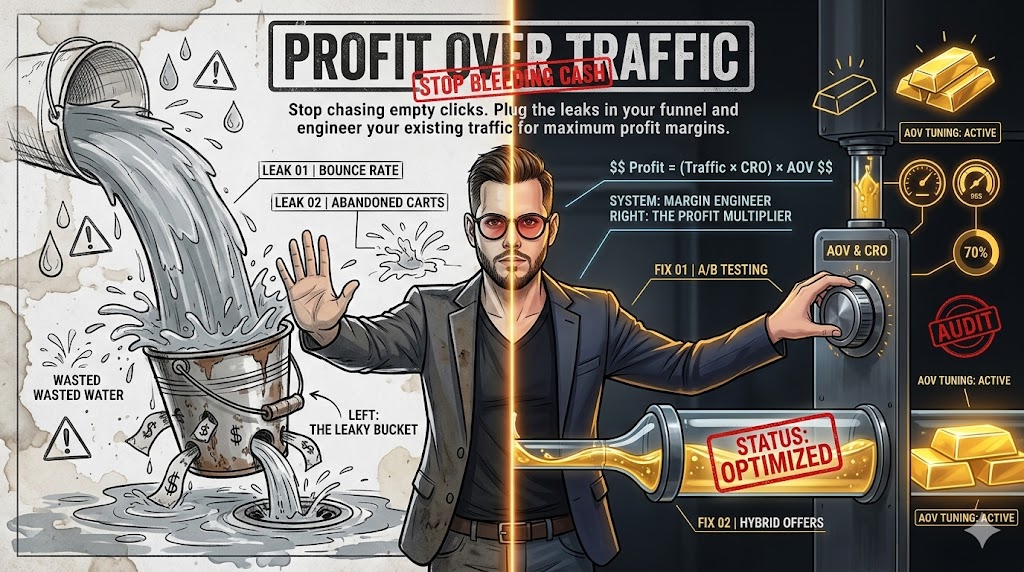
Focus on Profit, Not Just Traffic
This is absolutely worth it. Chasing more traffic without optimizing your current flow is a fool’s errand. You’ll bleed money and time for minimal gains.
- Optimize existing traffic for higher conversions and average order value.
- Requires deep analysis of your current funnels and offers.
- Best for affiliates with some existing traffic but stagnant profits.
If your current traffic converts at less than 1%, stop reading right now and fix that first.
Alright, let’s get real. You’ve got some traffic. Maybe it’s not a flood, but it’s there. The trap is thinking you always need more eyeballs. That’s often just a distraction. The real game is squeezing more profit from the traffic you already have. It’s about working smarter, not just harder. This isn’t some guru "get rich quick" crap. This is about digging into your numbers and fixing what’s broken.
Want to test your gut feeling on profit optimization? Try this quick quiz:
Which factor has the LEAST direct impact on increasing affiliate profit margins without more traffic?
Stop Chasing Unicorns: Why More Traffic is Often Bullshit
I’ve seen so many affiliates blow their budget chasing traffic that just doesn’t convert. They spend hundreds, sometimes thousands, on ads or "SEO services" only to see their profit margins shrink. It’s a damn cycle. Your profit shrinks when you prioritize raw visitor numbers over the actual value of those visitors.
Think about it. If your current site converts at 0.5%, doubling your traffic just means you’ll lose money twice as fast. That’s not growth; that’s a cash incinerator. The real win comes from making your existing traffic more valuable. This means getting more sales from the same number of people. It’s a fundamental shift in mindset.
Pros of Margin Optimization
- Higher ROI on existing efforts, making every visitor count.
- Reduced marketing spend, freeing up capital for other areas.
- More stable and predictable income streams from your current audience.
Cons of Margin Optimization
- Requires deep data analysis and A/B testing, which can be time-consuming.
- Initial learning curve for new tools and strategies might feel steep.
- Some changes might not yield immediate results, requiring patience.
This approach isn’t sexy. It doesn’t involve viral TikToks or "secret traffic hacks." It involves gritty work. But it’s the only way to build a sustainable affiliate business. You need to understand your numbers, identify leaks, and plug them. It’s less about finding a gold mine and more about refining the gold you already have.
The Conversion Rate Trap: Fixing Your Leaky Bucket
Imagine pouring water into a bucket full of holes. That’s what a low conversion rate feels like. You drive traffic, but most of it just vanishes. Your profit margin takes a hit when too many visitors bounce without taking action. I once worked on a site that had decent traffic but a dismal 0.3% conversion rate. We were leaving so much money on the table.
Conversion Rate Optimization (CRO): The systematic process of increasing the percentage of website visitors who take a desired action, such as making a purchase or filling out a form, without increasing traffic.
Fixing this means looking at every step of your user’s journey. Is your call to action clear? Is your page loading fast enough? Does your content actually persuade? Small tweaks can make a huge difference. We A/B tested a new hero section on that leaky bucket site. Just changing the headline and button copy led to a 0.7% conversion rate. That’s more than double, with the same traffic. Not bad for a few hours’ work.
- Page Speed: Slow sites kill conversions. Aim for under 2 seconds.
- Clear CTAs: Tell people exactly what to do. Use strong verbs.
- Mobile Experience: Most traffic is mobile. Your site must look perfect there.
- Compelling Copy: Focus on benefits, not just features. Address pain points.
- Trust Signals: Add reviews, testimonials, or security badges.
Don’t just guess what works. Use tools like Hotjar to see how users interact with your page. Run A/B tests on headlines, images, and button colors. Even minor improvements stack up fast. This isn’t rocket science, but it requires attention to detail. Ignoring these basics is a surefire way to keep your profits in the gutter.
Hybrid Offers: The Secret Sauce for Bigger Payouts
Most affiliates stick to promoting just one product or service. That’s fine, but it leaves a ton of money on the table. A hybrid offer combines an affiliate product with your own complementary product or service. Your profit margin skyrockets because you control more of the value chain. This strategy fails when you only push external offers, ignoring the chance to add your own value.
I’ve seen affiliates double their earnings by simply adding a small, low-cost digital product of their own alongside a high-ticket affiliate offer. For example, promoting a specific software (affiliate) and then offering a "setup guide" or "template pack" (your own product) for $27. The customer gets more value, and you get a much larger slice of the pie. It’s a win-win. You can learn more about this approach, especially for Amazon, by checking out the ultimate Amazon affiliate strategy for hybrid offers.
- Digital Guides: Create a PDF guide related to the affiliate product.
- Templates: Offer ready-to-use templates for software or services.
- Mini-Courses: A short video course on how to best use the affiliate product.
- Consulting/Setup Services: For complex products, offer personal help.
- Exclusive Bonuses: Provide unique content or tools not available elsewhere.
The key is to make your own product genuinely valuable and complementary. Don’t just slap something together. It needs to enhance the main affiliate offer. This approach allows you to capture more of the customer’s lifetime value. It’s a powerful way to boost your profit without needing a single new visitor. Just make sure your own offer is high quality.
Here is a prompt I use for this. Just copy and paste it into ChatGPT or Gemini to get started:
Boosting Average Order Value (AOV): Get More From Each Sale
Why settle for one sale when you can get two, or three? Increasing your Average Order Value (AOV) means each customer spends more. This directly impacts your profit margins without requiring more traffic. Your AOV suffers when you don’t present additional, relevant offers to customers at the right time.
Myth
Customers only want the cheapest option; adding more products will annoy them.
Reality
Customers often appreciate relevant add-ons or upgrades that enhance their primary purchase. The key is relevance and timing, not just price.
Think about Amazon. You buy a book, and they immediately suggest "customers also bought" or "frequently bought together." That’s AOV in action. You can do the same. After a customer clicks your affiliate link for a main product, present them with related offers. This could be a complementary product, an extended warranty (if available), or a higher-tier version of what they just considered. It’s about making it easy for them to spend a little more for a lot more value.
- Upsells: Offer a premium version of the product they’re looking at.
- Cross-sells: Suggest related products that complement their primary choice.
- Bundles: Package several related items together at a slightly discounted price.
- Post-Purchase Offers: Present a small, relevant offer immediately after they complete a purchase.
- Quantity Discounts: Encourage buying more units of the same product.
The trick is to make these offers feel helpful, not pushy. If someone is buying a camera, suggesting a memory card or a case makes sense. Suggesting a completely unrelated item, not so much. Test different offers and placements. You’ll be surprised how many people are willing to spend a bit more if the value is clear. This strategy is pure profit margin growth.
The Hidden Costs: Auditing Your Affiliate Expenses
This part absolutely sucks, but it’s crucial. I once ran an affiliate site where I was bleeding $300 a month on tools I barely used. It was a slow, silent killer of profit. Your profit margin gets eaten alive when you ignore recurring expenses and subscriptions. You sign up for a "free trial," forget about it, and then it becomes a monthly drain. This happened to me, and it’s a real head-scratcher.
Warning: Subscription Creep
Critical mistake to avoid: Letting unused or underutilized software subscriptions and services continue to auto-renew. This silently erodes your profit margins every single month, often without you noticing the impact.
Go through every single recurring expense. Hosting, email marketing, keyword tools, VPNs, design software. Do you really need them all? Are you using them to their full potential? If not, cut them. Even $20 here and $50 there adds up fast. That’s money directly back into your pocket. It’s not glamorous, but it’s effective. I found I was paying for two different SEO tools when I only used one regularly. Total crap.
Also, look at your hosting plan. Are you overpaying for resources you don’t use? Or, conversely, are you on a cheap, slow host that’s costing you conversions? Sometimes, spending a little more on a better host can actually increase your profit by improving site speed and reliability. It’s a balance. But the first step is knowing exactly where your money goes. Don’t be lazy about this. Your bottom line depends on it.
Negotiating Better Commissions: Don’t Be a Chump
Most affiliates just accept the default commission rate. That’s a huge mistake. If you’re sending consistent, quality traffic and generating sales, you have leverage. Your profit margin stays flat when you don’t advocate for a higher commission rate, even if your performance warrants it. I once negotiated an extra 3% on a product that was doing $5,000 a month in sales for me. That’s an extra $150 a month for a single email.
"The easiest money you’ll ever make is the money you negotiate for."
— General Consensus, Affiliate Marketing Forums
Affiliate managers want to keep good partners. If you’re a reliable source of sales, they’ll often be willing to increase your rate. Start by tracking your performance meticulously. Know your conversion rates, your average sale value, and your total sales volume. Present this data clearly. Show them the value you bring. Don’t be afraid to ask. The worst they can say is no. And even then, you might get a counter-offer.
Affiliate Performance Review: Q4 2026
| Product/Item | Sales Volume | Current Rate | Potential Rate |
|---|---|---|---|
| Software X | $8,500 | 15% | 18% |
| Course Y | $3,200 | 25% | 28% |
| Gadget Z | $1,800 | 10% | 12% |
Focus on programs where you’re already performing well. It’s easier to get a bump on an existing relationship than to negotiate a higher starting rate for a brand new one. Frame it as a mutual benefit: "If I get a higher rate, I’m incentivized to send even more high-quality traffic." This isn’t about being greedy; it’s about being smart. You’re a business, and you deserve fair compensation for your results.
The Funnel Fix: Plugging Profit Leaks in Your User Journey
Your affiliate funnel isn’t just a straight line. It’s a series of steps, and each step has potential leaks. Losing users at critical stages is a damn shame. Your profit margins will suffer if you don’t identify and fix where users are dropping off in your conversion funnel. I once saw a funnel with a 90% drop-off between the product page and the checkout. That’s just throwing money away.
Understanding these drop-offs is crucial for increasing profit without more traffic. This illustrative model shows how even a decent number of visitors can lead to very few final sales if the funnel isn’t optimized. It’s about maximizing the value of every click you already get.
Affiliate Conversion Funnel: Estimated Leakage
Illustrative model of user drop-offs from initial visit to final purchase.
This funnel chart shows a typical journey. You start with many visitors, but the numbers shrink at each stage. The biggest drops are your priority. For example, if "Product Page Views" to "Add to Cart" is a huge drop, your product presentation or call to action is weak. If "Checkout Initiated" to "Purchases" is the problem, it might be shipping costs, payment options, or trust issues. Each stage needs specific attention. Don’t guess. Use analytics to pinpoint the exact leak. Then, test solutions. This isn’t about getting more people into the funnel; it’s about getting more people *through* it.
Smart Offer Selection: Picking Winners, Ditching Losers
Not all affiliate offers are created equal. Some convert like crazy, others are dead weight. You dilute your efforts and profit when you promote too many low-performing offers. I’ve seen affiliates spend weeks creating content for a product that barely generated $50 in sales. That’s time you could have spent optimizing a winner. It’s a waste of resources.
You need to be ruthless. Regularly audit your affiliate offers. Which ones are actually making you money? Which ones are just taking up space? Focus your energy on the high-margin, high-converting products. It’s better to have five highly profitable offers than fifty mediocre ones. This means less content to create, less to manage, and more profit per effort. It’s about strategic focus.
- Track EPC (Earnings Per Click): This is your true north. High EPC means good offer.
- Conversion Rate: How many clicks turn into sales? Higher is better.
- Commission Rate: Obviously, higher commissions mean more profit per sale.
- Refund Rates: High refunds kill profit and can flag you as low quality.
- Product Quality: Only promote products you genuinely believe in.
Don’t be sentimental about offers that aren’t performing. Cut them loose. Reallocate that content space or promotional effort to your proven winners. Sometimes, a product might have a decent commission but a terrible conversion rate. That’s a loser. Other times, a lower commission with a sky-high conversion rate can be a massive winner. It’s all about the numbers. Trust the data, not your gut feeling. This is how you maximize profit from your existing audience.
Here’s a prompt to help you analyze your current offers:
Leveraging Email & Retargeting: Squeezing More Juice
Most visitors won’t buy on their first visit. That’s just how it is. Your profit margins take a hit when you let potential buyers vanish after their initial visit without any follow-up. Retargeting and email marketing are about giving those people a second, third, or even fourth chance to convert. It’s about maximizing the value of every single visitor you already have. This part is crucial.
Building an email list is probably the single most important thing you can do for long-term affiliate profit. It gives you a direct line to your audience, allowing you to nurture them, build trust, and promote offers repeatedly. A simple abandoned cart email sequence, for example, can recover 10-15% of lost sales. That’s pure profit from existing traffic. For more general strategies to scale your income, check out AffiliLabs.ai.
- Lead Magnets: Offer a free guide or checklist to capture emails.
- Abandoned Cart Emails: Remind users about items they left behind.
- Segmented Lists: Send targeted offers based on user interests.
- Retargeting Ads: Show ads to people who visited your site but didn’t convert.
- Educational Sequences: Build trust and educate before pitching.
Retargeting ads on platforms like Facebook or Google are incredibly effective. You’re showing ads only to people who already know you, which means higher conversion rates and lower ad costs (if you’re running any). Email is even better because it’s free after the initial setup. Don’t let those visitors just walk away. Give them a reason to come back and buy. This is how you squeeze every last drop of profit from your existing audience. It’s not rocket science, but it takes consistent effort.
Want to calculate your potential profit increase from better conversion? Use this tool:
Content Optimization for Conversions: Beyond SEO Rankings
It’s easy to get obsessed with SEO rankings. We all want to be #1. But ranking high doesn’t automatically mean high profits. Your content fails to drive profit when it ranks well but doesn’t actually persuade visitors to buy. I’ve seen pages ranking in the top 3 for competitive terms that had terrible conversion rates because the content was dry, academic, or simply lacked a clear call to action. That’s hell.
Your content needs to do more than just inform; it needs to convert. This means structuring your articles, reviews, and guides in a way that naturally leads the reader towards an affiliate offer. It’s about understanding user intent beyond just their search query. Are they looking for information, comparison, or are they ready to buy? Tailor your content to that intent.
- Benefit-Driven Headlines: Grab attention with what the product *does* for them.
- Problem/Solution Framework: Present a problem, then position the affiliate product as the solution.
- Strong Call-to-Actions (CTAs): Place clear, compelling CTAs strategically throughout the content.
- Comparison Tables: Help users make decisions by comparing features and benefits.
- Visuals: Use images and videos to demonstrate product value and build trust.
Don’t bury your affiliate links. Integrate them naturally, but make them visible. Use comparison tables, pros and cons sections, and clear "Buy Now" buttons. Your goal isn’t just to get a click; it’s to get a qualified click that leads to a sale. This is about optimizing the content you already have to work harder for your profit margins. It’s a fundamental shift from just ranking to actually converting. Think about the user’s journey and how your content guides them.
Here’s a prompt to help you craft better CTAs:
What I Would Do in 7 Days to Boost Profit Margins
- Day 1: Audit Expenses. Go through every single recurring subscription. Cancel anything you don’t actively use or that isn’t pulling its weight.
- Day 2: Identify Top 3 Offers. Use your analytics to find your highest-converting, highest-EPC affiliate products. Focus your energy here.
- Day 3: Optimize One Landing Page. Pick your highest-traffic affiliate page. Improve its headline, add stronger CTAs, check mobile responsiveness.
- Day 4: Implement One AOV Tactic. Brainstorm a simple upsell or cross-sell for one of your top offers. Add it to your content.
- Day 5: Negotiate One Commission. Reach out to an affiliate manager for one of your top-performing products. Ask for a 2-5% commission bump.
- Day 6: Set Up a Lead Magnet. Create a simple PDF guide related to your niche. Add an opt-in form to your site to start building an email list.
- Day 7: Review Funnel Drop-offs. Look at your analytics. Where are users leaving your site before converting? Brainstorm fixes for the biggest leak.
Profit Margin Optimization Checklist
- Have you audited all recurring expenses and cut unnecessary ones?
- Are your top 3 affiliate offers clearly identified and prioritized?
- Is your highest-traffic affiliate page optimized for conversions (speed, CTAs, mobile)?
- Have you implemented at least one strategy to increase Average Order Value?
- Did you attempt to negotiate a higher commission rate for a top-performing offer?
- Is there a lead magnet and opt-in form on your site to capture emails?
- Do you know your biggest funnel drop-off point and have a plan to fix it?
Frequently Asked Questions
Can I really increase profits without more traffic?
Absolutely. By focusing on conversion rate optimization, increasing average order value, reducing costs, and negotiating better commissions, you can significantly boost your profit margins using your existing audience.
What’s the fastest way to see results?
Often, improving your conversion rate on high-traffic pages or cutting unnecessary expenses can yield the quickest results. These changes directly impact your bottom line without needing new visitors.
Should I still try to get more traffic?
Yes, eventually. But only after you’ve optimized your existing funnels and offers. Driving more traffic to a leaky bucket just wastes resources. Fix the leaks first, then scale your traffic.





