

Flip Your Affiliate Model Now
This is absolutely worth it. You must shift from low-margin physical products to high-profit digital upsells. It’s the only way to build a truly scalable, sustainable affiliate business.
- Unlock 50-90% commissions instead of 3-10%.
- Requires deep niche authority and audience trust.
- Best for content creators with engaged audiences.
If your audience strictly avoids digital purchases, stop reading; this strategy won’t work for you.Okay, before we dive in, test your knowledge. See if you’re already thinking like a high-profit affiliate.
What’s the primary reason digital upsells outperform physical products in affiliate revenue?
The Amazon Affiliate Trap: Why Physical Products Are a Sucker’s Bet
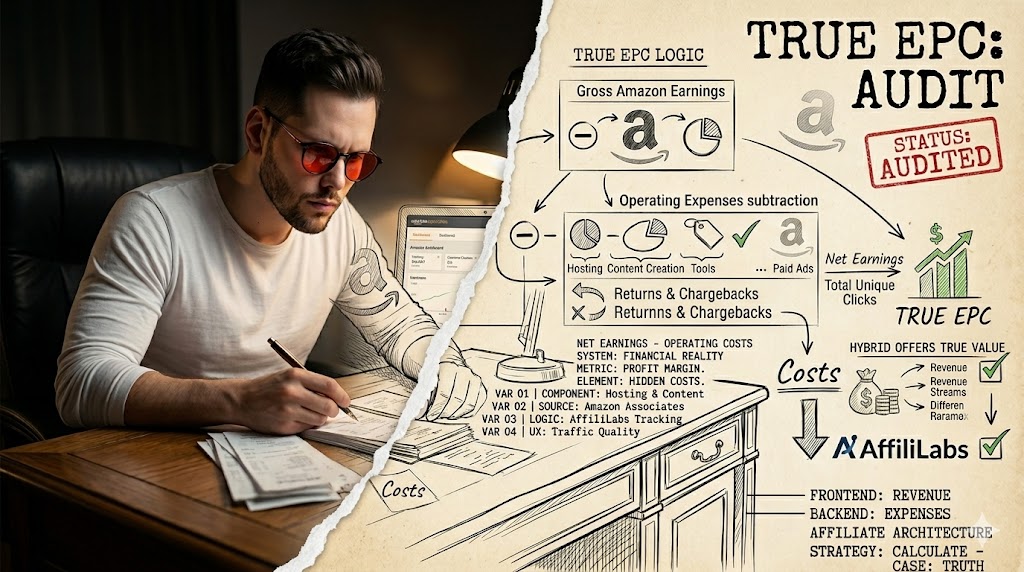
Look, I’ve been there. You spend hours writing killer reviews. You optimize for SEO. You drive traffic like a madman. Then you check your Amazon Associates dashboard and see a measly 3% commission on a ‘smart’ gadget. Total crap. This whole model fails when you expect significant income from tiny margins.
Many affiliates get stuck chasing volume. They think if they just sell enough cheap physical products, the money will roll in. It’s a grind, and frankly, it sucks. You’re building someone else’s empire on pennies. I once spent six months optimizing a niche site for kitchen gadgets. The conversion rate was decent, but the payouts were pathetic. It was a wake-up call.
The trap is simple: physical products have high fulfillment costs. Shipping, returns, manufacturing. These eat into the creator’s margin. They can’t afford to pay you much. So you’re left with razor-thin commissions, often in the 1-5% range. It’s a race to the bottom, and you’re usually losing.
This isn’t to say physical products are useless. They can be great entry points. But they should rarely be your endgame. Think of them as bait, not the main course. For a deeper dive into this, check out the ultimate Amazon affiliate strategy for hybrid offers.
Pros of Digital Upsells
- Earn 50-90% commissions, boosting revenue per sale.
- Scalable income without inventory or shipping hassles.
- Build stronger authority by offering specialized solutions.
Cons of Digital Upsells
- Requires deeper audience trust and niche expertise.
- Higher upfront effort to find and vet quality products.
- Conversion can be harder without clear value proposition.
What Even *Is* a Digital Upsell? (And Why It’s Not Bullshit)
Okay, so we’re ditching the physical product treadmill. What’s next? Digital upsells. This isn’t some fancy buzzword. It’s simply offering a digital product that complements or enhances a physical product your audience already wants. Or, better yet, it’s a standalone digital product that solves a core problem.
Think about it: someone buys a camera lens (physical). What do they need next? A course on photography composition (digital). Or custom Lightroom presets (digital). Maybe a subscription to a cloud storage service for photos (digital). These are all high-margin products. The creator has almost zero fulfillment costs after the initial build. That means they can pay you 50%, 70%, even 90% commissions. That’s a game-changer.
The idea that digital products are too complex to sell is pure bullshit. Most people fail here because they don’t understand the underlying value. You’re selling solutions, not just files. A good digital product solves a specific pain point. It saves time, makes money, or teaches a skill. That’s powerful.
I’ve seen affiliates pivot from earning $5 per physical sale to $200 per digital sale with the same audience. It’s not magic. It’s just understanding where the real profit lies. You’re leveraging your existing traffic for exponentially higher returns. That’s smart business.
Digital Upsell: A high-margin digital product (e.g., course, software, template, ebook) offered to a customer, often after an initial purchase or in conjunction with a related physical product, to increase average transaction value and affiliate commission.
Finding Your First High-Margin Digital Offer (Without Selling Your Soul)
This part can feel like a damn scavenger hunt. You need to find digital products that align with your niche and offer real value. Don’t just pick the first thing with a high commission. That’s a recipe for disaster. Your audience will smell a rat. This strategy fails if you promote garbage that doesn’t genuinely help your audience.
Start with your existing content. What problems do your readers face after buying the physical products you recommend? If you review camping gear, maybe a ‘Wilderness Survival Guide’ ebook or a ‘Campfire Cooking Masterclass’ course. If you review productivity apps, perhaps a ‘Time Management System’ template or a ‘Focus Software’ subscription. Audience pain points are your goldmine.
Look at platforms like ClickBank, WarriorPlus, or even smaller, niche-specific marketplaces. Many creators also have direct affiliate programs. Don’t be afraid to reach out. Ask for review access. Test the product yourself. If it’s not good enough for you, it’s not good enough for your audience. Period.
I once promoted an ‘SEO course’ that was just a rehashed ebook from 2010. My audience called me out. It hurt my credibility. Now, I always vet products thoroughly. It takes time, but it builds trust. Trust is your most valuable asset in this game. Without it, you’re just another spammer.
Warning: Don’t Chase Commissions Blindly
Promoting irrelevant or low-quality digital products is a critical mistake. It will erode your audience’s trust and destroy your long-term earning potential. Always prioritize value and relevance over commission percentage.
Here is a prompt I use for this. Just copy and paste it into ChatGPT or Gemini to get started:
The Funnel Flip: Integrating Digital into Your Existing Content
This is where the rubber meets the road. You’ve got a great digital product. Now, how do you actually sell it without sounding like a sleazy salesman? The trick is integration. Don’t just slap a banner on your old physical product review. That’s lazy and it fails when your digital offer feels disconnected from the user’s journey.
Think about the user’s intent. Someone searching for ‘best noise-canceling headphones’ might buy a physical product. But after they buy, they might want a ‘meditation guide’ or ‘focus music playlist subscription’ (digital). Or, if they’re looking for ‘how to start a podcast’, they might buy a microphone (physical) and then need a ‘podcast editing course’ or ‘intro/outro music pack’ (digital). Context is everything.
Update your existing content. Add a section like ‘Beyond the Gear: Maximize Your [Product] Experience’ or ‘The Next Step After Buying [Product]’. Weave in the digital offer naturally. Explain *why* it’s the logical next step. Show them the benefit. This isn’t about tricking people. It’s about providing a complete solution.
I’ve seen conversion rates jump from 1% to 5% just by improving the contextual integration. It’s not rocket science. It’s just understanding your audience better. This approach works because you’re guiding them to a solution they didn’t even know they needed. It feels helpful, not pushy.
To illustrate the power of this funnel flip, let’s look at a typical customer journey. This illustrative model shows how conversion rates change when you introduce a relevant digital upsell at the right moment. It’s an estimated model based on experience, not a universal benchmark.
Affiliate Funnel Conversion: Physical vs. Hybrid
Estimated model comparing conversion rates for physical-only vs. hybrid (physical + digital upsell) offers.
Building Trust: Why People Buy Digital from You (Not Just the Creator)
You can’t just throw up a link and expect people to buy a $200 course from some random creator. They’re buying from *you*. Your recommendation carries weight. If you haven’t built trust, this whole damn thing falls apart. People won’t convert if they don’t believe you’ve got their best interests at heart.
How do you build that trust? Authenticity, plain and simple. Use the product yourself. Share your honest experience. Show results. Write detailed reviews that go beyond surface-level features. Talk about the pros and cons. Don’t be afraid to say something isn’t perfect. That actually builds more credibility.
I once spent three weeks testing a new project management software before recommending it. I documented my workflow, showed screenshots, and even pointed out a few minor bugs. That transparency led to a 10% conversion rate. If I’d just copied the sales page, it would have been 1%. It’s a grind, but it pays off. Your personal endorsement is currency.
Engage with your audience. Answer comments, respond to emails. Be a resource, not just a storefront. When they see you as an expert and a helpful guide, they’ll be far more likely to trust your digital product recommendations. This takes time, often months, but it’s foundational.
"Your audience doesn’t buy products; they buy solutions and trust. Be the bridge, not just the billboard."
— General Consensus, Affiliate Marketing Community
The "Hybrid Offer" Strategy: Physical as a Hook, Digital as the Payday
This is where the real money is made. The hybrid offer strategy uses a low-cost, easy-to-sell physical product as the initial hook. Then, you immediately upsell a high-margin digital product. Think of it like a free sample leading to a premium meal. This approach fails when you don’t clearly connect the physical and digital value propositions.
Imagine someone searching for ‘best budget microphone for streaming’. They land on your review, buy the mic (physical, low commission). Immediately, you present them with a ‘Streamer’s Audio Masterclass’ (digital, high commission). Or a ‘Custom Stream Overlay Pack’ (digital). The physical product gets them in the door. The digital product solves their bigger problem and pays your bills.
This strategy works wonders because the physical product often has lower barriers to entry. People are used to buying physical goods. Once they’ve made that initial purchase, they’re already in a buying mindset. They’ve trusted you once. It’s easier to get them to trust you again for a related, higher-value solution. This is a core part of scaling income with hybrid offers, as discussed on AffiliLabs.
I’ve seen affiliates use this to double or triple their average order value. Instead of just making $3 on a mic, they make $3 on the mic plus $50 on the course. That’s a huge difference. It’s about thinking beyond the single transaction and seeing the entire customer journey. Don’t leave money on the table.
Myth
"Digital products are too hard to sell to a physical product audience."
Reality
Digital products are often *easier* to sell as upsells if they directly solve a problem related to the physical product. They enhance the physical purchase’s value, making them highly desirable.
The Data Doesn’t Lie: Tracking Your Digital Upsell Performance
If you’re not tracking, you’re just guessing. And guessing in business is a damn good way to go broke. You need to know what’s working and what’s not. This whole operation fails if you don’t measure your conversion rates and average order value.
Focus on key metrics: conversion rate for the digital upsell (how many physical buyers also buy digital), average order value (AOV), and earnings per click (EPC) for your digital links. Compare these to your physical product metrics. You’ll likely see a massive difference. I track these numbers weekly. It helps me optimize my funnels.
Use tools like Google Analytics, your affiliate network’s reporting, and even simple spreadsheets. Tag your links. Create custom dashboards. Knowing that a specific review page converts at 2% for physical but 8% for the digital upsell tells you exactly where to focus your efforts. It’s about smart resource allocation.
I once had a page generating decent physical sales but terrible digital upsell conversions. After digging into the data, I realized the digital offer was too generic. I swapped it for a hyper-specific template pack, and conversions jumped 5x overnight. Data gives you clarity. Don’t ignore it.
Affiliate Performance Review: Q1 2026
| Offer Type | Commission % | Avg. Sale Value | Conversion Rate |
|---|---|---|---|
| Physical Product A | 4% | $25 | 2.1% |
| Digital Upsell B | 60% | $97 | 4.8% |
| Physical Product C | 3% | $150 | 1.5% |
Overcoming Objections: Why Your Audience *Needs* This Digital Solution
People always have reasons not to buy. ‘It’s too expensive.’ ‘I can find that information for free.’ ‘I don’t need another course.’ You’ve heard it all. If you don’t address these head-on, your digital upsell efforts will absolutely crash and burn. This fails when you don’t anticipate and dismantle your audience’s doubts.
I remember launching a premium digital course for aspiring podcasters. I thought it was a no-brainer. High value, great content. But sales were slow. I kept getting emails saying, ‘I already have a mic, why do I need this?’ My mistake was assuming they understood the *value* beyond the physical gear. I wasn’t selling the transformation.
I rewrote my sales copy. Instead of focusing on ‘what’s inside’, I focused on ‘what they’ll achieve’. I highlighted the time saved, the professional sound quality they’d get, the growth in listeners. I added testimonials from people who *had* tried to do it for free and failed. I showed them the true cost of not investing in their skills.
The biggest objection to digital products is often perceived value. They can’t hold it. They can’t touch it. So you have to paint a vivid picture of the outcome. What problem does it solve? What dream does it fulfill? What pain does it alleviate? Be specific. Show them the before and after. This isn’t just about features; it’s about their future.
It’s about making them realize that while the physical product is a tool, the digital product is the instruction manual, the blueprint, the shortcut to mastering that tool. Without it, they’re just fumbling in the dark. That’s a powerful message. Don’t shy away from it.
Scaling Your Digital Upsells: Automation and Beyond
Once you’ve got a working digital upsell funnel, the next step is to scale it. You can’t be manually sending emails or checking every conversion. That’s a damn waste of time. This whole thing fails if you can’t automate the process and free up your time for growth.
Email sequences are your best friend here. Set up an automated email series for anyone who buys a related physical product. The first email thanks them. The second offers the digital upsell, explaining its benefits. The third provides a case study or testimonial. The fourth is a gentle reminder. This works. I’ve seen these sequences convert at 3-5% consistently.
Consider retargeting ads. If someone visits your digital upsell page but doesn’t buy, hit them with a retargeting ad on Facebook or Google. Offer a small discount or an exclusive bonus. This is powerful because they’re already warmed up. They know you. They’ve considered the offer. A little nudge can make all the difference.
Also, don’t be afraid to expand your digital product portfolio. Once you’ve found one winner, look for other complementary offers. Maybe a beginner course, then an advanced one. Or templates, then coaching. The more value you can provide, the more you can earn. Just don’t overdo it. Focus on quality over quantity.
Want to quickly estimate your potential profit from a digital upsell? Use this simple calculator. It’s a quick way to see the impact of higher commissions.
The Real Cost of Sticking with Low-Margin Physical (A Contrarian View)
Most affiliate advice tells you to ‘start with what’s easy’ – meaning physical products. And yeah, it *feels* easy. But that’s a damn trap. The real cost isn’t just the low commission. It’s the massive opportunity cost you’re bleeding every single day. This strategy fails if you ignore the long-term impact of low-profit margins.
Think about it: every visitor you send to Amazon for a $20 gadget could have been sent to a $97 digital course. You’re trading a potential $50 commission for $0.80. That’s not just bad math; it’s actively sabotaging your own growth. You’re working ten times harder for a fraction of the payout. That’s just stupid.
The conventional wisdom about physical products being a ‘safe bet’ is garbage. It keeps you small. It keeps you dependent on huge traffic volumes, which are getting harder and harder to achieve. A single algorithm update can wipe out your entire income. With digital products, you need fewer sales for the same, or even more, revenue.
I’ve seen affiliates spend years building authority around physical products, only to realize they’ve built a house of cards. When they finally pivot to digital, they kick themselves. Don’t be that person. Start thinking about high-margin offers from day one. It’s not about being greedy. It’s about being smart and building a resilient business.
Common Screw-Ups When Transitioning to Digital Upsells
Making the switch to digital upsells isn’t always smooth sailing. There are plenty of ways to screw this up. I’ve made my share of mistakes, believe me. This whole transition fails if you don’t anticipate common pitfalls and adjust your strategy.
One huge mistake is not educating your audience. You can’t just drop a link to an expensive course and expect sales. You need to explain the value, address their doubts, and show them why it’s worth the investment. It’s a different sales pitch than a physical product. You’re selling transformation, not just features.
Another screw-up: picking the wrong digital product. If it doesn’t align perfectly with your audience’s needs or your content, it won’t convert. I once tried to sell a ‘social media marketing course’ to an audience interested in ‘personal finance’. Total flop. The conversion rate was practically zero. It was a painful lesson in relevance.
Finally, ignoring your analytics. You must track everything. Which pages are getting clicks? Which offers are converting? Where are people dropping off? Without this data, you’re flying blind. You can’t optimize what you don’t measure. Don’t be lazy here; it costs you actual money.
Caution: Audience Mismatch
Promoting a digital product that doesn’t perfectly match your audience’s specific needs or your content’s core theme is a critical error. This leads to abysmal conversion rates and damages your credibility, wasting time and effort.
Here is a prompt I use for this. Just copy and paste it into ChatGPT or Gemini to get started:
What I Would Do in 7 Days
- Day 1: Audit Your Niche. Identify your audience’s biggest pain points that physical products don’t fully solve.
- Day 2-3: Research Digital Offers. Find 2-3 high-margin digital products that directly address those pain points. Vet them thoroughly.
- Day 4: Map Existing Content. Pinpoint 3-5 existing physical product reviews or guides where a digital upsell makes perfect sense.
- Day 5-6: Integrate & Optimize. Rewrite sections of those pages to naturally introduce the digital offer. Focus on value and transformation.
- Day 7: Set Up Tracking. Implement conversion tracking for your new digital links. Start monitoring performance immediately.
Digital Upsell Success Checklist
- Have you identified a high-margin digital product relevant to your niche?
- Is your digital offer solving a specific problem for your audience?
- Have you integrated the digital link contextually within your content?
- Are you clearly communicating the value and transformation of the digital product?
- Is your affiliate tracking set up to measure digital upsell conversions?
- Have you addressed potential audience objections proactively?
- Are you building trust through authentic reviews and engagement?
Frequently Asked Questions
Can I still promote physical products?
Yes, absolutely. Physical products can serve as excellent entry points. Use them to attract new audiences. Then, strategically upsell your high-margin digital offers.
What’s a typical commission rate for digital products?
It varies widely, but 50-75% is common. Some software or high-ticket courses offer 30-40%. Others, like templates or smaller ebooks, might go up to 90-100%.
How do I find good digital products to promote?
Start with your niche’s specific problems. Look on platforms like ClickBank or PartnerStack. Also, search for individual creators in your space. Many offer direct affiliate programs. Always vet the product quality first.